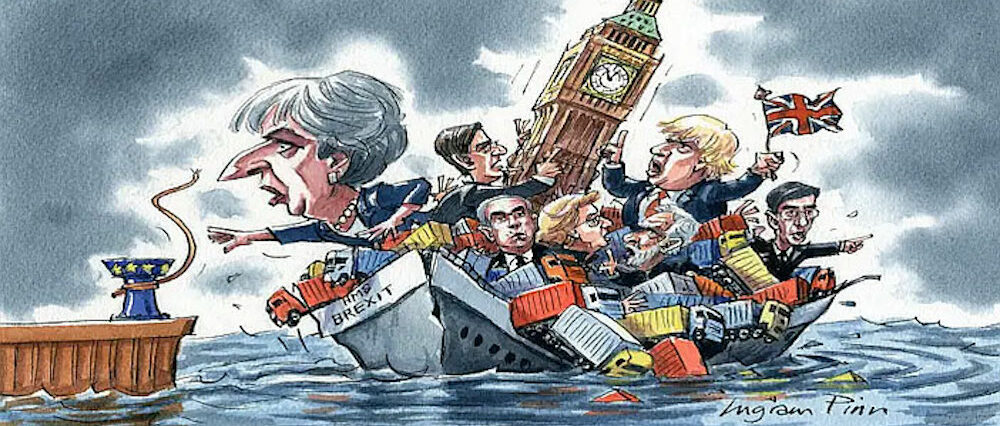
It’s 10 years to the day I awoke in London to see Nigel Farage’s smug grin plastered across every TV screen and newspaper front page, declaring “Independence Day” for the United Kingdom. That is, independence from our biggest trading partners, closest allies, and the neighbors with whom we share countless social ties, from ancient migration patterns to essential workforces in the present day. The unthinkable had happened – Britain had voted for Brexit, condemning itself to indefinite economic turmoil and political instability.
Although I never expected that this catastrophe would come to pass, I had already been planning my own exit strategy. Within a month of the Leave camp’s victory, I was fortunate enough to land myself a job teaching abroad for the upcoming school year, and from there I never looked back. Well, of course I had to look, as the ensuing car crash of bureaucratic wrangling, parliamentary implosions and border backstops was impossible to turn away from. But I had the privilege of doing so from a safe distance.
Since the start of 2018, I’ve been living in Portugal. It must be said that here they couldn’t have made it easier for Brits to repatriate back into the European Union, despite our suicidal political tendencies. I understand that it’s been almost as straightforward for UK citizens who moved to other EU countries in the wake of Brexit.
There was, no doubt, a temptation for our European cousins to hold us fully accountable for what we’d done. Indeed, fears about what it meant to be a non-EU citizen were widespread among Brits across Portugal in the late 2010s, while divorce negotiations between Brussels and Westminster dragged on. The truth is, though, for better or for worse, the sunny climbs of Southern Europe are too dependent on British tourists, expats, and holidaymakers to pull up the drawbridge, as much as we might have deserved it. In fact, throughout Europe, among the continent’s central policymakers, economic sense prevailed.
In my case, the transition to European residency as a non-EU citizen couldn’t have been easier. I became aware of a residency certificate all Portuguese residents from other countries were required to purchase anyway, from their local municipal office, just in time. With this certificate in hand, my path to obtaining a five-year residence permit after Brexit was finalized turned out to be remarkably simple. Those facing huge delays and violent discrimination at the hands of Portugal’s new immigration service AIMA will likely be appalled at just how easy it was for me.

Pandering to xenophobia
Portugal rolled out the proverbial red carpet for me and other Brits, giving us a free 24/7 English-speaking Brexit phone line to call for advice, and prioritizing our appointments to provide biometric data at immigration centers. They even extended the deadline by which we needed to apply for our new residence cards to 18 months beyond the date when Brexit officially came into force. During this period, I was even able to obtain a special residence permit for my wife, a third-country national, on the basis that she was married to someone who was still technically an EU citizen, as far as immigration laws were concerned.
Sadly, the same exemplary treatment hasn’t been afforded to EU citizens who wished to remain in Britain after Brexit. Anyone who had lived in the UK for less than five years before post-Brexit rules came into force has been subject to exactly the same residency restrictions as so-called third-country nationals. Meanwhile, prohibitive financial thresholds make it incredibly difficult for spouses and other family members to join UK residents in Britain from Europe without already having a work visa in place.
Such discriminatory measures are deeply ironic when you consider that workers originating from EU countries are the lifeblood of the NHS, British farming, logistics and other delivery services, and the retail, hospitality and cleaning industries. As various studies indicate, including a recent report for the UK Parliament, migrants in general are significant net contributors to the British economy.
Most of the right-wing demagogues blaming immigrants for the country’s problems are well aware of this fact. Yet, the entire Westminster political establishment plays into this narrative. They pander to xenophobia and implement protectionist policies, then when things only get worse, have the gall to act as if no one told them this would happen.

The politics are toxic
It’s important to note that the political trajectory catalyzed by Brexit isn’t unique to Britain. Even if we leave aside Donald J. Trump and his acolytes further afield, the Europe continent is now awash with far-right mavericks taking advantage of widespread and wholly justified anti-establishment sentiments for their own duplicitous political ends. From the Netherlands to Italy, the likes of Geert Wilders, Marine Le Pen and Giorgia Meloni have been brewing a toxic concoction of racism, xenophobia and misdirected anger. Even Portugal, which was the one European country without a far-right MP when I arrived here, now has its own brand of this phenomenon, in the form of Andre Ventura’s Chega.
Of course, the electoral swings propelling these political hucksters to power are destined to go the other way once they get there, as we’ve already seen with Meloni. Their rhetoric might embolden dangerous social forces, and their xenophobia certainly carries weight when it comes to immigration policies and violent state brutality, but all they have to offer their target demographics in the grand scheme is more of the same austerity and attacks on living standards.
In countries where the far-right is in charge, mass disillusionment is palpable.
Meanwhile, the application of Brexit in real terms has put in the final nail in the coffin of Britain’s position as a first-rate world power. When the UK voted to leave the EU, it ended the tenure of the country’s fifth prime minister across the previous 37 years. As of next month, we’ll have had seven prime ministers in 10 years since Brexit. Both politically and economically, we’re a laughing stock to the rest of the developed world. And Nigel Farage has absolutely no genuine solutions to the suffering experienced today by ordinary Britons.
Brexit marked the end of “Great” Britain, but it’s just the first wound inflicted by the Great British people on their own establishment. They’ll have the final word, long after Farage has departed the scene in disgrace.
––––––––––
Read more about Brexit here in Dispatches’ archives.
See more from Alex here.

Alex Beaton
Alex Beaton is a writer from London, UK. His published works include a guide to starting a business in Warsaw, a fictionalised account of his time living in Egypt, and a 2013 report of the political situation in Bulgaria. He has also written extensively about his travels in France, Portugal, Italy and Malta.