
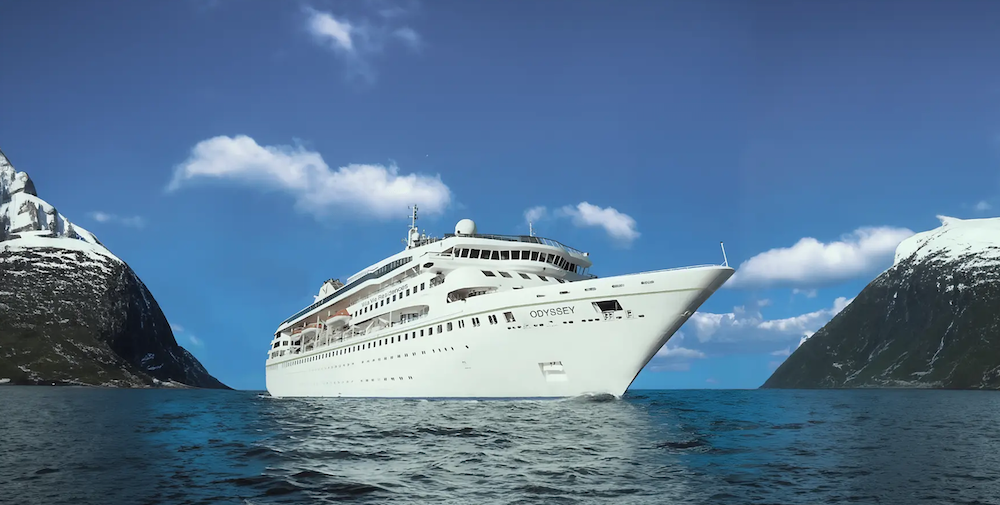
Having completed my one-year stay aboard the Villa Vie Odyssey and tried to reflect on it all throughout the holidays, I must admit my head is still spinning a bit. My global journey included visits to 47 countries, each breathtaking in its own way, and many of which I’ve written about in this space. But, most of the questions I’m asked are about life onboard. In this age of digital nomads and aspiring expats, and because the majority of Odyssey residents are indeed there for life, these are valid questions.
So, here’s a look back at some of the pros and cons of living on a residential cruise ship.
Of course there were the unexpected challenges, like the recent Asian typhoons and earthquakes that led to major itinerary changes and adjustments. We had to “flee” Manila two days early due to severe weather, which meant making last-minute docking arrangements in other ports. One of those Philippine ports was Cebu–which was then struck by a magnitude 6.9 earthquake just before we arrived.
You just can’t make this stuff up.

Never a dull moment
The overall experience onboard was many things, but never dull. I like to say it’s the ultimate expat challenge, because of its uniqueness. For example, when researching the requirements to settle in a new country, you go online, learn all you can, fill out the forms, and get your visa. Maybe a couple of recon trips, and then you’re done. You’re ready. But, what if you had to do that same research and jump through those same hoops over and over again for every country you’d be visiting? You’re never really done.
One example was on the beautiful islands of Palau where, just a couple of days before arrival, residents learned there would be a $100 per person government mandated environmental fee. This had never been communicated, even though Palau was not an emergency port but had been on the itinerary
from the beginning. Further, because the ship tendered adjacent to one of Palau’s premier resorts, there was a $45 per person, per day fee to use the beach, its facilities and WiFi. (The latter fee was not mandatory for those just walking through the resort to go on tours, but plans and budgets were still affected.)
Such costs may sound insignificant, but they add up. And uexpected logistical issues make it difficult for those embarking or temporarily disembarking for excursions, etc., to make travel arrangements. It’s a constant challenge, exacerbated by various countries’ ever-changing policies.
Opposite extremes
Of course, visa requirements vary widely by country and applicant nationality. Many countries now have an Electronic Travel Authorization (ETA). It is the residents’ responsibility to determine what is required where, and to either secure their visas in person before boarding or their ETA online while at sea (despite websites crashing, apps not cooperating, and spotty WiFi). While I obtained my Australian ETA without incident, it took others hours or even days.
So, there are opposite extremes. On one hand, you have great meals at the sit-down and buffet restaurants, the pools, gym, spa and various shipboard activities and entertainment, and the cabin stewards’ excellent housekeeping and laundry services. But then you have the periodic safety drills and daily PA announcements to remind you that this is not the “home” you may have envisioned. And, with about 350 current residents, it’s impossible to accommodate everyone’s preferences in meals, itineraries, etc.
Moreover, the Odyssey is 30 years old. There were regular plumbing and air conditioning problems that even caused some to have to change cabins. These have been largely corrected, but one always wonders when the next issue will crop up. Yes, weather-related issues are out of the company’s hands, and yes, Villa Vie Residences is a start-up. But these things gave many residents pause when considering their future onboard.

Wake-up calls
As with any expat destination, another important consideration is health care. The Odyssey’s medical center provides minimal services (with ongoing improvements – after my departure I was happy to learn that the long-awaited X-ray machine had finally arrived!). Not unexpectedly, several residents have contracted flu and other illnesses and injuries, and a few have been hospitalized onshore in foreign ports. They then incurred hotel and airfare expenses to catch up to the ship once they were released.
The first resident death also occurred not long ago, due to stroke. These were certainly wake-up calls for the entire community.
The digital nomads onboard experience unique pros and cons. Some rent private offices and others work in their cabins or the business center. Adjusting for their home time zones, many work through the night. The ship provides midnight snacks, etc., but Starlink has not always been reliable (it is unavailable in some regions), and there have been numerous horror stories of repeated dropped calls and Zoom meetings, etc.
Clearly a dealbreaker for some remote workers.
Finally, there is shipboard life with fellow residents. After this first year, many lifelong friendships and bonds have formed. But there is also political extremism and willful ignorance, middle school gossip mongering and drama, and old-people hookups and breakups – not uncommon in any expat or senior community, but a lot less tolerable in such close proximity.
So…. is it doable? Is the expat life aboard a residential cruise ship a realistic goal? Yes. And no.
The Odyssey Pollyannas see no issues and have no complaints. And the cranky naysayers have nothing but complaints. It’s all subjective and depends on your expectations. As for this former resident, it was a magical year of seeing the world and fulfilling dreams. But the shipboard lifestyle is not for me.
One year as a seafaring expat is enough, thank you.
–––––––––
See more about life aboard the Villa Vie Odyssey.

Carla Bastos is a former journalist and newspaper editor, and an American expat in Italy for several years. See her personal blog here: https://globalcarlabastos.blogspot.com/