
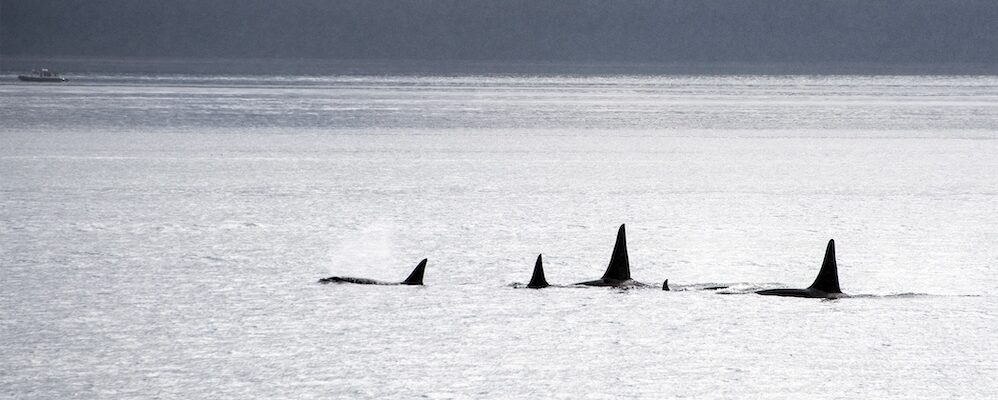
Orcas, often called killer whales, have been here for around 5 million years. Like death, taxes and Mick Jagger, you don’t expect the orca to change very much. Now, one group of orcas has started attacking sailboats off the Iberian peninsula and the effects are sometimes catastrophic.
Since 2020, about 630 boats in the Strait of Gibraltar and off the Atlantic coastline from Great Britain to Morocco have been attacked by orcas. The primary damage they cause is to the boat’s rudder, though other contact has occurred. Seven boats have been sunk. No one aboard the boats has been injured.
While there has been much conjecture, there is no scientific consensus on why these attacks have begun. Put in perspective, sailing vessels have been traveling these waters since the Iron Age with no recorded encounters with orcas. This is new, causing considerable trauma among the thousands of mostly leisure sailors who travel these waters every year.
Beyond the dangers of being in a crippled boat at sea, many boaters have faced massive repair and towing bills after an attack. Expat sailors dreaming of sailing these waters have been forced to deal with this new reality.
Sighting orcas used to be something you excitedly reported on your YouTube channel. Now it might need to be reported to your insurance agent.
What can be done?
Orcas are extremely intelligent animals with sophisticated social structures. Over thousands of millennia, they have evolved as one of the most widely dispersed mammals on earth (second only to humans), adapting to environments as diverse as tropical seas and arctic coastlines. Like human communities, as orcas spread out, they adopt behaviors appropriate to the location.
Across the oceans, separate communities of orcas communicate differently, consume different diets and hunt in ways unique to their pods. The orcas of the Iberian peninsula are the only orcas currently attacking sailboats.
The question is, “What can be done?”
• Will firecrackers scare them away? (patently illegal)
• How about underwater speakers blaring irritating rock music (insert your own love-to-hate name here)?
• Online you can buy special “pingers” and propellers claiming to deter the orcas and sharp, orca-deterring blades that can be attached to the rudders.
• My favorite strategy was the catamaran crew who repaired their damaged rudder and painted it in bold, orca-friendly letters “We freed Willie. Leave us alone.”
Guidelines
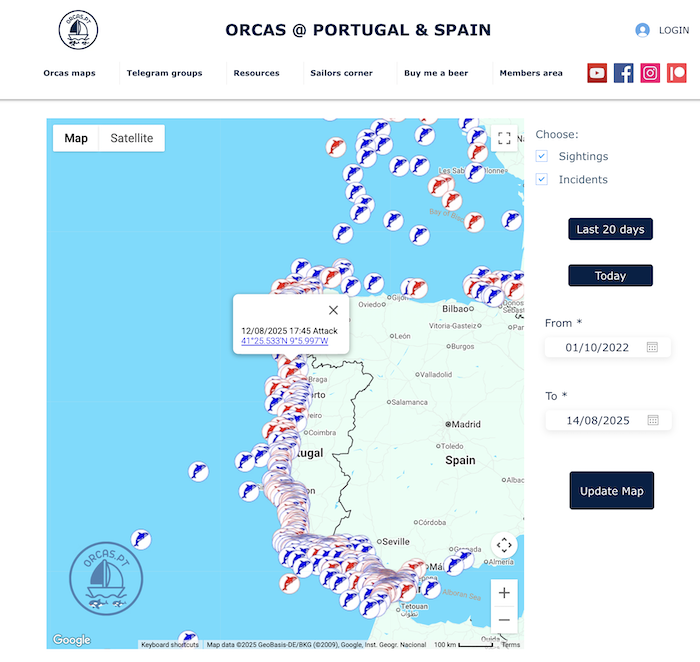
So far, none of these strategies has been proven more than anecdotally to be helpful. Organizations and governments have come together to help. For many sailors traveling through Gibraltar, the most important of these groups is Orcas.pt, a citizen-supported platform. In collaboration with sailors, marine biologists and government agencies, the objective is to use good science and modern communication to guide sailors through these waters.
While being clear that no strategy is guaranteed, Orcas.pt has found excellent success with
sailors who follow three guidelines:
• Know where the orcas are.
• Stay in waters less than 20 meters deep.
• If approached by orcas, keep moving, if possible, to shallower waters.
To the first point, a vibrant community has come together to provide up-to-the-hour information on the Internet. Staying shallow is not based on the behavior of orcas but of tuna, the only source of food for Iberian orcas. Tuna are rarely found in such shallow waters, so why would orcas go there?
Continuing to move (which is the most debated strategy) has two purposes:
First, orcas hunt in pods and need to stay together. No sailboat can outrun an orca, but moving away from the pod to chase a sailboat may not be in the orca’s interest and so they lose interest and stop an attack.
Second, it is a matter of motion physics. Think of an American football player or a rugby player being chased by a faster member of the other team intent on tackling them. When the tackler hits a running player, the impact is less powerful than if that player is standing still waiting to be hit. An orca hitting a moving boat may do less damage as well.
In June of this year, my wife Dawn and I sailed our 42-foot sailboat Kairos from Nazare, Portugal through orca-infested waters, past Gibraltar and into the Mediterranean. Following the advice from orcas.pt, staying in shallow waters when we were in areas where orcas had been seen, we joined the large number of boats who are now passing safely off the Iberian coasts.
No one knows why this orca behavior started or if – or when – it may stop. We are now finding ways, though, to travel safely and live together in these historic, beautiful waters.

Tom Hay