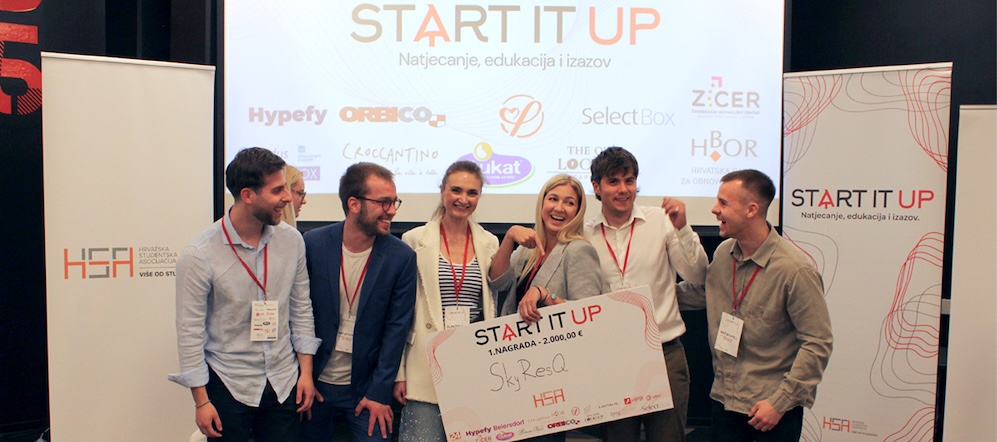
(Editor’s note: This post on SkyResQ is part of Dispatches’ Tech Tuesday series. Dispatches covers tech because so many of our highly skilled internationals are entrepreneurs and founders.)
It all began with a somewhat unusual taxi ride in Spain. A pedestrian suddenly collapsed in front of the car, the driver noticed that the man was suffering a cardiac arrest. Since a large number of police cars in Spain have defibrillators as a normal part of their equipment, the taxi driver and passenger immediately transported the man to the first police vehicle they saw.
“Owing to such a rapid reaction and because the necessary equipment was practically at hand, his life was saved,” recalls Leon Ivan Filep Podrecca, one of the three co-founders of the Croatian startup SkyResQ, for whom the incident was a light bulb moment.
As he recalled for Jutarnji, he remembered that the other co-founder, Marul Medvešek, was working on a project with FPV drones (first person view) as part of his studies. They soon included Adrian Puntarec in this startup story, and their little team got to work.
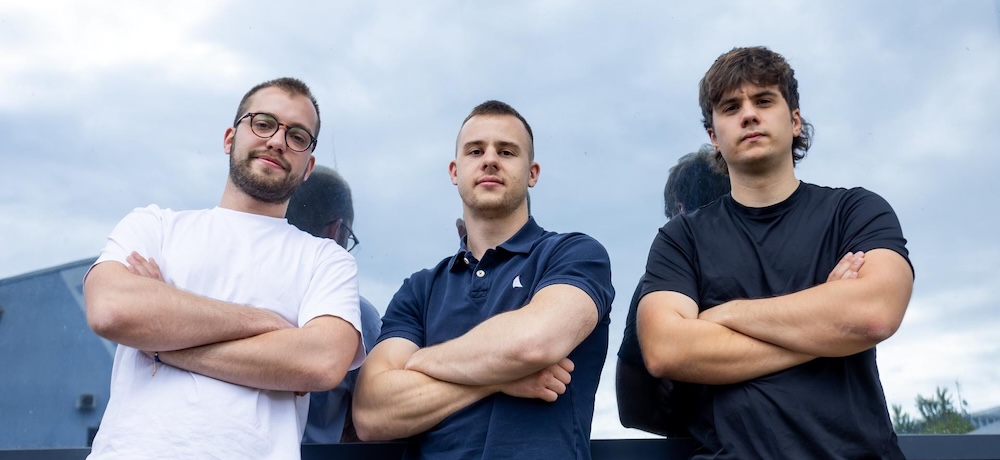
The knowledge they each bring to this ambitious project is diverse:
• Marul is a student at the Faculty of Mechanical Engineering and Naval Architecture in Zagreb and is in charge of technology development, hybrid 5G and radio communication systems, as well as hardware.
• Adrian attends the Faculty of Architecture and his role is to create 3D models and spatial planning,
• Leon Ivan, a student of Tourism and Hotel Management at Libertas University, took on the responsibility of communicating with potential clients, analysing the market and defining how SkyResQ can be offered to private clients of all kinds.
Light and fast drones
SkyResQ is a Croatian product and system for delivering emergency medical supplies via FPV drones. “The idea is to use light, fast and precise drones that are controlled in real time by operators. We want to drastically reduce response times in emergency scenarios,” Marul said.
The list of items that can be delivered in this way is enormous in practice, but initially SkyResQ plans to limit itself to the most basic ones: defibrillators, EpiPens, glucagons, hemostatic bandages and so on. “These things are absolutely crucial to get to the patient within the first three minutes of a call
for help,” he said.
The system consists of numerous FPV drones and their operators, then a “nest” (which they called Resqon Nest) in which the drones “hibernate” until they’re called for help. There are also “Aid Packs” which are prepared in advance for all sorts of different scenarios.
In practice, it should look like this:
When someone calls for help, the operator in the nest immediately puts the necessary “Aid Pack” onto the drone and sends it off to the place where it is needed. The founders of SkyResQ state that the idea is not to replace the classic ambulance, but to be an upgrade to it. In fact, emergency care in cities is not their focus at the moment.
“Where we’d start and what is primary for us is the private sector – campsites, ski resorts and the like. It will be much easier for us to conduct tests there because there’s less bureaucracy, it is easier to get flight permits, as well,” Adrian said.
Prototyping
First, SkyResQ needs proof of concept in that area, and then will work on the upgrade. “We aren’t a replacement for the ambulance service, but the idea is to arrive earlier in situations where mere seconds are crucial,” Adrian said, adding that they already have an memo of understanding with a large Croatian hotel company about potential cooperation.
Croatia’s SkyResQ team is currently in the phase of building their first functional prototype. “We’re focused on testing out key technical components in real conditions, which means optimising the mass, speed and stability of the aircraft, and designing and manufacturing modular aid packs,” said Marul Medvešek.
The next step will be to develop the Resqon Nest station with the ability to send out multiple packages on a daily basis, and then develop a security procedure for precise content retrieval out in the field, collect data on protocols and reaction times in large complexes such as tourist resorts, ski resorts and campsites.
The goal is to enable a fast, precise and reliable response where it’s needed, Marul said.
Assembling the puzzle pieces
As for the necessary equipment, they plan to assemble the aircraft and their nest from components widely available on the market. “The drones shouldn’t pose much of a problem because the world is literally flooded with parts for them. The nest could pose a bit of a problem for us because we really have to make it from scratch,” Marul said. The idea is that it has a kind of “revolver’ system” so that the packages rotate and can be launched as needed.
And as for the communication system, the SkyResQ team is working on a combination of 5G and radio communication. That way, the operator communicates with the nest via 5G, and then the nest itself communicates with the drones via radio connection.
When it comes to the capital needed to get the project off the ground, the SkyResQ team states that they need to raise more than 100,000 euros to get things off the ground (no pun intended).
“It won’t be cheap, of course, but if we save even one life, then it’s worth it,” said Leon
Ivan.
–––––––––––
See more about Croatia’s tech ecosystem here in Dispatches’s archives.

Lauren Simmonds
Lauren Simmonds is the editor of Total Croatia News, the largest English language portal in Croatia. She lives in Zagreb, Croatia, and is a translator, content writer, interpreter and the co-author of "Croatia - A Survival Kit for Foreigners," which was published in 2022.