

The school bell rings, and students come flooding out of their classrooms. They run to their parents, drop their bags and often play with friends until their parents are done chatting. No school buses are taking them home, and most parents aren’t rushing off, trying to get back to their next video call. This scene plays out every weekday across the Netherlands, and it’s pretty much the same at any Dutch school.
American visitors who have gone with me to school pick-up are fascinated by how parents can be at school in the middle of the afternoon.
By this point, I’m used to this reality, but it raises a good question. How can parents do this?
The simple answer is that Dutch parents rearrange their work schedules and usually work less, whether one parent or both.
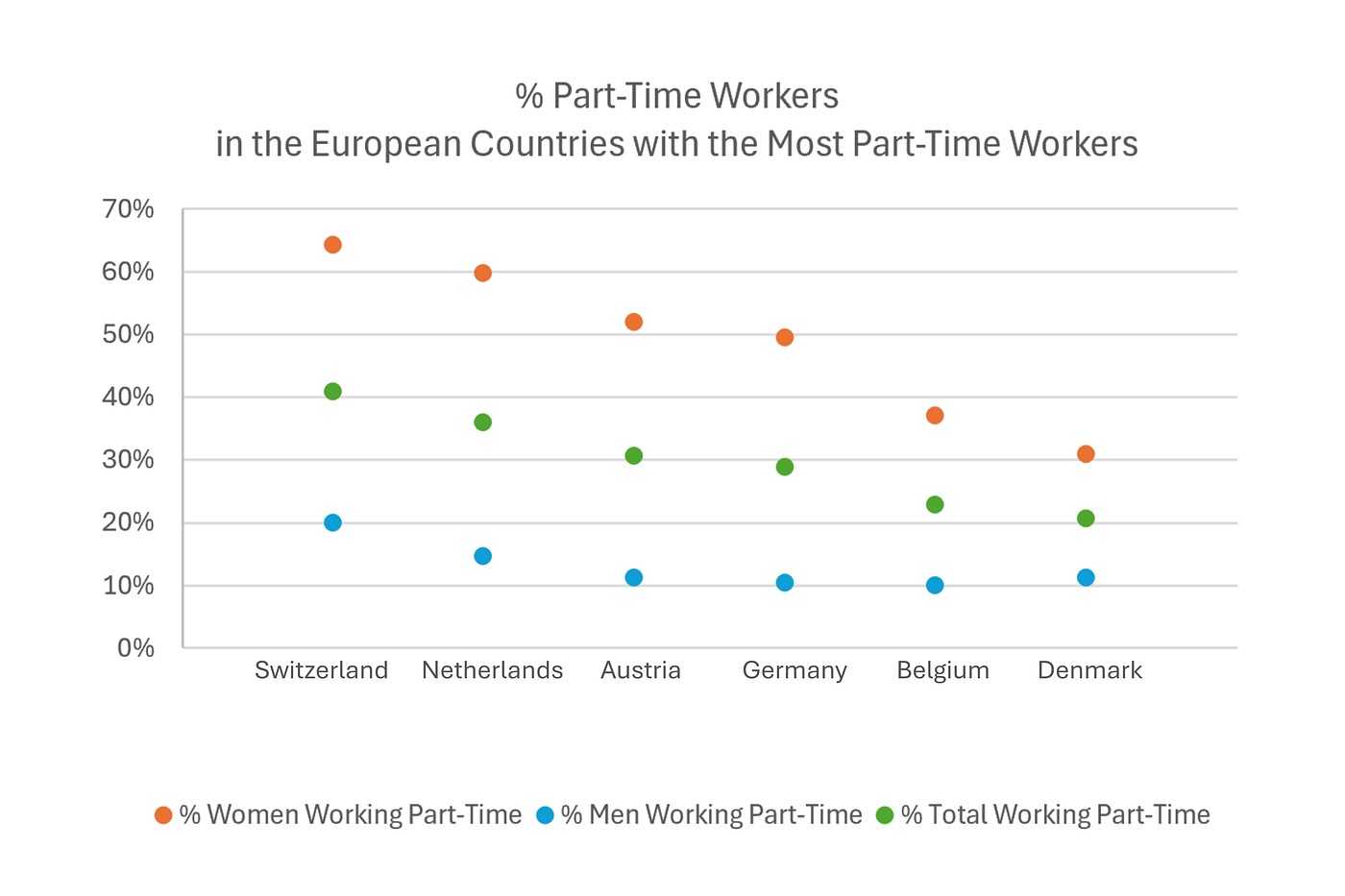
The Netherlands and Switzerland have the highest share of part-time workers in Europe. Austria, Germany, Belgium and Denmark follow, but with a significant gap.
Part-time work the norm for women
In the Netherlands and Switzerland, 60 percent or more women work part-time, and 15 percent or more men work part-time, according to recent data from Eurostat.
As you can see from the chart above, there is a high disparity when it comes to part-time men versus women.
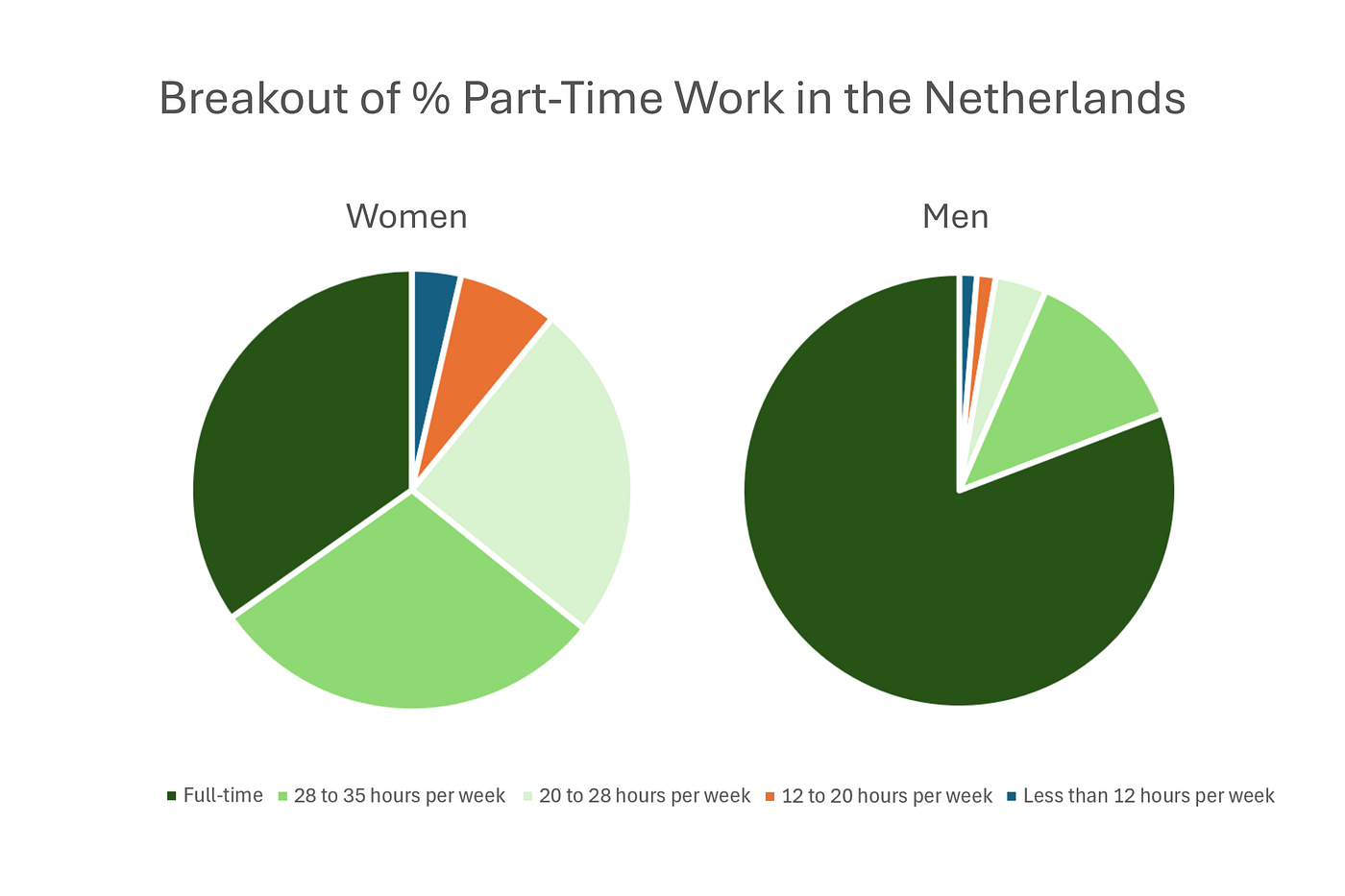
But while there is a large gender disparity, most women are still working. In 2023, only 13 percent of families with minor children were single-income households, and this number has declined significantly since 2013.
These part-time statistics bring to mind several questions, including:
- Is it always by choice to work less?
- Would more parents work full-time if the school system were different?
A mixed bag
Yes, not everyone chooses part-time work freely. Care responsibilities, health issues or labor market constraints play a role for some. For the part-time working population, research shows that the reasons are a mixed bag. Some choose it for a better work and family balance, while others might not have a choice. Some may have to take care of loved ones, some can’t find full-time positions and others have an illness or disability that prevents full-time work.
For many families, the decision to work fewer hours is practical, which you see up close in a Dutch school yard.
School days are short and end between 2 p.m. and 3 p.m. Wednesdays are even shorter and traditionally end at lunchtime.
After-school care (buitenschoolse opvang or BSO for short) exists, but in most families, it’s treated as a supplement, not a default. Parents and grandparents coordinate schedules to pick up the kids after school and supplement with after-school care. Most children do not go to after-school care five days per week.
Some expat couples who both work full-time have even described a stigma when other parents find out that their child goes to the after-school program every day of the week. Although this attitude is not fair or welcoming for expats, it shows how unusual it is to use after-school care so much.
Who works part-time? Who doesn’t ….
What I find most interesting about the Dutch data is not just how many people work part-time, but who can do it.
The option isn’t limited to a narrow slice of the workforce. Doctors, lawyers, teachers and business owners regularly reduce their hours.
No matter the reason to work less, the striking part is this: when people do choose to work less, the culture largely supports it. There is no automatic assumption of lower ambition or lower value. Working less doesn’t mean losing health insurance, career credibility or long-term security.
The result is not a country (or continent) uninterested in work. It’s a region that approaches work differently and asks questions like:
“Even though I can work 40 hours per week, do I need to? Do I want to?”
I rejoice that most of Europe has a culture where anyone — not just mothers and fathers — can work less. It’s a refreshing change from the work culture in the United States, where the options are full-time or unemployed in most industries. The Dutch part-time numbers are staggering, yes. But they also point to something rare: a system designed around real life rather than life squeezed around work.
Call it work-life balance, call it flexibility, call it common sense. Whatever the label, part-time work in Europe is not a detour; it’s a parallel lane.
––––––––––
See more about the Netherlands here in Dispatches’ archives.

Lane Henry is an accidental long-term expat. She is an American who came to the Netherlands for two years—or so she thought. She has now lived in the Netherlands and explored Europe for over a decade.