When I lived in a Dutch city along the German border, I’d occasionally see a few cyclists in helmets. Do you know what my first thought was?
“They must be German.”
Since moving to the Netherlands, I’ve never worn a helmet. Despite knowing full well that it is a very good idea to do so, I can’t bring myself to wear one. Do you know why?
I barely see anyone wearing one.
Okay, okay, there are a few people who wear them, but they can be summarized as follows: old, young or hardcore. Road bikers without fail wear helmets and for good reason due to their high speeds and daring nature when it comes to cycling in groups right in the lane of traffic. I also see the occasional helmet on older people – especially those riding an e-bike – and I sometimes spy a helmet on a child just learning to ride a bike.
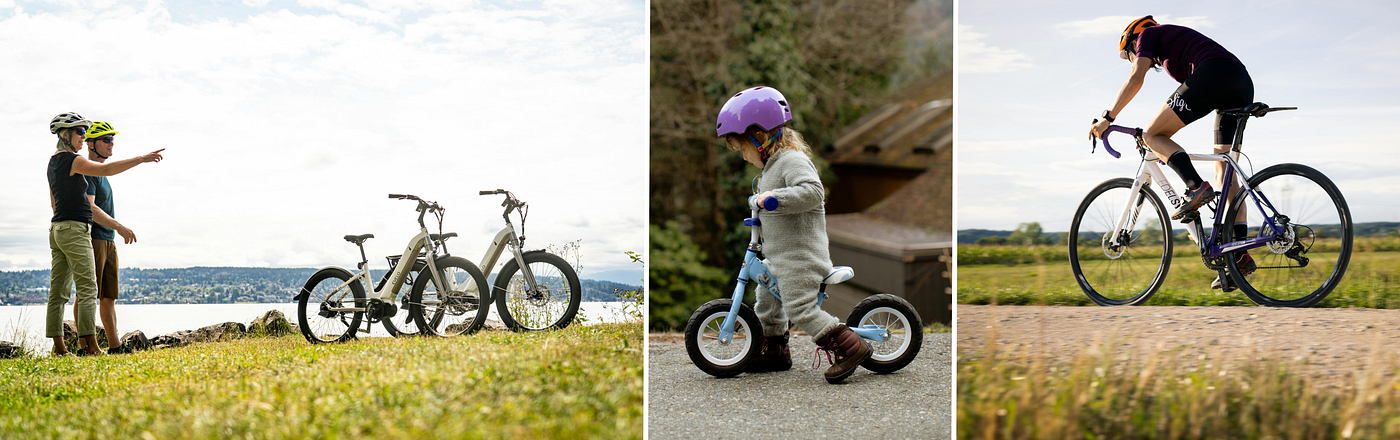
Every other non-race-biker between the ages of six and 80? Nope, not a helmet in sight.
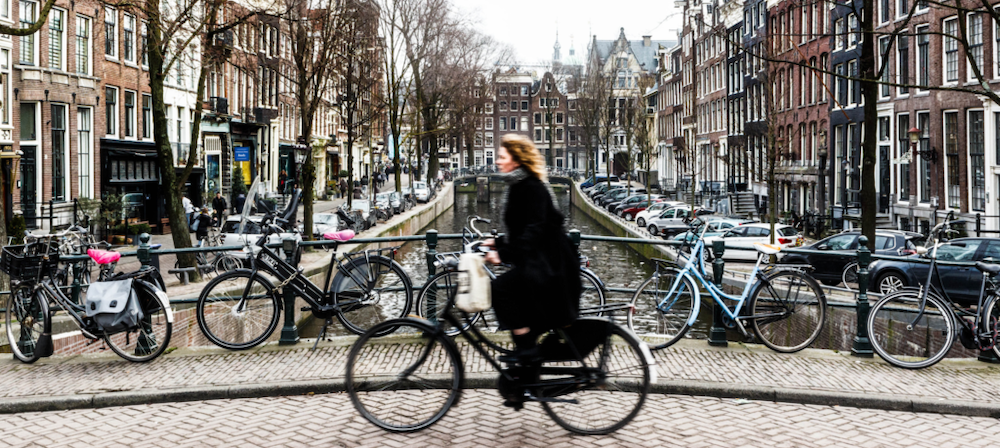
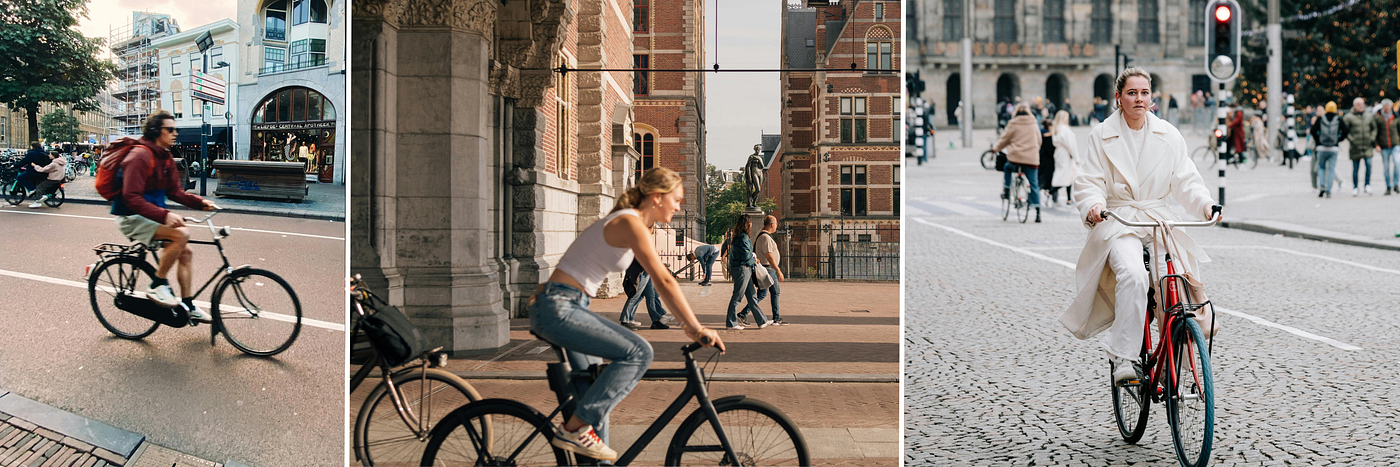
Instead, most Dutch cyclists look like this: relaxed, unconcerned and helmetless.
Biking in bike-unfriendly US requires guts … and a helmet
Riding my bicycle in the U.S., I dutifully strapped on my helmet for each ride – not because it was mandatory, but because it was smart. I used to bike a lot, both in rural areas and in Washington, D.C. Let me say this: You are vividly aware of your mortality as cars speed by and act like bikes have no place on the roads. You have to have a lot of guts to ride a bike while sharing the road with American cars.
Hence, the helmet. Strapping on a helmet seems like a better alternative to getting your head squashed like a melon.
But the number of American cyclists is laughable compared to Europe. Many people like to say that some American cities are becoming “so bike-friendly,” but that’s until you see the Netherlands or Denmark. Then those arguments go out the window.
That’s why when you fly to the Netherlands and get on roadways much more crowded with bicycles, the difference is jarring. “WHY IS NO ONE WEARING A HELMET?,” I sometimes think very loudly as I’m crowded between other cyclists at a traffic light.
It’s like those bare heads are the Dutch way of blatantly flaunting the country’s pride that the cycling infrastructure is so advanced and that cars know how to respect the existence of bicycles on the roads. But, accidents still happen. And to the best of my knowledge, Dutch skulls are not superhuman or any stronger than other skulls, despite how much milk the Dutch consume.
Freedom
It wasn’t until COVID that I realized how resistant the Dutch could be to requirements and even guidelines. They don’t like people telling them what they have to do. They don’t want anyone taking away their individual freedoms. Sound familiar?
It made me realize how similar – in this respect – the Dutch were to Americans.
And just like COVID rules, helmet requirements for regular bicycles probably would be received in the same negative manner. Some people feel that pushing too hard for helmet use would discourage Dutch people from using their bikes on a daily basis, but could this really be true, given how much the Dutch love their bikes? For most Dutch, life revolves around the bicycle, and for some errands in urban areas, bikes are more convenient, and sometimes faster, than cars.
Cultural differences across borders
At my children’s school, there are rows and rows of bicycles, but probably no more than a few helmets dangle from those handlebars. At public places and train stations, I can leave my children’s helmets on my bike, because you know what? No one uses them, so no one wants to steal them.
However, if you skip across the border to Belgium or Germany, it’s drastically different.
In Belgium, a helmet is not to be missed, even among my generation. I saw friends leave brunch and strap on helmets for each member of their family of four before heading out on their bakfiets (cargo bike). Germans obediently click on their helmets before rides, as I saw from my stint in the city of Venlo, which is two kilometers from the German border.
About a year ago, I ran across a quote that stuck in my head. It was a quote by a representative from Denmark’s transportation ministry about why the majority of Danes wear helmets despite it not being required by law. “Because they’re smart,” he said. “We have very little other than our heads and if we don’t take care of our heads we won’t be able to provide for our families.”
Despite this, European helmet laws for adults are few. Instead, helmet use seems to be determined by cultural attitudes rather than laws.
Cyprus and Finland are the only countries in Europe where helmets are mandatory for everyone. Malta used to be on this exclusive list but scrapped its mandatory helmet law in 2018 to try to encourage more cycling, thinking that the law stifled bike usage.
European countries do a little bit better when it comes to protecting the heads of their younger generation. Children are required to wear a helmet in many countries, but the age limit varies. I found child-specific requirements for many countries, including Austria, Croatia, the Czech Republic, Estonia, France, Malta, Slovakia, Slovenia and Sweden.
Some countries also have helmet requirements for certain speeds, electric bikes or for other circumstances, such as Switzerland (over 20km per hour), Malta (e-bike), Portugal (e-bike) and Spain (outside urban areas).
In other European countries, there are no mandatory helmet laws, but it seems that most countries “recommend” helmet use. Hence, adults clip on their helmets in Germany and Belgium, despite no compulsion to do so.
Will it change in the Netherlands with the rise of fast bicycles?
While helmets will probably never become mandatory in the Netherlands for adults on regular bicycles, it could change for other categories. Perhaps ….
The cycle paths are becoming more and more crowded, and sometimes dangerous, with fast scooters/mopeds, speed-pedelecs, e-bikes and trendy fatbikes, which wiz past you, piloted by a duo of joyriding teens. A mandatory helmet law went into effect in January 2023 for light-moped riders and along the way, some cities have proposed helmet laws and/or minimum age requirements for e‑bikes and fatbikes.
So it is exciting news that in August 2025, the Dutch government announced that it wants to implement mandatory helmet use for those under the age of 18 when they’re riding a fatbike or e-bike. If it passes, it would go into effect in 2027.
In a recent poll, over 70 percent of Dutch people surveyed thought this mandatory helmet law was a good idea, at least for fatbikes and e-bikes. That’s right, 80-plus percent of those surveyed don’t wear a helmet themselves and don’t want to. So, I guess only time will tell. Culture doesn’t change in a day. Just like the Dutch cycle paths evolved over decades, I hope one day you’ll see more people opting to use helmets.
Until then, I’ll probably still go helmetless – because culture can be stronger than caution and common sense. And I’ll keep hoping the culture shifts before a crash does.
––––––––––
See more about the Netherlands here in Dispatches’ archives.

Lane Henry is an accidental long-term expat. She is an American who came to the Netherlands for two years—or so she thought. She has now lived in the Netherlands and explored Europe for over a decade.