Paris has always had a soft spot for eccentrics, revolutionaries and people who refuse to behave exactly as expected. So perhaps it was inevitable that an abandoned bank building would eventually become one of the city’s most gloriously unruly art spaces.
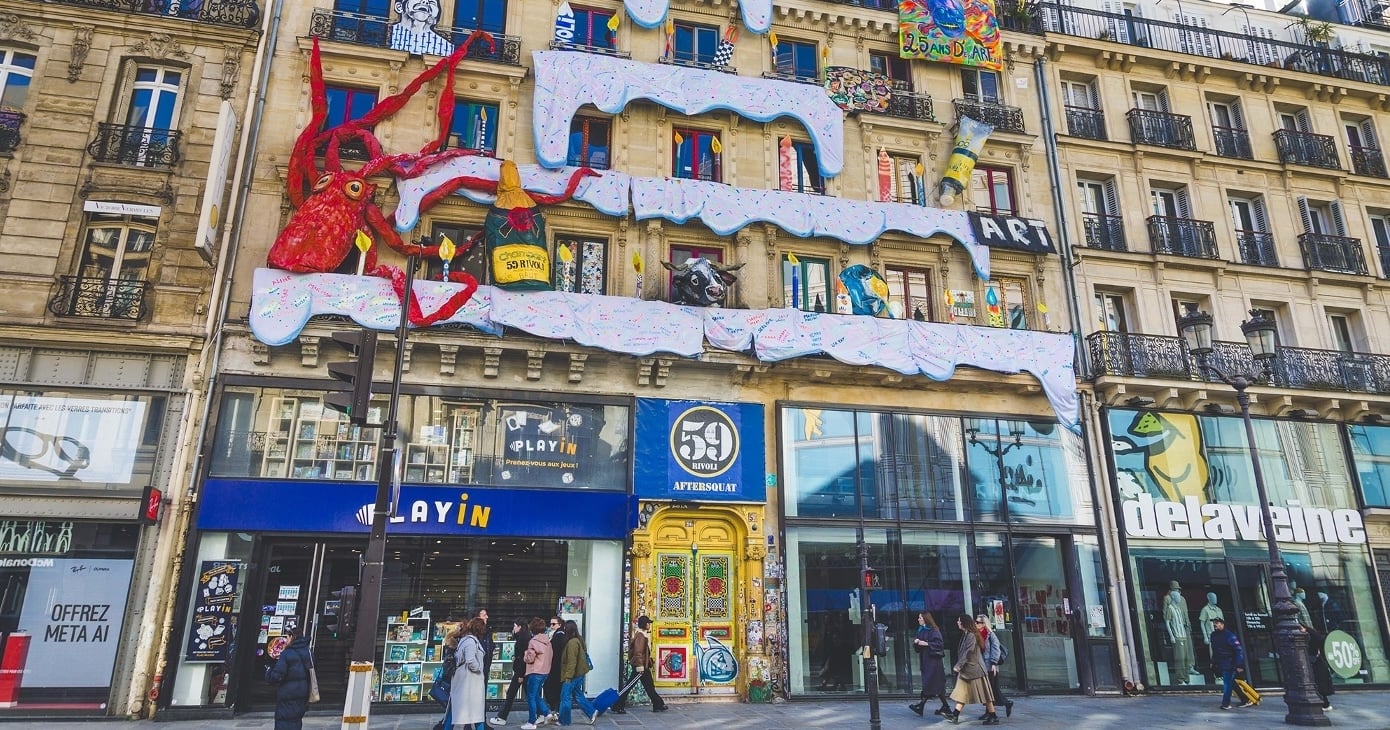
Welcome to 59 Rivoli, better known as AfterSquat.
The story begins on 1 November, 1999, when artists Gaspard Delanoë, Kalex and Bruno Dumont slipped into a handsome Haussmannian building at 59 rue de Rivoli that had been sitting empty for eight years after the Crédit Lyonnais collapse. A handful of artists followed. They installed studios, opened the doors to the public and transformed a derelict financial property into a buzzing center for alternative art.
Within its first year, more than 40,000 people had visited.
There was just one tiny problem: technically, they were squatting.
Paris embraces the movement
An eviction order followed. But the artists had become so popular – and apparently so little trouble – that the authorities hesitated. Then Bertrand Delanoë became mayor of Paris in 2001 and did something rather wonderful: instead of simply throwing the artists out, the city bought the building and decided to preserve its artistic purpose.
Voilà. Problem solved.
After several years of renovation, 59 Rivoli reopened officially in 2009. The illegal squat had become an “after-squat” – a legal, self-managed home for artists that retained much of the rebellious spirit that created it.
Today, about 30 artists work there in studios spread across six floors. The public can wander through the building for free, watching artists actually make things rather than merely staring at the finished product in a hushed white gallery while wondering whether one is supposed to understand it.
And the variety is enormous: painting, sculpture, mosaics, installation, street art and other contemporary practices. The artists come from different backgrounds and countries, and the walls and communal spaces themselves are constantly changing.
No two visits are quite the same.
The whole place has a wonderfully improvised, slightly anarchic energy. It feels less like visiting a museum and more like being allowed backstage at the Paris art scene.
There is also a gallery, along with a regular program of concerts, performances and late-night “Nocturnes.” Previous nocturnal events have included DJs, live art, installations and performances stretching into the night. In other words: if you think art is more fun after dark, keep an eye on the calendar.
The details
And then there is the location.
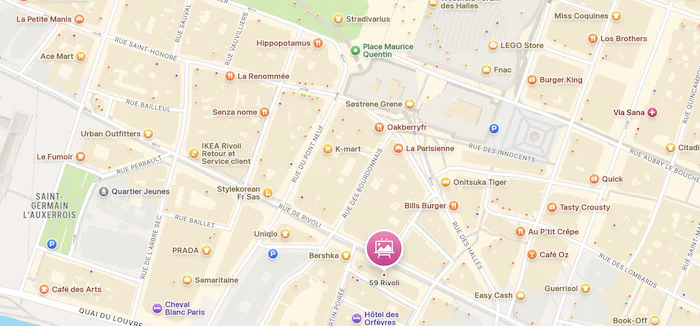
59 Rivoli sits smack in the middle of Paris, on rue de Rivoli, a short walk from the Louvre, the Seine, Châtelet and the Marais. The easiest arrival is Châtelet, served by Métro lines 1, 4, 7, 11 and 14, with RER A, B and D at Châtelet–Les Halles. Numerous buses—including 21, 58, 67, 69, 70, 72, 74, 75 and 85—serve the neighborhood.
The doors are open Tuesday through Sunday, 1 p.m. to 8 p.m., and admission is free. The official phone number is 09 50 87 72 42.
So what is the great lesson of 59 Rivoli?
Perhaps that cities don’t always have to choose between order and creativity. Sometimes you can take a building that has been sitting useless for eight years, fill it with artists, invite the public in and see what happens.
Paris did.
And rather than killing the rebellious spirit, the city gave it a lease.
That may be the most Parisian thing of all.
After the art: Eat, drink and wander
The beauty of 59 Rivoli is that you can turn an afternoon visit into a full Châtelet adventure without getting back on the Métro.
For inexpensive-ish eating:
- Senza Nome — pizza and Italian comfort food, around 10–20 euros.
- Pastasuta — excellent handmade Italian pasta, around 20–30 euros.
- Manteigaria, practically next door at number 55, is the place for a Portuguese pastel de nata and a sugar rush before continuing your cultural education.
For a drink and some trouble: head toward rue des Lombards, where Paris’s jazz clubs cluster together. Le Baiser Salé, Sunset/Sunside and Le Duc des Lombards are all within walking distance, making it remarkably easy to go from contemporary art to live jazz without changing neighborhoods.
For something more nightclub-ish, Bar La Planque Paris 1 on rue de Rivoli runs late Thursday through Saturday.
And if you still have energy, wander toward Montorgueil, the Seine or the Marais. This is central Paris at its most useful: art, food, music, history and the occasional questionable decision, all within a few blocks.
–––––––––––
See more about Paris here in Dispatches’ archives.
Read more from Alice here.

Alice Verberne is a contributing writer for Dispatches Europe. She has worked in print journalism and magazine production in the United States and Europe throughout her career. She currently resides in France where she enjoys visiting former French speaking colonies and discussing history with the locals.