(Editor’s note: This post about Donald Trump and his relationship with Europe includes the opinions and observations of the author.)
This past week revealed to Europe’s leaders a hard truth: Donald Trump is neither a leader nor a statesman. And he’s no ally of Europe. What Trump is, and always has been, is a chaos agent. Over the decades, he fancied himself a real estate mogul but went broke four times after big bets on casinos, going through about $400 million his father left him, and racking up a $334 million debt with Deutsche Bank. A debt that mysteriously disappeared.
Two events bailed him out financially and reputationally: “The Art of the Deal” hagiography touting his non-existent negotiating skills and a reality TV show, “The Apprentice,” dreamed up by Mark Burnett, an ex-British 3 Para soldier-turned-producer. Reality TV has nothing to do with actual reality, which is Trump never had the intellect, attention span, management skills or the organization abilities to succeed at anything. Now, he’s an angry, unstable old man, clearly suffering from dementia, who spent last week denigrating America’s most crucial allies. The question becomes, could he withdraw American forces from Europe?
If he does, the impact on you and me and everyone in Europe could be painful and permanent. Why? Money.
Guns, or butter?
Last week, Trump put Europe on notice: “We’re not going to support you.” As Canadian Prime Minister Mark Carney noted in his World Economic Forum speech last week, Trump is bent on disrupting the post-war world order, and the free world must rally without the U.S. to protect liberal, democratic values. Or as Carney termed it, “A pluralistic society that works. A public square that’s loud, diverse and free. An economy that delivers broadly shared prosperity. A democracy that chooses to protect the most vulnerable against the powerful.”
Without the U.S., that moral high ground is unimaginably expensive real estate. Europe can no longer count on the U.S. for defense, trade or technology and this is going to translate into a classic guns-or-butter dilemma.
Europe’s biggest problems are lack of defense and military projection. Whether you’re talking about the Romans, Louis XVI or Napoleon, militaries and military adventurism have always sucked dry public treasuries and presaged revolution. After 80 years of depending on the Americans, it’s important to understand in real terms how painful Trump’s forcing Europe to rearm could be.
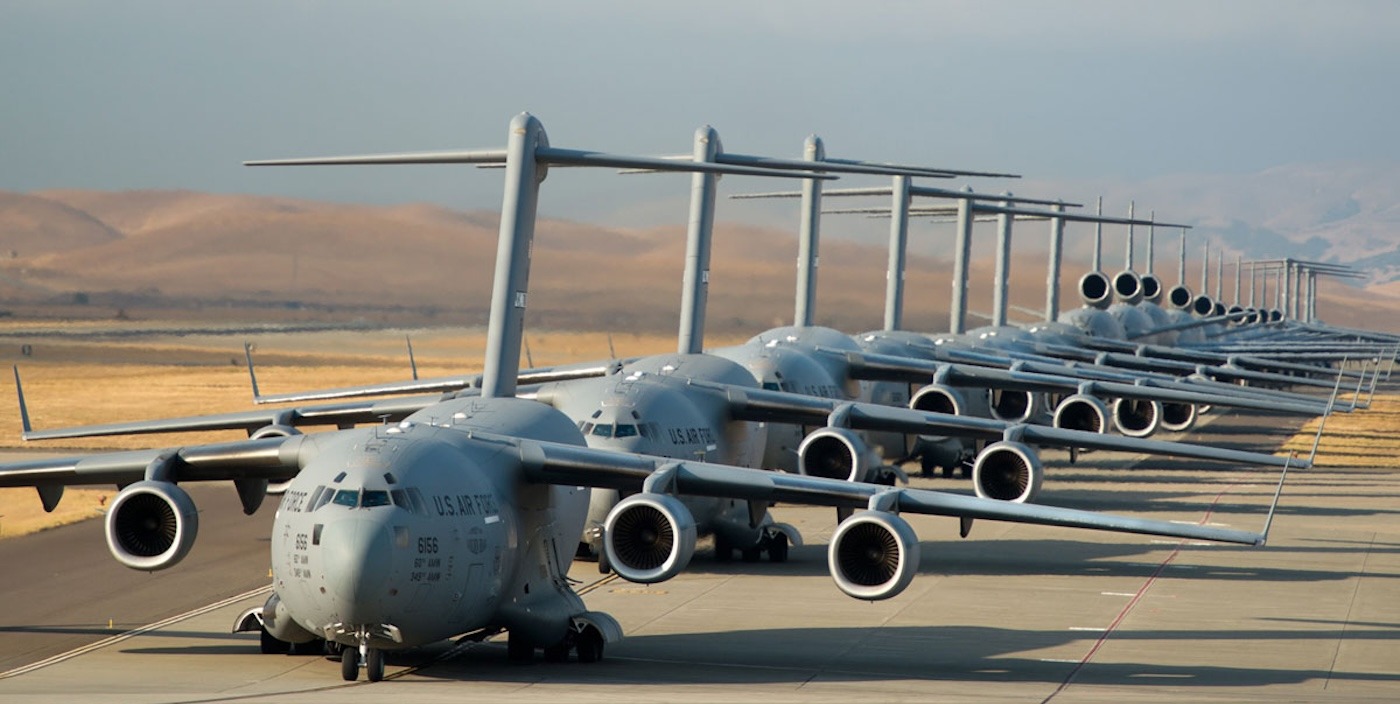
I was covering American deployment at USAG Baumholder, home to the U.S. Army’s 1st Armored Division, and Ramstein Air Base in Germany, the main U.S. Air Force transport hub, when the Second Gulf War began in 2003. Fighting modern wars takes tens of thousands of people, not just to fight, but to transport soldiers and materiel to the battlefield. It requires hundreds of transport aircraft, such as C-17s and C-130s. Each C-17 costs about $400 million. Add to that about $23,000 per hour to operate just in fuel, not counting crew and maintenance. The U.S. has more than 200. The United Kingdom, the only European country with C-17s, has eight. Yes, there are made-in-Europe transports, but between them, France, Germany and the UK have a few dozen.
Having a large fighting force and airflift is just the beginning. It takes complex logistical coordination to put them in the fight. Over the course of U.S. involvement in Iraq and Afghanistan, there were more than a million troops deployed. Advanced surveillance aircraft such as the Rivet Joint are crucial to defense and are also wildly expensive. The U.S. has dozens. The UK has eight. Between them, the UK and all the countries in Europe might be able to round up a few dozen transport planes and surveillance aircraft and a few thousand troops. Few of the troops would be sufficiently trained and equipped. Unlike their Russian or American counterparts, few European officers outside Ukraine have an essential warfighting qualification – combat experience.
The chickens come home to roost
There are U.S. bases – Army, Navy, Air Force, NSA and CIA – across Europe from Spain to Romania. Replacing American equipment and personnel in Europe would cost around $1 trillion, according to the International Institute for Strategic Studies think tank. Most European militaries use American weapons such as fighter aircraft. Finland’s President Alexander Stubb said in Davos last week that his country’s fleet of U.S.-made F/A-18s and F-35 fighters can’t fly without the U.S. support … spare parts and equipment updates, according to the Wall Street Journal. “The country must instead trust that Washington will continue to help them fly, which (Stubb) said it was in their interests to do,” according to the post. Finland, which has a 1,340-kilometer border with Russia, is basically defenseless without US military technology, and vulnerable to the whims of a mercurial president.
The reason I’m telling you this is because at a time when global threats are increasing, populations are shrinking and national budgets are inelastic unless taxes are increased. To expand military capabilities to make up for the Americans is going to mean reducing social spending and running massive budget deficits, just like the Americans.
That’s just the military side.
If Trump keeps pursuing his disruptive tariffs, punitive fees for H1B visas and trade wars, that will come home to all of us. Trump’s policies are going to cost Europe big time in infrastructure, pensions, research, education and every other aspect of life. Everything is going to get more expensive, including housing – already at a premium – and governments are going to cut services to make up for increased military expenditures.
A friend just sent me a late Christmas present, the book “Remember Us,” by Robert M. Edsel. At the bottom of the dust jacket is the subtitle, “American Sacrifice, Dutch Freedom and a Forever Promise Forged in World War II.”
Apparently, “forever” doesn’t last as long as it used to.
Ultimately, the political process will push Trump out. But the damage will be done in Europe as it struggles to cope with threats from Russia and China. Trump has broken the most strategic post-World War II covenant. Whoever replaces him is unlikely to renew that covenant as the U,S, deals with its own $38 trillion debt bomb.
Receive the latest news and updates from Dispatches Europe. Get lifestyle & culture, startup & tech, jobs and travel news dispatched to your inbox each week.