
As Dispatches’ co-CEOs, Cheryl and I work with a lot of writers and contributors for everything from long-form posts about expat life to social media marketing to pitch training for startups. Our motto is, “Creative people, creative content.” We require people to put their own brand on what they write – to analyze and summarize with their own personal styles. And we noticed something … we can spot AI generated content almost instantly.
Well, Cheryl can because she edits so much material … me not so much because our Dispatches contributors typically are telling unique stories that can’t be scraped from the Internet. As I read online content, I do start to pick up on the word choice and structural predictability. They’re all there; the phrases and lingo that are most prevalent at the moment in popular culture and tech talk.
I decided to go to the source to find out why. So, of course I asked Perplexity AI, “Why does AI make text sound all the same … the same phrasing and syntax?”
The answer I got back was refreshingly honest:
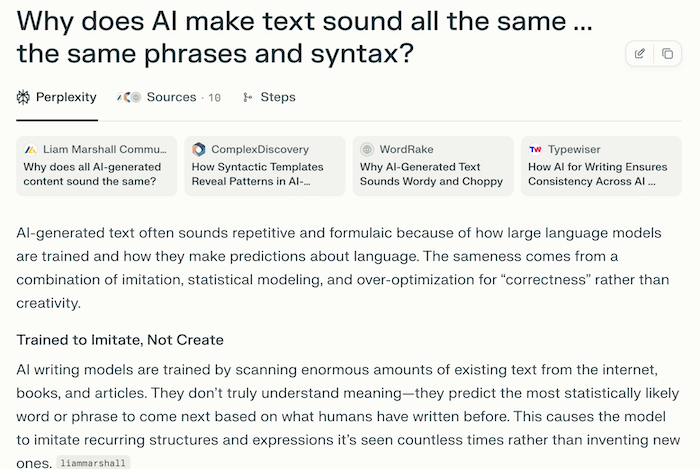
AI-generated text often sounds repetitive and formulaic because of how large language models are trained and how they make predictions about language. The sameness comes from a combination of imitation, statistical modeling, and over-optimization for ‘correctness’ rather than creativity.
In other words, AI isn’t creative. It’s imitative. Answers are based literally on what’s trending.
“This causes the model to imitate recurring structures and expressions it’s seen countless times rather than inventing new ones.”
Unfortunately, a whole lot of what you’re reading these days is written by “journalists” using AI.
Writing is revealing
When you’re a young journalist, professors and editors tell you to “find your voice.” That your writing should reflect your personality, and it should be genuine. I often told the people I worked with, “Tell me this story like you’d tell your grandmother.” Keep it simple and objective. Because information is important.
Writing in its purest form is a glimpse into the author’s soul.
Is the person creative? Reliable? Insightful? Or is he/she just a stenographer, writing down the facts with no perspective or personality. Like a computer. Or at the other end of the spectrum … overly embellishing and manipulating with an agenda in mind?
In 2025, it’s important for information consumers to be aware of low value AI-generated content. AI LLMs might not be creative, but they are analytical. So, again we turned to an LLM to reveal whether a sample of text was generated by a human brain, or artificial intelligence.
Here’s what we got back when Cheryl asked Claude, “Can you analyze this content and tell me if it was AI-generated?“
- “More than you think” – Classic AI rhetorical hook
- “aren’t just X, they’re Y” – The exact phrasing you flagged
- “Looking good, [Company]” – Generic AI congratulations
- “and way to prove that” – Awkward AI transition phrase
- “the very best ones” – AI loves superlatives as fillers
Other AI patterns:
- Opening with a rhetorical question + immediate answer
- “just ask our portfolio company” (formulaic pivot)
- Lists with “and more” as a lazy closer
- “spend less time X, and more time Y” (AI loves parallel structure)
- Em dash used to add “substance” to a basic claim
- Exclamation points doing the emotional heavy lifting
- The whole third paragraph is pure LinkedIn-AI cheerleading
Structural tells:
- Three tidy paragraphs with perfect topic flow
- Each paragraph ends with a neat bow
- Zero personality, zero risk, zero actual human voice
Instead of reasoning like people, LLMs are predictive … they predict word sequences. They recognize and replicate syntactic templates, patterns such as, “In conclusion, it is important to note…” or “The reason is that….”

Shape of things to come
Information is like oxygen: you suffer without it. We’re very much in the information delivery business. Using AI to collect and aggregate information is just obvious. But when it comes to really understanding and synthesizing what’s going on around us, the biggest failing of AI is that it’s not curious. Which means it’s not really intelligent.
Yet.
I say this in October 2025. But we’re not naive enough to think that’s never going to change. I’m a digital/computer native. I saw home computers evolve from novelties – really just a fancy typewriter/calculator/gaming device – to indispensable tools. To more than that … to the nerve centers of modern life.
In 1984, with my Commodore 64 and a dial-up Internet connection, it would have been impossible to imagine streaming movies or creating complex graphics. Connecting to global social media sites or running a digital media corporation. Computers are just tools and AI is just another enhancement.
A better hammer.
Even now, we have music, images and short videos that are completely synthetic. Not to get all Kierkegaard about it, but we still need the real world of human context to define what we’re seeing and hearing. And thinking. The danger in all this is that we really do move to a singularity, giving in to the temptation of giving AI, algorithms and their giant feedback loops agency in our day-to-day decision making. Which would make Sam Altman the ultimate master of our destinies, the conduit for what we read, think and “know.” Do we really want that?
Artificial intelligence must always be the servant, not the master.

Co-CEO of Dispatches Europe. A former military reporter, I'm a serial expat who has lived in France, Turkey, Germany and the Netherlands.