(Editor’s note: This Eindhoven Business Briefing is part of a continuing series dedicated to startups because ecosystems die without constant innovation. This is part of our Tech Tuesday series.)
We’re going to start with the good news first because honestly, there isn’t that much when it comes to Europe’s startups once you look past ASML’s investment in French AL startup Mistral. (More on that later.) As you might expect, Eindhoven is a player in the hydrogen game, which is increasingly getting attention from global investors.
While the Americans are still digging coal and dismantling its renewable energy infrastructure, Europe pretty much owns the hydrogen market. Germany is building a hydrogen hub, Rheinisches Revier, in North Rhine-Westphalia next door to the Netherlands. The United Kingdom, France, Germany, Saudi Arabia and other others are investing billions, even though there’s not really a practical use for hydrogen, either in cars or in energy. We’re confident they’ll think of something.
Eindhoven-based industrial giant VDL’s Hydrogen Systems and startup Battolyser Systems are merging to introduce what they claim is the “first fully flexible, large-scale industrial electrolyzer.” The combined company will develop and produce a state-of-the-art system capable of efficiently generating green hydrogen from renewable electricity, providing a crucial tool for integrating intermittent solar and wind power into the energy system, according to the media release we got.
Avoxt, based on High Tech Campus Eindhoven, is creating advanced technologies for extremely efficient hydrogen production.
Green hydrogen, or “renewable hydrogen,” is hydrogen produced with sustainable energy, according to TNO. The best known is electrolysis, in which water (H2O) is split into hydrogen (H2) and oxygen (O2) via green electricity. A large number of companies in the Netherlands are experimenting with these megawatt-scale electrolysers. (Hydrogen is also released during high-temperature gasification of biomass: i.e., garbage and organic substances such as wood.)
Clearly, the R&D institutes such as TNO hold Eindhoven’s future in their labs.

500 million euros … that’s a lot of money! (No, it’s really not)
Yeehaw, our troubles are over. The Dutch government just announced it is planning to invest more than 500 million euros in the country’s technology sector starting in 2026, according to Silicon Canals. That scheme is scheduled to be official today.
So, from now on, the sky’s the limit for startups here in the Netherlands.
Seriously, that 500 million sounds like a lot of money until you find out the largest early stage venture funds such as London-based Index Ventures start at $1 billion. That’s one VC. And unlike in Europe, American funds are just as big and are focused on an exit, not funding startups at random. Greed, for lack of a better term, is a motivator. Here, not so much. It’s all about politics.
If you dig into this new initiative, you see there are multiple competing initiatives, including European Tech Champions Initiative, something called the “Important Project of Common European Interest,” not to mention several funds for new research fabs in various provinces.
Also, we’d like to know who’s in charge of deploying these “investments,” and what the process entails. Because VCs such as A16z, Kleiner Perkins and Benchmark have developed winning investment formulas over the decades and have the multi-billion-dollar exits to prove it.
Honestly, we’ve never heard of a government initiative producing anything of value except good feeling, glowing publicity and the chance for bureaucrats and politicians to shake hands on stage and pat each other on the backs.
As we’ve said so many times before, Europe’s secret weapon is spinouts from corporates such as Philips and from R&D institutions such as TNO and imec, which get government funding.
If you’re in a European startup, do NOT read this
We’ve met lots of startup teams here in the Netherlands who like to talk about “the startup lifestyle.” Why? Our guess is, they saw the movie “The Social Network” and bought into the idea that partying with Sean Parker is somehow part of the creative process.
That’s so 2006.
The Wall Street Journal has a post, “AI Startup Founders Tout a Winning Formula—No Booze, No Sleep, No Fun” about a new generation of AI founders.
And trust us … this ain’t no “lifestyle.” This is pure masochism.
The post by Katherine Bindley, Xavier Martinez and Rebecca Picciotto has detailed reporting about just how badly startup life in The Valley sucks these days. Take 28-year-old founder Marty Kausas in San Francisco. Kausas recently posted on LinkedIn that he put in three 92-hour weeks in a row. He tried to go on vacation one time, he told the WSJ, but didn’t like it. He flew home early because he was “too stressed about work.” His goal is to build a $10 billion company in 10 years.
They way he and the other startup founders are going to do that is to work non-stop and forgo social lives and – sit down for this, Europeans – no vacation until the exit. We know … sad.
This is all driven by something Europe doesn’t really have – effective incubators and accelerators. Most of the founders interviewed came out of Y Combinator, the startup incubator that birthed Drop Box, DoorDash and Airbnb. Since Y Combinator launched in 2005, it has invested in more than 5,000 companies with a combined valuation of more than $800 billion. The incubator received 20,000 applications just for this year’s summer program.
Kausas says his ideal employee for a sales role at the startup is a “PhD” – poor, hungry and desperate. Nico Laqua, 25, wants to build a trillion-dollar company to replace the traditional insurance sector and he hires only people willing to work seven days a week. Of his 40-plus employees, around 30 are ex-founders. His welcome gift to new hires is a mattress to keep at work.
These teams live in shared quarters, work off tables in bare offices, eat prepared foods so as to not waste time at restaurants or cooking and they don’t drink or date. These are almost comically obsessed people, but many of the companies are thriving and some have even gone public, according to the WSJ.
Kausas is from Lithuania and his parents are just normal folks. In fact, there are lots and lots of Europeans in The Valley, but very, very few Americans in Europe. There’s a reason for that.
EU struggles
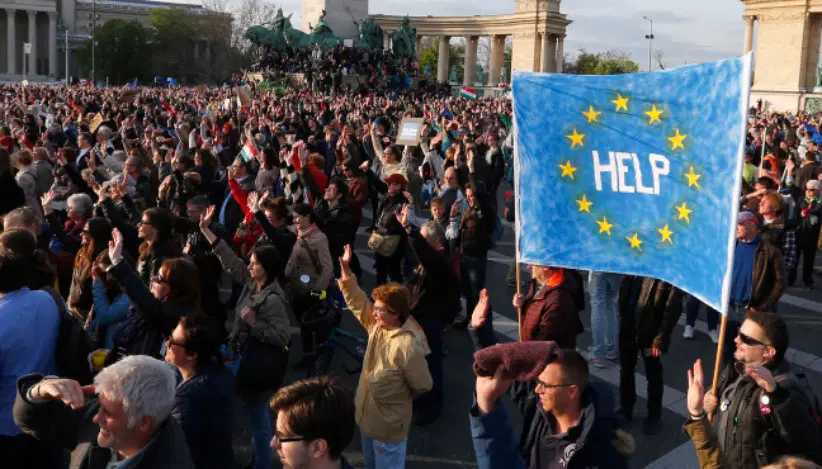
The Wall Street Journal recently had a long essay about “Europe is Losing.” The conservative news outlet is no fan of the European Union or the entitlement-driven economy long on vacations but short on work ethic. Today Europe, particularly Western Europe, “finds itself adrift, an aging continent slowly losing economic, military and diplomatic clout.”
Part of the problem is that the EU still thinks in central planning terms of Five Year Plans and puts princes in charge of tech innovation. (The prince thing is especially puzzling to Americans because most of our greatest innovators – Steve Jobs, Larry Ellison and Jim Clark – are from humble backgrounds.)
Politico has a summary of how wrong things can go. In “EU’s dream of 1 startup regime risks shattering into 27 pieces,” the post illustrated why bureaucrats shouldn’t be in charge of the tech sector. “Fundamentally flawed” and “insane” were some of the words used to describe the European Commission’s proposal to craft a set of EU-wide corporate rules to allow tech startups to scale up.
Startups and scale-ups complain about the weirdly inconsistent rules governing incorporation, hiring and taxation in each of EU country, noting how they hinder market expansion compared to U.S., where the 50 states have similar – though hardly identical and interchangeable – rules. But starting a startup in the EU has no template if you want to expand from, say, the Netherlands to Bulgaria.
From the post:
The idea of having one set of harmonized rules across all EU member countries, rather than being subjected to 27 different national systems, was appealing to many. However, startups are now freaking out as they claim the promise is at risk of being fragmented into 27 different pieces.
The issue comes down to whether the commission’s plan should be a directive across all EU countries or implemented nation by nation with changes from Portugal to Poland.
Here’s an idea: Why not have a simple incorporation process across the EU, minimum hiring rules and no taxes. Kind of like the United Arab Emirates, which seems to be doing okay.
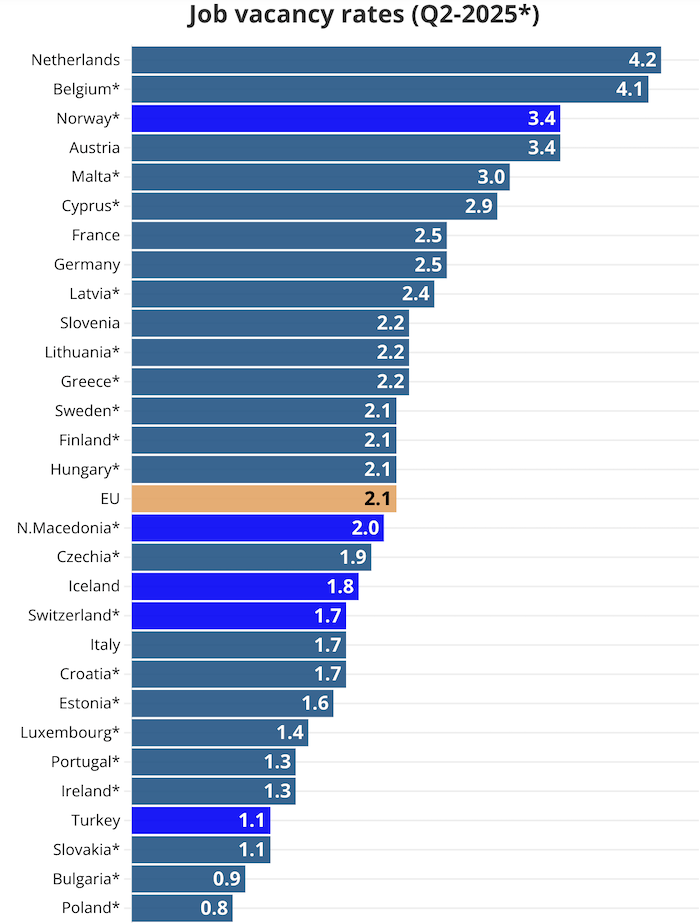
Netherlands has the most open jobs per capita
(Editor’s note: The first version of this section used an incorrect metric for the percentage of jobs open.)
Which countries have the most unfilled job vacancies? The Netherlands leads the pack, despite all kinds of government initiatives, with 4.2 job openings per 100 in Q2. But Germany has the most openings in real terms, with 1 million unfilled jobs, according to Eurostat. The UK is next with 750,000, then France with 500,000.
Part of this goes to demographics and aging populations. And part of it goes to the post-COVID phenomenon of working age people – particularly students – dropping out of the economy. In the UK, about a quarter of the working age population age 16 to 64 currently don’t have jobs, according to the BBC. That’s about 11 million people out of the population of about 70 million.
So, you have unfilled jobs at a time when a lot of people aren’t participating in the economy.
Stay curious, my friends
We’re avid readers of the Always Be Curious newsletter by Sander at ASML and we think you should be, too. It’s an entertaining way to keep up with not just with the Eindhoven ecosystem, but semiconductor trends across Europe.
Here’s a sample item from the most recent edition:
Watch this brand spankin’ new animation that unravels the science and engineering of ASML’s Extreme Ultraviolet lithography systems. Over the past year, the amazing Branch Education worked on a long-form explainer animation about EUV, with ASML providing input and feedback throughout their creative process. It was my honor to be part of that core team at ASML. The film strikes a balance between accessibility and technical depth, while learning about lithography has never been more entertaining.
ABC says, “Share it far and wide and let’s keep educating the world about the semiconductor industry!” So, we are. (See the video above.)
Quick hits:
• ASML’s recent $1.5 billion investment in AI startup Mistral is a bit of a puzzle. If you’re like us, you were asking, “What the heck’s this all about … the Dutch photolithography giant invests in a two-year-old AI startup … and a French one at that?” European media tended to paint the deal as ASML investing to protect “European digital sovereignty,” limiting European dependence on U.S. tech giants. But ASML CEO Roger Dassen told the New York Times that AI is crucial to ASML’s growth and that “teaming up with Mistral would help it better understand and influence the technology’s development.” ASML lead Mistral’s C round with DST Global, Andreessen Horowitz, Bpifrance, General Catalyst, Index Ventures, Lightspeed and Nvidia all part of the syndicate.
• Japanese Dai Nippon Printing Co. is working with TNO to open a R&D hub on High Tech Campus. Dai Nippon Printing Co., Ltd. (DNP), a leading Japanese technology company, and TNO announced the establishment of DNP’s first overseas R&D center at the High Tech Campus Eindhoven. This partnership and its new R&D hub will focus on advancing co-packaged optics, a key technology for enabling the development of next-generation semiconductors. DNP and TNO will also partner with The Photonic Integration Technology Center (PITC) to conduct a three-year research project at the hub.
• Silicon Valley-based Synopsys, which acquired Eindhoven-based Intrinsic ID in 2024, reported a very good Q3, with revenue up 14 percent year-over-year. Synopsys maintains operations on High Tech Campus Eindhoven. You can see the full release here.

Co-CEO of Dispatches Europe. A former military reporter, I'm a serial expat who has lived in France, Turkey, Germany and the Netherlands.