
Moving to Spain is the dream for many people. The warm climate, thousands of miles of coastline and a Mediterranean lifestyle are just a few of the obvious attractions. But there is also a relatively low cost of living and excellent healthcare. Whether you’re planning to retire, find a job or start a business in Spain, here’s what you need to know before making the move.
Do you need a visa to live in Spain?
If you’re an European Union/European Economic Area or Swiss citizen, you don’t need a visa to move to Spain, although if you plan to stay more than three months, you must register as a resident. For most other nationalities, a visa is required if you want to live in Spain for more than 90 days. There are several options, and which one is most appropriate for you will depend on what you are planning to do.
Some of the most common visas for moving to Spain are:
• Digital Nomad Visa: If you are a remote worker, Spain’s digital nomad visa lets you live in the country while working for clients or companies based predominantly abroad. To be eligible, you will need a university degree or at least three years of relevant work
experience. If you are a self-employed digital nomad, you can earn up to 20 percent of your income from Spanish clients.
• Non-Lucrative Visa: This is for people with sufficient savings, dividends, pensions or other passive income to support themselves without working. You are not permitted to work at all with this visa, including remotely for an overseas company or client.
• Employee Work Visa: Your prospective employer must first apply for authorisation for you to live and work in Spain. Once this has been approved, you can apply for the visa. The employer may also need to demonstrate that they have been unable to fill the
position with workers already in Spain, unless it’s on Spain’s shortage occupation list. As the name suggests, this register lists job roles that employers have difficulty filling.
• Self-Employed Work Visa: You will generally need a self-employed work visa if you want to move to Spain and work for yourself, whether as a freelancer or to set up your own business. Requirements include presenting a viable business plan, showing you have enough money to get started and proving you have the necessary qualifications or licences for your profession, where required.
• Entrepreneur Visa: This is for people who want to establish an innovative business considered of economic interest to Spain. Your project will need to be assessed and approved by ENISA (Empresa Nacional de Innovación) before you can obtain the visa.
• Highly Qualified Professional Visa: If you’ve been offered a highly skilled job, you may qualify for this fast-track route. It usually applies to jobs requiring a higher education qualification, although relevant professional experience may be accepted in some cases.
What happened to Spain’s Golden Visa?
You may have heard of the Golden Visa, which allowed non-EU nationals to become residents of Spain if they made a substantial investment in the country. This included property worth at least 500,000 euros. However, the visa was abolished in April 2025, and there is no direct replacement, so new applicants will need to qualify via another route.
Cost of living in Spain
So once you are here, how much will it cost you to enjoy a decent standard of living?
Spain continues to be one of Western Europe’s more affordable destinations. That being said, rents have surged dramatically in recent years, driven by a growing demand and a shortage of available homes. The problem is particularly acute in large cities and popular tourist areas, where short-term and seasonal rentals often leave fewer properties available to long-term residents.
In response, some municipalities, including Barcelona and Pamplona, have been declared “stressed housing markets,” allowing restrictions on rents for certain new contracts. The aim is to curb rising rents and make housing more affordable for tenants.
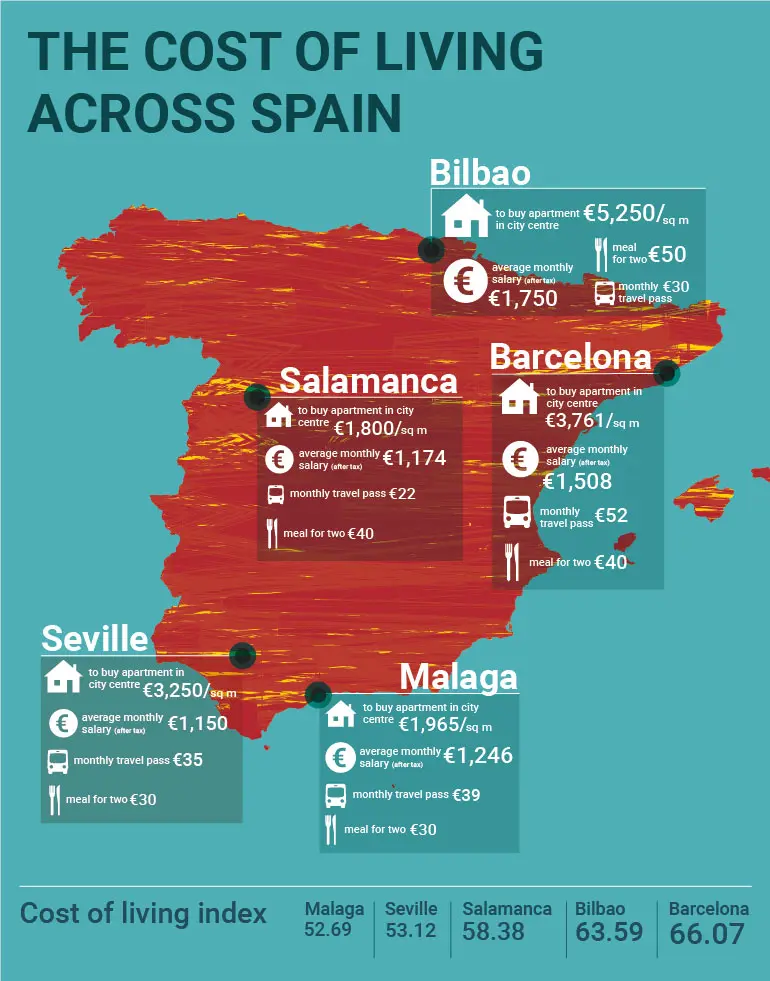
Living costs can vary greatly depending on where you settle. Madrid, Barcelona and Palma are among the most expensive, particularly for rent, while smaller cities such as Jaén, Cáceres and Ciudad Real are considerably cheaper. To give you an idea of what to budget for, Numbeo, a crowdsourced cost-of-living database, estimates that the average rent for a one-bedroom apartment is around 900 euros per month in a city centre and 710 euros outside it. Basic utilities, including electricity, heating, cooling and water, average about 130 euros per month for an 85-square-meter apartment, with internet adding another 30 euros or so.
Grocery costs, of course, will vary depending on what you buy and where you shop, but staples are relatively affordable. For example, a litre of milk costs around 1.05 euros, a dozen eggs 3 euros and a kilogram of chicken around 7.50 euros. Meanwhile, a family of four can expect to pay about 1,080 euros per month to rent a three- bedroom apartment outside a city centre, and approximately 1,400 euros per month for an equivalent home in the centre.
Healthcare in Spain
One of the most important considerations is access to healthcare, and Spain has one of the best-rated public systems in the world. It’s called the Sistema Nacional de Salud (SNS) and is mainly funded through taxation. It covers GP visits, hospitalisation and prescriptions, which are heavily subsidised for many patients. You can register at your local health centre by filling out an application form, presenting your ID and providing proof that you qualify for public healthcare, such as your social security registration and residency documents. You will then receive your health card, typically in the post within two to three weeks.
Whether you are entitled to the SNS will depend entirely on your individual circumstances.
Note that simply moving to Spain doesn’t necessarily mean you can immediately access public healthcare.
Salaried employees and the self-employed (autónomos) are generally covered through the social security system. Retirees from the EU/EEA, Switzerland and the United Kingdom may be able to transfer their healthcare entitlement to Spain. For anyone not covered by the public healthcare system, one option is the convenio especial. This is a state buy-in scheme costing roughly 60 euros per month for those under 65 and 157 euros oer month for those aged 65 and over. You generally need to have been resident in Spain for at least a year before you can apply.
Private insurance may be necessary if your visa requires you to have healthcare cover. In some cases, you may need comprehensive private health insurance that gives you the same level of coverage as the public healthcare system.
Moving to Spain from the UK after Brexit
Moving to Spain from the UK used to be a relatively straightforward affair. When I emigrated in 2008, all I needed initially was an NIE, a foreigner identification number. I already had a home here, but even if I hadn’t, the move would still have been relatively simple, with no visa required. After settling in, I applied for my residency certificate and registered with the social security system. Now it’s different and more complicated. That’s because, since Brexit, the EU has considered the UK a “third country. “Brits moving to Spain are therefore generally subject to the same immigration rules as other non-EU nationals, such as Americans, Australians and Canadians.
You can still visit Spain without a visa for up to 90 days in any 180-day period, but you cannot use that time to move here and start working. If you are a UK national and wantto move to Spain now or in the near future, you will typically need to qualify for one of the visa routes outlined above. If your application is successful, you then register on the padrón (municipal register) at your local town hall once you arrive and apply for your physical residence card, TIE (Tarjeta de Identidad de Extranjero).
There may well be a lot to sort out before moving to Spain, from visas and healthcare to finding an affordable place to live. But getting the practicalities right at the planning stage will help ensure you are well prepared for your new life in the country.
Good luck!
–––––––––––
Read more about Spain here in Dispatches’ archives.

Paul Arnold
Paul Arnold is a former BBC producer who worked on science, news and magazine programmes, traveling the world to interview Nobel Prize winners, politicians and celebrities. After 16 years, he left the corporation and moved to southern Spain, where he ghostwrites for publications across the USA, Canada and Europe.