For quite a long time, Portugal had been one of the most accessible European Union countries for those seeking to relocate to Europe. Famously, it used to have one of the shortest waiting times for the citizenship application, which, unfortunately, has been recently doubled to 10 years from five years of legal residency for most foreign nationals, and to 7 years for European Union and CPLP (Portuguese-speaking) citizens. Portugal also restricted its rules for the Golden Visa applicants: direct property purchases are now off the table.
All of it being said, for expats coming from countries with bigger economies, Portugal is still an attractive place with relatively low living costs: according to the recent stats of the biggest rental portal Idealista, with general costs roughly 42.7-percent lower than in the United States without rent, and with rent prices in the US about 65-percent higher than in Portugal. In spite of the changing approach to immigration rules, Portugal still offers a number of feasible options for students, digital nomads and wealthy retirees that might work for you.
Digital Nomad Visa (D8)
The digital nomad visa has been around since October 2022, and it’s actually pretty straightforward if you tick the right boxes. The main condition is your income — you need to show you’re making at least 3,680 euros per month from work done for clients or companies outside Portugal. They also want to see you’ve got some savings to fall back on, at least 11,040 euros sitting in your bank account (the equivilant of 12 minimum salaries in Portugal).
There are two options:
• a temporary visa that lets you stay for one year but doesn’t lead to residency.
• a longer-term one that gives you a shot at a proper residence permit.
The long-term one is what most people go for — you apply, get a four-month visa, then sort out your residency permit with the immigration office from within the country. That permit lasts two years and you can keep renewing it. The application is made via the Portuguese consulates in your country of residence. You’ll need to gather the usual paperwork — passport, proof of remote work (contract or freelance agreements), bank statements, a clean criminal record and a rental contract in Portugal with at least a one-year agreement.
You’ll also have to sort out health insurance that works in Portugal. Fees are around 75–90 euros for the visa application, plus some extra for the residency card. Family members like spouse, kids under 18 and even parents over 65 years old can join you too. Just be ready to show extra savings for each person you bring along.
Overall, the process takes about six months from application to getting your residency sorted.
Golden Visa: Is it still on the table?
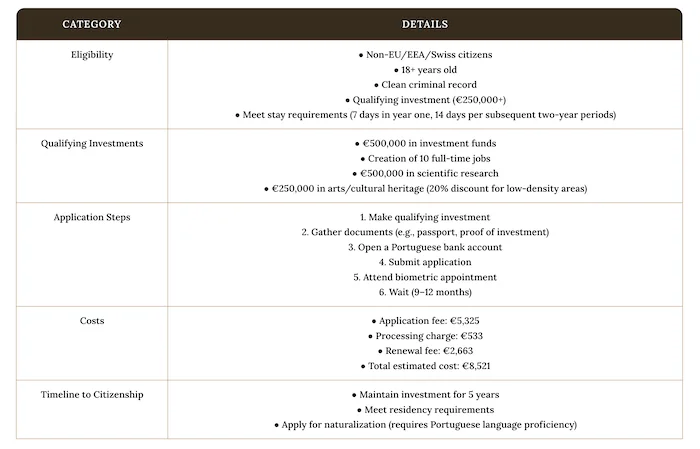
The program’s been around since 2012, but the property investment route was stopped in October 2023. However, you’ve still got a couple of decent options if you’ve got the cash.
First is the donation route: 250,000 euros goes straight to an approved cultural heritage organization, such as restoring historic buildings or museums. It’s “cheaper,” but you’re not getting that money back.
More popular is the fund investment option. You’re looking at investing 500,000 euros minimum into a government-regulated fund that keeps at least 60 percent of its capital in Portugal. Some funds are newer and set up just for golden visa applicants; others are big established players with over 1 billion euros in assets.
Cost-wise, you’re starting around 271,650 euros-plus for a single applicant, and around 294,600 euros-plus for a family of four. The visa lets you live in Portugal, travel freely in the Schengen Zone, and you can apply for permanent residency after five years.
What about citizenship? That’s 10 years now, same as everyone else.
Still quite a deal if you’ve got the means.
Student Visa (D4)
Perhaps not ideal for full-time workers, but definitely an option for someone who can, and wants, to get another degree. Portugal has a lot of master’s of arts degrees in English and the enrollment process is generally rather easy if you fit the requirements, plus the fees are still cheaper compared to other places in Europe. Once you have an official certificate of enrollment, you can apply for a student visa in your country of residency. The list of required documents is similar to the one for the nomad visa minus the working contract. Once you are done with your studies, you can prolong the residency from within the country under the condition that you are officially working and paying taxes in the country.
Passive Income Visa (D7)
This one is aimed at people living off pensions, rental income or investment returns: no active work required (but also not prohibited!). The baseline is 920 euros per month (11,040 euros yearly) coming from outside Portugal. Bring a spouse and you’ll need an extra 460 euros monthly; each child adds 276 euros to the tab.
As with other options, you have to secure accommodation — a rental contract for at least one year or proof you own a place — and open a Portuguese bank account with enough saved up to cover 12 months of living costs. Health insurance and a clean criminal record are also non-negotiable. The D7 gets your foot in the door, then you trade it for a residence permit that sticks for two years and can be stretched another three years after that.
Government fees work out to about 300 euros per person and the whole process takes roughly half a year from start to finish. Personally, I know a couple of people who used this variant while still working remotely for their home country, and they claimed this option to be one of the fastest.
The patience part ….
Having listed all the technicalities, I feel there is still an important thing to be added: whoever wants to live in Portugal, will learn the hard way that nothing here happens fast — especially paperwork. Waiting times for document applications, renewals, etc. will drain your energy. That’s why I believe one should move to Portugal only if feeling that something about the
country, its people, its way of living deeply speaks to you.
If that’s the case, you will love it. If not, leave Portugal as your favorite holiday destination.

Nina Danilova is an art writer and contemporary art curator. She is about to finish her PhD
in Culture Studies. She grew up in Russia and lived in Germany, Estonia, Italy and
Portugal, where she is currently based. She is passionate about history, languages, food,
and dancing.