
A diploma for cycling. A diploma for golf. Welcome to the Netherlands. Come springtime in the Netherlands, you’ll see kids on bikes navigating the streets in fluorescent vests. Sure, the bright colors are noticeable, but perhaps it’s the extra-cautious nature of these juvenile bikers that’s the reason you actually notice. Unlike normal, they aren’t wizzing past your car or biking two or three across.
This event is not something you see every day, so it’s a bit of an oddity when you first notice it. These bright jackets all have numbers on the back, and at intersections, you’ll see people (usually retirement-aged folks) sitting with clipboards in their hands.
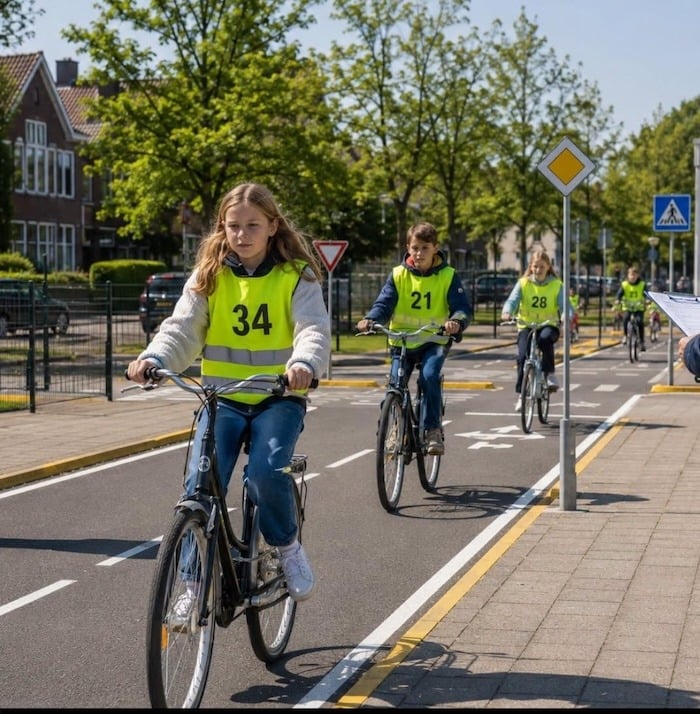
So what is this? It’s the “traffic diploma” practical test that students in Group 7 and 8 (ages 10 to 12) can take between March and June. Now, if you are like me the first time I heard about this, you’re thinking: “Really? A diploma for cycling? Is that necessary?” Yes, I’m not joking. It’s a written theory exam, followed up by a practical biking exam to see if the children follow all of the rules. Volunteers watch at checkpoints to make sure each child follows the proper traffic rules. This diploma is not technically required, but in practice, almost all kids do it. Traffic (verkeer) education is a compulsory subject at every Dutch primary school, but the exam is not nationally mandated. However, more than 80 percent of elementary schools participate.
When you think about it, this diploma makes sense, just like traditional driving licenses for cars. This is the age right before children switch to secondary school, at which point most children ride to school on their bikes alone. And many of these secondary schools are farther from home than their primary schools.
This bicycle traffic diploma is just one of the many diplomas that Dutch child will receive in their childhood.
There are others …
As kids grow up, there are the swimming diplomas (all three of them), as I covered in a previous post, ice skating diplomas and other gym diplomas. Are these mandatory? No, but some, like the swimming and traffic diploma, are highly encouraged. The swimming diploma is also necessary if kids want to attend an open swim alone or go to a swimming birthday party.
I get it.
Most of these things are very practical and what I would categorize as life skills. But then why are my children’s memorabilia boxes packed with other rinky-dink diplomas? From a tying-your-shoes diploma to a “Piet” diploma from a Sinterklaas-themed activity, it seems the only thing they don’t get a diploma for is learning to pee in a toilet.
Drop your child off at any kid’s birthday party, and they will likely come out toting a diploma. Whether it’s a “superhero-training” diploma, an “I-caught-all-the-pokemon” diploma or a “princess-in-training diploma,” the culture is obsessed. It’s like the Dutch version of the participation trophy.

So what’s going on?
The diploma system seems to be a window into something fundamental about Dutch society. These diplomas for basic safety skills are things that in other countries around the world, we’d assume children just picked up somewhere between birth and adulthood.
But in the Netherlands, these moments are marked, certified and celebrated.
The cycling diploma exists because Dutch children ride independently to school, across real intersections, starting young. You cannot send an eight-year-old into live traffic without verifiable skills. But surely, by the time you’re 18, all of this diploma nonsense is over and done, right?
Not quite. You don’t escape these tests and diplomas in adulthood.
If you want to play golf, well, there’s a diploma for that too. To play independently on almost any official golf course in the Netherlands, you must earn a GVB (Golfvaardigheidsbewijs), which is now rebranded as Handicap 54 by the Dutch Golf Federation (NGF). You need baanpermissie (permission to go on the course), a passing score on the golf rules exam and playing one qualifying round with a certain score.
A culture of collaboration
Diplomas are not uniquely Dutch. You can find to some degree throughout Europe swimming diplomas and intense driving schools followed by driving exams . But the sheer density of diplomas in the Netherlands and the degree to which they are woven into childhood development and adult leisure does appear to be distinctly Dutch.
To outsiders, all of this can look excessive. But the Dutch diploma culture did not appear out of thin air. It might be the product of a society that spent centuries making decisions together about the water and land. You cannot manage a system of reclaimed land, dikes and polders on a cowboy-everything-works-out kind of basis. Shared standards, shared accountability, and documented proof of competence were baked into Dutch civic life long before anyone invented a swim test (think: historical guilds with formalized tests of competence and water boards with collective labor contributions). Maybe these diplomas are also based on a belief that skills can be taught to anyone who works at them, that progress can be measured and that society benefits when everyone who participates in something meets a baseline standard.
When you look at it, there is a good reason behind the golf diploma. There are fewer courses per golfer in the Netherlands than in some other countries, and showing up without basic competence creates hazards for other players (fore!). So yes, most diplomas are rooted in practicality, but the other childhood diplomas? Maybe they are just a form of grooming to integrate them early into this culture. Or maybe I’m just reading too much into children’s diplomas…
Until the time I figure out the reason behind all of this, I’ll be stuck with a box bursting at the seams with diplomas. Kids love them, feel pride in them and won’t get rid of them. But you still won’t catch me handing them out at my kid’s next birthday party.
I guess I haven’t integrated that much.
**********
See more about the Netherlands here in Dispatches’s archivees.
Read more from Lane Henry here.

Lane Henry is an accidental long-term expat. She is an American who came to the Netherlands for two years—or so she thought. She has now lived in the Netherlands and explored Europe for over a decade.