
(Editor’s note: The Europe Business Briefing is part of Dispatches’ Tech Tuesday series. Dispatches covers tech across Europe because so many of our highly skilled internationals are founders and entrepreneurs.)
Zagreb has become the first city in Europe to boast a commercial robotaxi service, after Mate Rimac’s Verne, Pony.ai and Uber announced a strategic partnership to develop futuristic autonomous transportation. The plan ultimately is for expansion outside Croatia.
The three companies will jointly work on the introduction of Zagreb’s commercial robotaxi service. It will combine Pony.ai’s autonomous driving system, Verne’s system and operating model and Uber’s global mobility platform. Verne will be the fleet owner and service operator, with Pony.ai providing the autonomous driving solution and Uber integrating the service into its global ride-hailing network, which will be an option within the Verne app.
The trio of companies wants to set the stage for Zagreb’s commercial robotaxi service, eventually expanding it to other markets, with plans to expand to a fleet of thousands of autonomous cars. Road tests have already been taking place in Zagreb using Pony.ai’s Gen-7 autonomous driving system. Verne will lead the launch process and will obtain all regulatory approvals, setting a scalable framework for expansion outside of Croatia. Verne also expects an investment from Uber, as well as expansion support as a strategic partner.
Should all go to plan, Croatia’s capital will become one of the testing and development centers for autonomous transportation in Europe.
The autonomous vehicle service will span the wider city center and Zagreb Airport, with the service soon made available on the Uber app. By then, the service will also expand to other city areas. In addition to Zagreb, Verne is in discussions to launch the service in 11 cities across Europe and the Middle East, with more than 30 additional cities also considered.
–– Lauren Simmonds

Prague-based Choice Saas reservations platform raises $7.1 million
Choice, a Prague-founded restaurant SaaS platform, has raised a $7.1 million Series A, led by Alea Capital with participation from Reflex Capital, Smartlink and J&T Ventures, bringing total funding to $11.6 million.
Choice is building what it describes as an all-in-one operating system for independent restaurants — combining QR code ordering and payments, direct online ordering with no commissions, reservations, loyalty programs, marketplace integrations and centralized customer data analytics, all in one platform.
The company currently serves 30,000-plus restaurants, with 7,000 paying monthly, processing 1.5 million orders per month and generating around 35 million euros in monthly gross merchandise value, which is essentially the value of all transactions, of which Choice gets a cut. Active in nine European markets, Choice is a player in Central and Eastern Europe and is doubling revenue year-over-year.
With approximately 2 million restaurants in Europe – twice as many as in the U.S. — the company sees industry fragmentation not as a weakness but as an opportunity to scale market by market. The new funding will be used to expand across Southern and Western Europe and to further develop AI-driven tools that automate marketing, pricing and customer retention for independent restaurants.
–– Lauren Simmonds
New chip technology partnership in Eindhoven
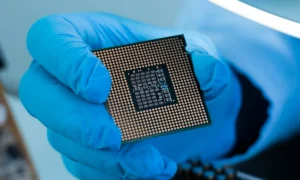
Lund, Sweden-based AlixLabs is bringing a new chip manufacturing technology to Eindhoven in partnership with VDL ETG. The Dutch/Swedish partnership promises a less complex and less energy-intensive production processes, according to a media release.
Unlike ASML, which uses ultra-violet energy (EUV) to etch chip circuitry, AlixLabs uses atomic pitch splitting, or APS. The claim is APS can create structures matching the most advanced chips used in AI chips and smartphones.
The technique discovered by researcher Jonas Sundqvist in 2015 splits nano circuitry at the atomic level. And of course, the smaller the circuit, the faster the processing. (Okay, we don’t have a staff physicists, so that’s as close as we can get to an explanation. See the video above.) “Our mission is to create equipment that allows companies that don’t have access to EUV tools to scale down their production to 5 nanometers and beyond. By eliminating the dependency on EUV lithography, we’re offering the industry a path toward more sustainable and economically feasible high-density chip production,” Sundqvist told Bits&Chips.
What we find interesting is that AlixLabs chose Eindhoven and ASML supplier VDL to build this project. We’ll tell you more as we find out the details.
Kyiv-based Harmix raises $1 million to address operational blindness in SMBs
There might be a war going on, but Ukraine just keeps innovating. Harmix, a Kyiv, Ukraine developer of autonomous artificial intelligence agent infrastructure, has raised $1 million in funding to support the deployment of PAM (Proactive AI Manager). The platform is designed to help small- and medium-sized businesses unify data across fragmented software tools, according to a media release.
Founded by Vector Institute researcher Nazar Ponochevnyi, along with co-founders Nick Shcherban and Oleksandr Kuprii, Harmix addresses what it terms “operational blindness.” For small- and medium-sized businesses, this occurs when critical business context is scattered across email, internal chat and basic software systems, often causing lean teams to miss risks or repeat manual tasks.
“Most AI tools are reactive and require a specific user prompt to provide value,” said Nazar Ponochevnyi, Harmix CEO. “For smaller businesses where resources are limited, managers cannot always spend time asking the right questions. PAM is engineered to monitor these fragmented interfaces proactively to identify bottlenecks and track decisions.”
The PAM architecture utilizes a long-horizon memory layer to maintain context across varied software environments. The system integrates with standard tools, including Slack, Gmail and customer relationship management platforms, to automate reporting and internal coordination.
The new capital will be used to accelerate the delivery of Harmix’s 2026 technical roadmap, with a focus on data sovereignty and security. Funds will be allocated to obtaining SOC 2 certification and developing self-hosted deployment options, allowing businesses to maintain full control over their proprietary data on private clouds. Additionally, the investment will support the engineering team’s expansion to scale operations within the North American and European manufacturing sectors
Harmix is an AI research and product firm based in Kyiv and Toronto. Building on a technical foundation of processing more than 30 million multimedia assets for global brands, the company aims to eliminate operational blindness, allowing organizations to maintain full ownership of their data and AI infrastructure.
Orqa joins forces with Ukraine’s General Cherry
Speaking of Ukraine, Croatia-based drone tech company Orqa and Ukrainian defense technology company General Cherry have signed a strategic cooperation agreement on the development of unmanned aerial systems. Together, their focus will be primarily on the development and production of
interceptor drones, components and other unmanned aerial systems. Work is also underway to build joint production facilities in Croatia and Ukraine.
Interceptor drones specialize in neutralizing enemy drones in the air. Unlike classic air defense systems that use costly missiles, these drones provide a cheaper solution for combating drone swarms. “This partnership is based on a co-production model that allows us to combine General Cherry’s operational know-how and experience with our tech. It will allow us to offer effective air defense capabilities against ultra-modern unmanned threats. This is a significant step forward in placing extremely efficient systems at the service of the security,” said Orqa co-founder Srđan Kovačević.
–– Lauren Simmonds
Rimac is moving more of Bugatti’s production to Croatia
France’s L’Argus revealed that an even more significant part of the production of future Bugattis is set to shift to Croatia, more specifically to the Rimac Campus in Sveta Nedelja, not far from Zagreb. Production currently is in Molsheim, France in the Alsace region.
For decades, Bugatti and Alsace have been connected, with models including the iconic Veyron and Chiron produced there. The process of transferring to Croatia could begin as early as later this year, according to media reports. Croatia would possibly produce particular mechanical parts and the chassis for the Bugatti Tourbillon, while the final assembly and interior design would remain in France.
French media emphasized that a development of this scale would mark a new phase in the
development for Bugatti-Rimac. For Croatia itself, this would also be a confirmation of its increasingly significant role in the high-tech automotive industry, of which Mate Rimac has been the face.
–– Lauren Simmonds
High Tech Campus Open Day coming up on 13 June
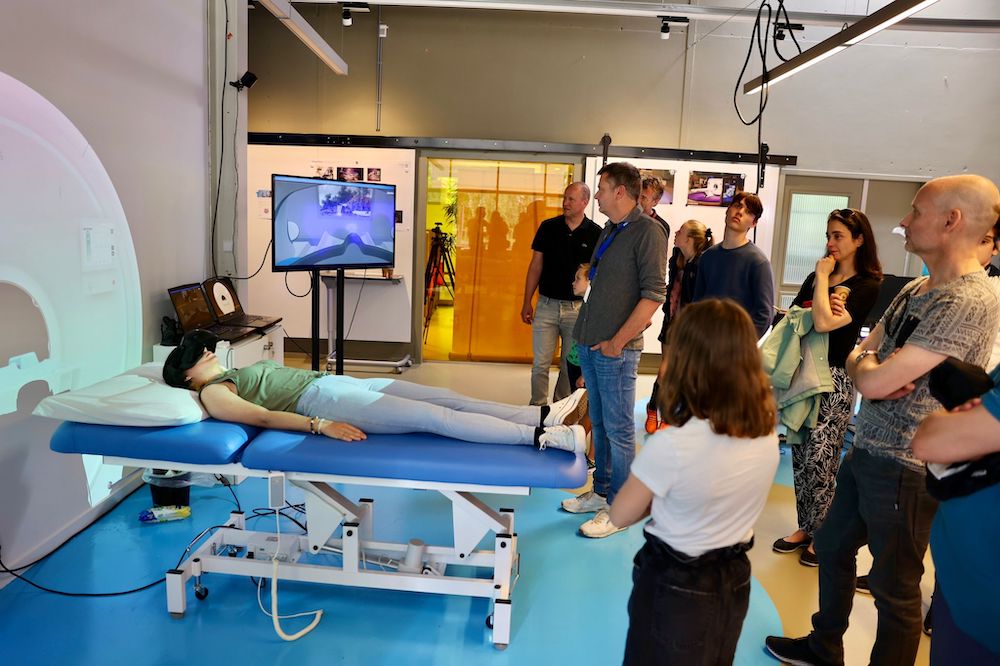
Dispatches is based on High Tech Campus Eindhoven, so we think everyone in Europe has visited here at least once. Sadly, they haven’t. In fact, most people in Eindhoven have never been to this giant research campus, where access used to be tightly restricted by Philips. If you’re one of these people, put 13 June on your calendar.
That’s the next Open Day, when the Campus puts on a party to show off its companies, with more buildings open in 2026 than during previous Open Days. In 2024, more than 7,500 visited Campus during Open Day.
This is a bi-annual event and the 2026 theme is, “Homebase for Breakthrough Technology and Innovation.” And breakthrough technology and innovation are what you’ll see when you visit. At least 50 Campus tenants will host activities and/or open their doors including NXP, Philips, TMC, Shimano and Signify. Some of the most celebrated tech companies and research institutions in the world are headquartered here. HTC 37 and the 3EALITY innovation hub will be the center for startup and scale-up demos and activities.
We’ll have more info as plans progress.

Co-CEO of Dispatches Europe. A former military reporter, I'm a serial expat who has lived in France, Turkey, Germany and the Netherlands.