
(Editor’s note: This edition of the Eindhoven Business Briefing is part of our Tech Tuesday series. Dispatches covers tech because so many of our highly skilled internationals are founders investors and entrepreneurs.)
With the victory of Rob Jetten’s liberal/centrist D66 party, we expats in Eindhoven dodged a bullet. But the Netherlands still faces a choice – go down the road of nationalism and identity politics, or keep its huge lead in global tech innovation. Which it has, in part thanks to highly skilled internationals.
A couple of years ago, it looked all but certain that the Netherlands would fall to the trend of far-right authoritarian governments sweeping across Europe. Geert Wilders and his Party for Freedom (PVV) won the 2023 general election running on an anti-Islam, ant-immigration platform. But Wilders turned out to be the anti-Dutch, an ideologue who doesn’t care about consensus or reality, for that matter.
Last week, Wilders came in second in the national elections, so expect more from him. Anti-internationalist, Peter Omtzigt still works in the background with New Social Contract, the conservative party he founded in 2023, to put a cap on migration.
But Jetten is the new Golden Boy, smart, thoughtful and steady. Everything Wilders is not.
We met Jetten back in 2021 when he visited High Tech Campus Eindhoven. We were mightily impressed. Here was this young leader who was actually interested in tech and who was in the process of visiting Dutch engineering programs and innovation centers.
Back then, Jetten identified three ways to boost innovation:
• Officials provide sufficient public funding to enable Dutch businesses to become more innovative, “but (the government) is always looking for a return on investment,” he said. Generally seven percent. But that means the government is missing out on the opportunity – though it’s riskier – to invest in the companies of the future.
• Dutch policy should encourage the big pension funds “to be a bit more willing to take more risk” as they invest their billions.
• The Netherlands should have tax policies that incentivize individual investors to invest in startups, scaleups and SMEs: “I think it’s a missed opportunities for the Netherlands.”
Let’s see whether, should Jetten become prime minister, he acts on these.
Whatever the case, there’s no going back. In 2025, the CEO of ASML is French, and a leading politician, Dilan Yeşilgöz, of the conservative-liberal (I know, it’s a Dutch thing) Party for Freedom and Democracy, was born in Ankara.
So, the Netherlands is still positioned for global prosperity, though the Omtzigt approach is, if anything, accelerating. We see more companies and schools adopting “we only hire Dutch speakers” policy. Which makes no sense in a country that’s aging quickly and has huge deficits when it comes to skilled labor. And that is in the European Union.
There were 129,000 immigrants from the European Union alone in 2022. Omtzigt want to limit the number to a net 50,000. ASML officials have even pointed out they might depart the Netherlands for The Valley if they can’t hire enough American engineers.
Choices. Consequences.
Better than ASML?
There is a threat to Eindhoven’s prosperity far more insidious than Geert Wilders … innovation. When we were kids in the States, we learned first-hand about disruptive technology as the Japanese nearly killed the American auto industry with cars that were reliable and modern … everything American cars weren’t.
Substrate, a small SanFran-based startup, claimes to have developed a chipmaking tool capable of competing with the most advanced lithography equipment made by ASML. Substrate has raised $100 million in a funding round at $1 billion valuation, according to The Wall Street Journal. The round saw participation from Peter Thiel’s Founders Fund, General Catalyst, Allen & Co., Long Journey Ventures, Valor Equity Partners and the CIA-backed not-for-profit firm In-Q-Tel.
Substrate claims to have a simpler process using x-rays from particle accelerators and custom lithography, which projects energy through the blueprint of a chip design and onto a silicon wafer to etch circuitry on chips. While not exactly simple, that’s far less complex than the giant, wildly complex ASML machines. Those room-sized machines – the most complex in the world – etch circuits directly on chips using extreme ultra violet light generated by pinging tin molecules with the world’s most powerful lasers.
Head. Exploding.
Substrate’s goal: Take on TSMC and build chips in the U.S. at the lowest possible cost.
But the Journal notes serious skepticism about whether Substrate can do what it says it can do … even with $100 million in the bank.
Not surprising, because the Chinese have tried for a decade to even copy ASML, much less surpass it, and have failed miserably. Moreover, Substrate is connected to U.S. Vice President JD Vance, who was arguably among the least successful “venture capitalist” ever trusted to invest a buck. Vance’s golden moment was as a lead investor in AppHarvest in our home state of Kentucky, a scheme to build elaborate, expensive high-tech grow houses instead of, you know, just growing tomatoes in the ground.
Shockingly, AppHarvest went bankrupt, burning through at least $600 million.
So, you have to wonder how seriously ASML executives are taking this threat to their global near-monopoly.

Paris is no Eindhoven
There’s an old saying that war is too important to be left in the hands of generals. That civilians should have a role in strategic decisions. And landies and gentlemen, we in Europe are fighting a war. If Europe doesn’t win, China or the U.S. will.
Last month, the European Commission, in its infinite wisdom, released a report naming the Top 10 most strategic regions for research and innovation in the EU and globally. The study “uses economic indicators to investigate the progress in competitiveness and support policy initiatives” on closing the divide between EU and its global competitors, according to an EC news release.
The top three most strategic regions – Munich, Paris and Madrid.
Did Eindhoven/Brainport get a nod? Sort of … as a region pivotal within the EU due to its intra-EU project collaborations.
Let’s think about this for a moment. Brainport has, of course, ASML, Philips and NXP. It also has the research institutions TNO and imec; well, part of imec, while the rest is in Leuven, Belgium, which didn’t get recognition, though it should. We mention the big tech companies headquartered here because they concentrate the density of talent simply by hiring every top physicist and electrical engineer they can get their hands on, who often go off to do their own thing.
Now, Paris does deserve a top spot, with the new AI venture Mistral (now mostly owned by ASML ) and the Dassault conglomerate, which makes everything from fighter planes to software. But Paris has no semiconductor companies or other deep-tech. Munich does have advanced auto industry tech because of BMW and startups such as 3C ai, but nothing equivalent to ASML or NXP.
Paris and Munich have huge numbers of patents granted every year, no question. But in 2022, Dealroom ranked the Brainport Eindhoven region No. 7 on its list of global Science Hubs, regions that have a leading position in high-tech research, university talent and patents. The report compared 201 global ecosystems, with Eindhoven just behind Cambridge and Oxford in Europe.
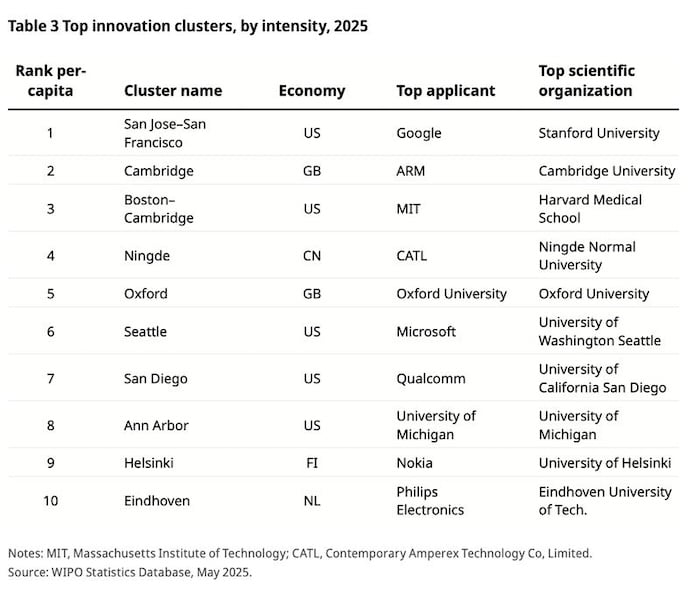
This year, the Global Innovation Index 2025 ranked Eindhoven at No. 10 globally, No. 2 in the EU behind Helsinki.
At the same time as the report, EU officials also announced a 1 billion euro plan to ramp up the use of artificial intelligence in key industries amid a push to cut the EU’s reliance on U.S. and Chinese technologies. New initiatives include finance, tourism and e-commerce. Apparently, there’s no problem a good government action plan and a billion euros can’t solve. Inexplicably, Europe still trails far behind the U.S.
Actual briefs
• VIVOLTA, the specialist in electrospun medical implant manufacturing, has signed a long-term agreement for a dedicated production facility at High Tech Campus Eindhoven. The new site marks a major milestone in VIVOLTA’s growth, driven by increasing customer demand for industrial-scale manufacturing of regenerative medical implants, according to a press release. Electrospinning, if you’re wondering, is an additive manufacturing technique that allows nanofabrication of ultra-fine fibers on an industrial scale, in this case for making implantable medical devices such as grafts and stents.

Co-CEO of Dispatches Europe. A former military reporter, I'm a serial expat who has lived in France, Turkey, Germany and the Netherlands.