
(Editor’s note: This special Sunday edition of the Eindhoven Business Briefing is dedicated to the arrival of Eliyan in Eindhoven. Dispatches covers tech because so many of our highly skilled internationals are founders and entrepreneurs.)
If you’re wondering what’s next in semiconductor, it’s here. And it represents a reversal of the flow of promising startups fleeing to the U.S., with Eliyan arriving in Eindhoven from Santa Clara, Calif., in the heart of Silicon Valley, headquarters for both Lisa Su’s AMD and Jensen Huang’s NVIDIA.
Eliyan is creating an R&D design center in HTC 41 on High Tech Campus Eindhoven in a deal facilitated by the Brainport Development Agency, or BOM. The move is to take advantage of Eindhoven’s density of talent, chip design expertise and its existing semiconductor cluster, according to a BOM media release.
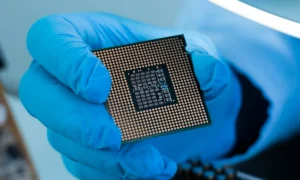
Though it took us some serious searching to figure this out, Eliyan builds chiplets – small, modular integrated circuits that act as building blocks for a larger, more complex chips – for data centers and high performance computers, supercomputers and computer clusters.
Or as BOM’s team lead for foreign investments Maarten Brouwer puts it:
At the heart of Eliyan’s mission is solving one of the semiconductor industry’s biggest challenges: how to move data faster and more efficiently within AI and computing systems. Eliyan has developed an advanced interconnect technology that enables higher bandwidth and lower power consumption between chiplets, unlocking scalability and efficiency for next-generation AI infrastructure.
More speed, less energy
The startup uses die-to-die memory interconnect, a technology connecting separate silicon “dies,” or integrated circuits, within a single package, letting them act as a single system. Chiplets are tiny integrated circuits with specialized functions, which can be combined to make larger integrated circuits. They contain multiple smaller circuits, instead of one monolithic circuit like conventional GPUs.
We know … this is a lot of jargon, but basically this is all a way to boost conventional chip technology to meet the demands of artificial intelligence.
Eliyan’s chiplet interconnect technology speeds up AI chip processing, with the company claiming it achieves up to four times the performance – at half the power – of other solutions. This is also the missing piece of the data center puzzle, a way to speed up processing while lowering power demand. So, this is the deep end of the deep-tech ecosystem pool.
Adding to Eindhoven’s semicon cluster
When we say Eliyan is a “startup,” it bears little relationship to most European startups. Founded in 2021, Eliyan raised a $40 million A round in in 2022, then a $60 million Series B this past March. Samsung Catalyst Fund is an investor.
Eliyan will join another AI chip company based on High Tech Campus, Axelera AI. Axelera has also raised serious capital for its “AI on the edge” concept and shares Samsung as an investor. And Bloomberg recently reported that Axelera co-founder Fabrizio Del Maffeo is in talks to raise 150 million, an investment round that would close by year-end.
Axelera builds chips for cameras, robots, computer vision and other systems without using large cloud services. And it’s no coincidence that both Axelera and Eliyan are on lists of semicon startups with break-out technology.
Not to put too fine a point on this, but we think the arrival of Eliyan cements Eindhoven’s position as the No. 1 semiconductor hub in Europe, with ASML, NXP and a growing list of newcomers. Just how big Eliyan’s presence in Eindhoven will be isn’t clear. Stay tuned ….

Co-CEO of Dispatches Europe. A former military reporter, I'm a serial expat who has lived in France, Turkey, Germany and the Netherlands.