

As an itinerant petsitter of many years, I have noticed that when it comes to dogs, the canine social rules can differ dramatically from one European country to another. In the United Kingdom, I am used to enjoying a lot of freedom whenever I take a dog out and about a city. Pooches are welcome almost everywhere, which makes life fairly hassle- and stress free.
Over the past few years, I did many dog sits throughout Spain and Barcelona, and was taken aback by the number of rules concerning what you can or cannot do with a dog.
Sometimes that affects even the simplest daily routines. If you’re thinking of visiting Barcelona or relocating with your dog, here are some of the essential things you should keep in mind.

Relocating to Barcelona with a dog
Three things are mandatory when relocating to Spain with your furry friend from another country (whether within or outside of the Euroepan Union):
A pet passport
A recent rabies vaccine
Your dog must be microchipped
In addition to that, if you’re staying permanently, you are required to have your pooch listed in the relevant municipal register of pets. That can make your life much easier should anything bad happen to your furry friend, if they get lost or stolen, for example. You can find more in-depth info on all the rules and requirements on the webpage of the Barcelona City Council.
Taking your dog on public transport
I am super used to the fact that in London, and in any other UK city, I can get on any form of public transport with a dog. In Barcelona things get quite complicated if you want to travel with a pooch because different means of transport set different rules. The trickiest ones are inner-city buses – you can only board them with a dog if it fits inside a carrier, which basically means that medium-sized and large dogs are not allowed to travel. The good news is that your pooch is welcome on all other forms of transport – tram, metro and trains. However, on trains your dog must wear a muzzle or stay inside a carrier (or crate). You can decide which one is more practical depending on your pet’s size.
If you want to explore other parts of the country, different cities set their own rules, so be prepared for surprises. Furthermore, your dog might not be allowed on all long- distance trains, so you have to check the regulations on a case-by-case basis. If you plan to take your dog farther away from your neighbourhood regularly, having a car might be your best option.
Dogs are allowed in almost all parks throughout Barcelona, however, do keep in mind that parks are rarely fenced off. If your pooch has poor sense of recall and you’re worried about it straying off, seek out the nearest dog park. These are usually small, enclosed spaces where your dog can play undisturbed – often in the company of other local canines.
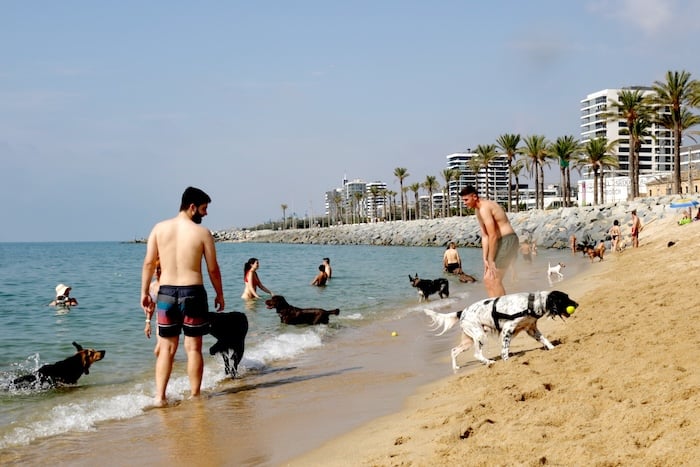
Outdoor spaces accessible to dogs
Dogs are generally welcome on urban beaches in winter but in the warmer months there are very strict rules about their access to sandy stretches.
From April throughout June dogs are only allowed on beaches on
weekdays.
From July throughout September dogs are not on the beaches.
These rules are very strict, so if you get caught breaking them, be prepared to pay a fine.
After all, they ensure that the beaches remain hygienic and enjoyable for beachgoers at the height of the swimming season. Besides, the summer heat in Barcelona can be dangerous to your pooch, so would you even want to bring it to the beach?
Probably not.
Renting with a dog
As I have previously written, nowadays the rental market in Barcelona is particularly strained, so much so that local protests frequently make the news. Demand outstrips supply many times over and to top it all, prices have doubled in a few years alone. Finding a place to rent can be a headache with or without a pet. However, it can become a little trickier when you have a furry flatmate.
Everyone’s experience can be different, of course, and while one acquaintance of mine who owned a tiny dog fretted that she could not find a rental for months, a couple with five pets (both cats and dogs) bragged that they secured their apartment in the city centre in only a month.
The best approach is to not rely on the handful of listings mentioning that pets are allowed. Instead, if a listing does not specify whether pets are welcome or not, ask the landlord whether they will accept your dog. Also, keep in mind that the owners of unfurnished apartments are more likely to accept furry tenants – after all, there are fewer things that a dog can damage in an empty home.
Weather considerations
Spanish summer is a scorcher; there are no two opinions about that. It can literally feel like a shock to your system if you are used to milder or colder climates. The same applies to your furry friend. If taking your pooch out for a walk in summer (especially from June to September), keep in mind that the heat can be dangerous and even lethal.
Some precautions I have taken with my borrowed dogs have included avoiding long walks in the middle of the day in favour of early morning and late evening strolls. It’s also wise to avoid walking your dog on paved roads under direct sunlight because the heated asphalt can burn their paws.
Last but not least, keep your dog hydrated. The great thing about Barcelona (and many other Spanish cities) is that you can find water fountains in every neighbourhood. If you can’t see one nearby, ask at the nearest eatery – many keep a dog bowl handy and won’t refuse to fill it with water for your pooch even if you’re not a customer.
Personally, I prefer to carry bottled water with me despite its abundance. The heat can get so relentless, I don’t want to risk a heatstroke while looking for water.
That applies to both humans and dogs!
Setting Spanish boundaries
Training your dog to respect boundaries is a no-brainer. Expecting the Spanish to keep boundaries around your dog, however, is a different story. This came as a culture shock to me personally. In England people respect a stranger’s space and won’t approach your dog without asking permission first. The Spanish might just walk up to you and start petting your dog without ever asking your permission at all. Some might even call your dog while you’re in a hurry or just busy.
This might be fine with you or it might not. After all, it can be irritating when you’ve got things to do or you need space – or in situations that might be dangerous to your dog or the other person. Being firm but polite is what usually helps resolve such situations. On a few occasion, people acted offended or downright ignored me. The Spanish can be emotionally intense in some social situations. You will just have to get used to it and get on with it.
Your dog might prove to be the calmest in such situations. However, you choose to approach it, part of the challenge of being in a new country is embracing new cultural quirks.
––––––––––––
Read more about Spain here in Dispatches’ archives.
See more from Teodora here.

Teodora Gaydarova
For 15 years Teodora Gaydarova has been covering culture, travel, hospitality and other beats for different publications and global brands. A Bulgarian by birth, she has lived all over the United Kingdom and parts of Spain, and she writes about the experience of navigating life across different countries and cultures on her blog, The Local Insider.