As an expat, you have to learn a lot, and that gets even more intense when you have kids.
Suddenly, all the knowledge you accumulated growing up – the unwritten rules, the social norms, the “how things are done” – goes right out the window. You have absolutely no foundation for raising your kids in your new country.
In the Netherlands, it starts as soon as you see two lines on the pregnancy test. You have to learn how the Dutch midwife system works and dive into preferences for delivery and maternity nurses. Then, as your child grows, it’s which daycares are good, the ins and outs of childcare subsidies (kinderopvangtoeslag) and when to register your child for elementary school … and, naturally, which types of schools exist.
Every new phase of childhood ushers in a fresh wave of things to learn.
And then your kid turns five, and someone says:
“Is your child on a swim school waiting list?”
Um, no, my child was not. I had no clue.
Growing up in the U.S., swim lessons were optional. Some kids went, some didn’t. If you did go, maybe your swim school had guppy and dolphin levels that you worked through, but it varied from school to school. There was no national standard or diploma, no universal expectation that every child must swim.
You already know where this is going.
National standards
The Netherlands has a nationally-standardized swim diploma program with three levels: Diploma A, Diploma B and Diploma C.
Of course there are, given that this is a country that passes out diplomas for everything from learning to ride a bike to attending a Sinterklaas kids’ gym.
Diploma A allows children to swim in indoor pools without a life jacket, unsupervised by a parent. Diplomas B and C practice longer endurance needed for swimming outdoors.
Are these diplomas required? Not really, but there is a very strong, unspoken social expectation that your child will complete all three very early in their life.
However, if you want your child to have their diplomas by 8 years old, it requires some forethought.
The waiting lists for swim schools are enormous. At my child’s fifth birthday, I realized I had missed the boat. Many popular swim schools had waiting lists of 14 to 20 months. Luckily, a new swimming pool had recently opened in our area, and I spotted a sign advertising shorter wait times.
Phew, within only nine months, my oldest could start. I say “only” because that is considered fast here. When it was time for my second child, we waited seven months.
What it actually costs
Once you’re in and the lessons begin, so do the invoices. Let me break this down for you, because nobody hands you a cost summary when you sign up.
At our swim school, lessons currently cost €67 per month per child. That price has crept up from the €50 per month we started paying just 18 months ago.
On top of monthly fees, there are additional costs that hit you along the way, without warning: €36 just to register (inschrijfgeld), €39 for a swim vest (required for lessons at the beginning) and €39 each time your child takes a diploma swimming test. You’d think this this last one would be included, right?
Since there are three diplomas, that’s €117 in test fees alone over the course of the program.
As for how long this takes? On average, a child takes about 18 months to earn Diploma A, three months for Diploma B and three more months for Diploma C. That’s roughly two years of your life, running every week to the swimming pool.
Run the numbers, and here is what you are looking at per child, at current prices, depending on the swim school:
- Monthly fees: 24 months x 67 euros = 1,608 euros
- Registration: 36 euros
- Swim vest: 39 euros
- Three diploma tests: 117 euros
- Total: approximately 1,800 euros per child
For two kids, you are looking at about 3,600 euros from start to finish. And that’s before any price increases along the way, which, as I’ve already experienced firsthand, do happen.
For low-income families, there is a subsidy available to help cover costs, which is worth looking into. But for most families, swim school is simply a line item in the household budget, the same as childcare or new clothes.
Why it matters so much here
The Dutch love to structure society, but in the case of swimming lessons, there is a good reason behind it. Canals, rivers, lakes and roadside ditches are part of everyday life, and the Dutch take drowning prevention seriously. Swim lessons are not treated as a nice-to-have but as a basic life skill, like reading or riding a bike (which, by the way, also has a diploma, of course).
The social pressure is also real. Talk of swimming lesson woes is constantly heard in the schoolyard. Parents will probably consider you strange if your child only does “A” and you think that’s enough. Your child doesn’t have “A” young? Well, then they might not be invited to a swimming birthday party where a diploma is required for all kids.
When kids earn their diplomas, they bring their medals to school to show them off. There is genuine pride attached to it, both from the kids and from the parents who finally get to stop going to the pool each week and doing tons of laundry.
Getting through your C diploma is very much the expected milestone, not an exceptional one. Skipping it would stand out.
And honestly? Once you see what these children can actually do, you understand why.
The moment it clicks
I recently watched my six-year-old swim 100 meters without stopping and thought: how many adults can do that? And that was not the most impressive part. She did it with shorts, t-shirt and shoes on.
In the Diploma A program, children start swimming with their clothes on. It starts simple, with shorts, a t-shirt and water shoes for Diploma A, then goes up from there until the child is swimming in shoes, jeans and a light jacket in Diploma C.
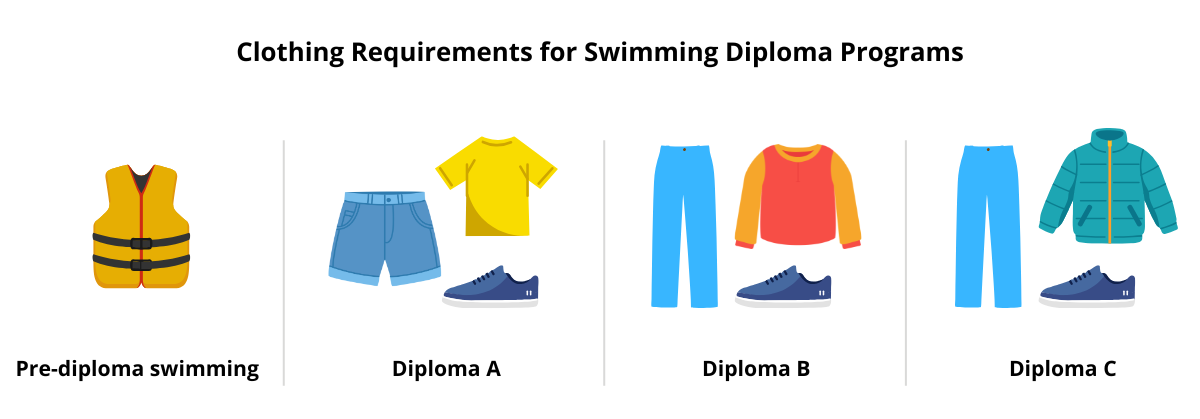
The point is not just to be comfortable in water; it’s to be able to survive falling into a canal fully dressed.
Then there are the things that surprised me that nobody warns you about ahead of time:
- No goggles. The children swim the entire program (every lesson and test) without them. At first, I thought this was an oversight, or maybe just the policy of our particular swim school. It is not. It is very much intentional. The Dutch want children to be able to swim in real-world conditions, and in real-world conditions, you will not have goggles handy when you fall into a canal.
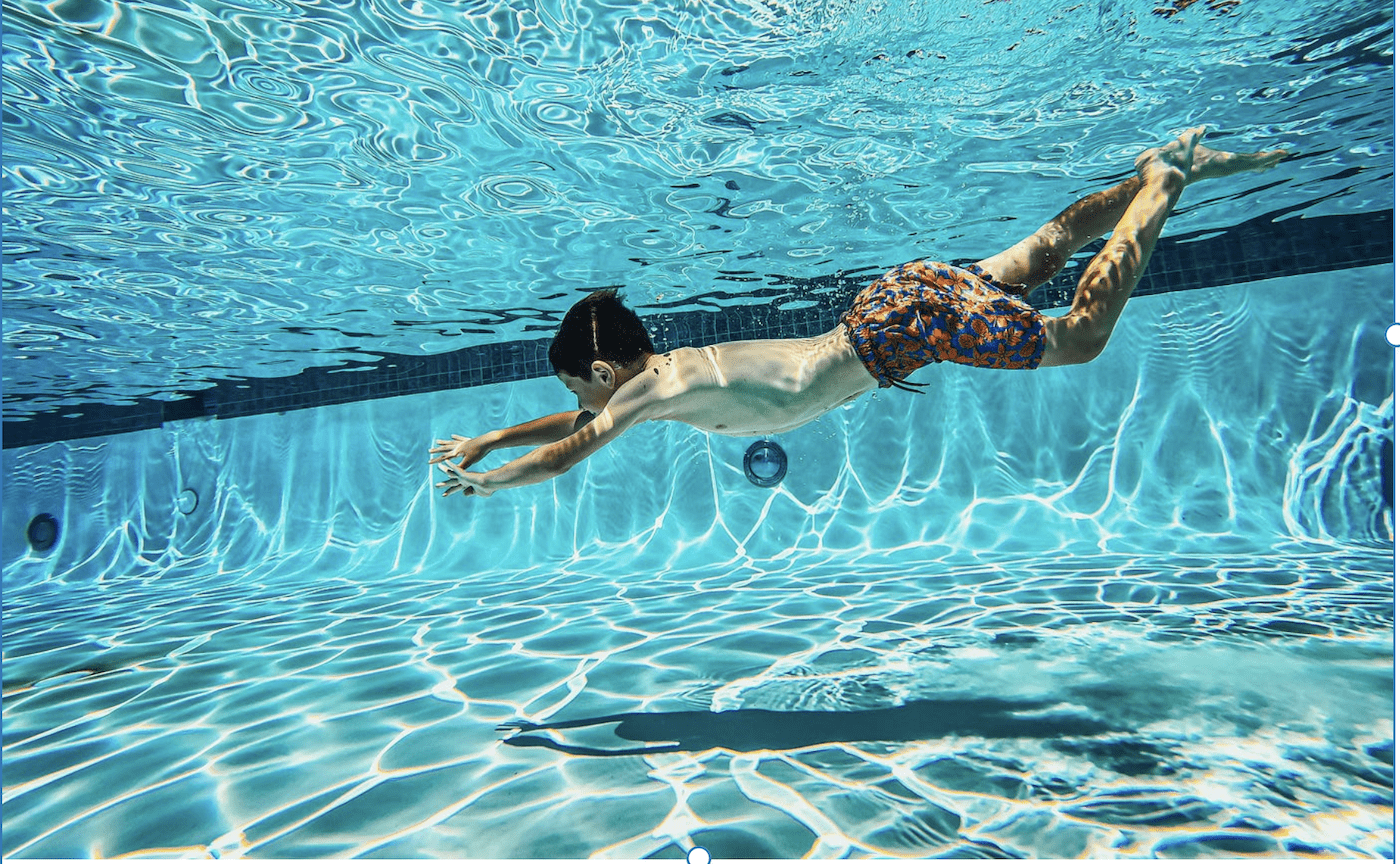
- The underwater hole. In Diploma A, the children are required to swim through a large submerged hoop — eyes open, underwater, with no goggles. I watched my child do this for the first time and felt a mix of admiration and mild shock. She was completely unfazed. Good thing too because in Diploma B and C, the hoop gets deeper and further away.
Watching a small child in soaking wet clothes churn through 100 meters of a swimming pool is both slightly absurd and genuinely impressive. My kid was proud she could do it, and I was proud of her.
So yes, swim school in the Netherlands is a rare beast. The waiting lists are long, and the expectations are high. But it is one of those Dutch systems that, once you understand the reasoning behind it, makes complete sense.
But the price does not.
It’s still a racket. But it is a racket that works.
–––––––––––
Read more about the Netherlands here in Dispatches’ archives.

Lane Henry is an accidental long-term expat. She is an American who came to the Netherlands for two years—or so she thought. She has now lived in the Netherlands and explored Europe for over a decade.