
Everyone knows it – moving abroad with your family is complicated. And what if your family includes a little furry friend on four legs? Charlie the dog or Leo the cat are just like your kids – you can’t leave without them!
If the thought of their trip gives you cold sweats, read on. Documents, plane tickets, travel preparations this 3-point guide covers the essentials you need to know about moving to the European Union with pets.
Gather the necessary documents
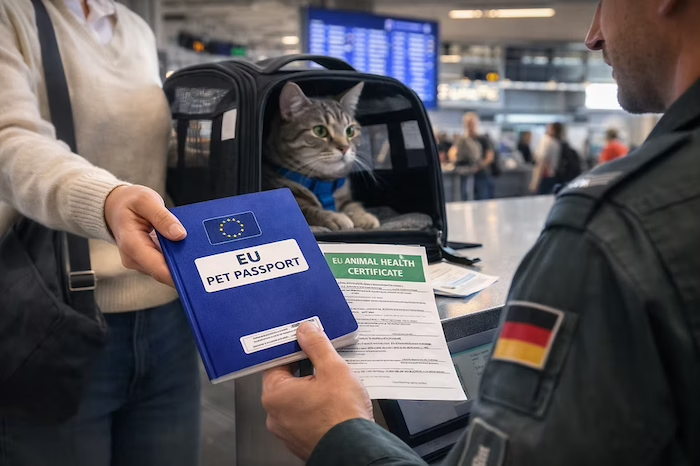
Bringing pets into a specific geographic area requires compliance with a number of rules. Fortunately, the regulatory requirements for traveling with cats, dogs (and ferrets!) to a European Union country are the same for all countries – simply because these three species are the main pets capable of transmitting rabies.
However, the rules for bringing other animals (birds, fish, etc.) into the EU vary from country to country. For these animals, you will need to check the regulations in effect in your destination country.
Generally speaking, your dog or cat will be allowed to enter the EU if it meets three conditions:
• It must be microchipped ;
• It must be vaccinated against rabies with up-to-date boosters or a first dose administered at least 3 weeks prior; and
• it must have obtained a health certificate issued by a licensed veterinarian in your country no later than 10 days before your trip.
So it’s really not that complicated.
In addition, there are a few other specific requirements, such as:
• If you are traveling with your dog to Finland, Ireland, Malta, Northern Ireland or Norway, you must administer a deworming treatment effective against the Echinococcus multilocularis tapeworm no later than five days before your departure – as this tapeworm has been completely eradicated from these countries;
• Travelers from certain countries must also have their pet undergo a rabies antibody titer test three months before the date of travel – note that Canada, Japan, the UK and the United States, among others, are exempt from this requirement;
• Enter the country through specific border crossing points. This corresponds to the major international airports in each country, so this requirement is easily met.
There is some bad news, however: Certain countries, such as Germany and Denmark, prohibit the entry of certain dog breeds considered dangerous such as pit bulls and Argentine Dogos, while France strictly regulates their entry. Be sure to check these requirements.
One final important detail – you can travel with up to five animals without it being considered a commercial “import.” Beyond that number, commercial regulations will apply.
Book your flight tickets
Unless there are special circumstances, you and your pets will most likely be traveling by plane.
Keep in mind that the travel conditions for your pets depend on the airline – there are no EU-wide rules.
You will therefore need to identify the available options for your pet by contacting the various airlines that fly to your destination.
Generally speaking, your pet’s weight will determine your options:
• Under 8 kg: you can bring your cat or dog into the cabin in an approved crate or bag;
• 8 kg to 75 kg: your pet must travel in the hold as ‘checked baggage,’ so to speak, in a sturdy crate approved for cargo transport;
• Over 75 kg: air cargo will often be required. Your pet will not travel on the same flight as you, but its journey must take place within a maximum of 5 days of yours. You will often need to use a freight forwarder specializing in animal transport, which will book the flight ticket for you.
Tip No. 1: If you have the choice, opt for travel in the cabin.
Flying is scary enough for your cat or dog, and your presence will reassure them. Meanwhile, in the hold – even if the pet compartment is properly climate-controlled and separate from the luggage area – the presence of other animals can be a stressful experience for your furry friend.
Tip No. 2. If you can, travel in business class.
The space allocated in economy class is ridiculously cramped for a human traveler, so imagine with a cat or dog on top of that. Business class is incomparably more comfortable and if you’re lucky, your pet will be pampered and allowed to travel on your lap.
It happened to me!
How do you book a flight ticket for your pet?
Whether your pet travels in the cabin or in the hold, you can book their ticket at the same time as your family’s tickets. If you book online through the airline’s website, the option to bring your pet in the cabin or in the hold is often available after you’ve selected your route and date, and before checkout.
Like any other service, you can also add it later to your ticket reservation, but don’t wait too long! The number of pets allowed on board for each flight is often limited. Once the quota is reached, the service will no longer be available during booking.

Prepare your pet for the trip
Once you’ve gathered all the necessary documents and booked your flight, it’s time to prepare your pet for the journey. To read about other travelers’ experiences and ask specific questions, check out social media – Facebook groups such as Traveling With Your Pets Tips, ExPETriates and others are gold mines for answers and advice from people who have already moved with their pets.
Crate or bag?
In the cabin, a bag is safer, in my opinion. A bag designed for air travel always comes with an internal leash. Whether you’re traveling with a dog or a cat, it’s strongly recommended that you put a harness on your pet before placing it in the bag and attach the harness to the carrier’s internal leash. This helps prevent escapes. If your pet tries to run away, the bag will slow it down as it has to drag it along, increasing your chances of stopping it quickly.
Going through security checkpoints
Upon entering the airport, your cat or dog’s carrier must be screened just like any other piece of luggage. You will then need to decide whether to take your pet out of its carrier or leave it inside and run the carrier through the X-ray scanner. X-rays are obviously not without risk to your pet’s health. The best option is to take your pet with you and go through the human security gate together.
However, here’s the thing: with some animals, there’s a risk they might escape.
Depending on your pet’s temperament, it’s up to you to weigh the pros and cons and decide which option is safest – in the carrier, or out of the carrier?
What if my pet is anxious?
Cats and dogs don’t always enjoy being transported in a carrier, which they may associate with a trip to the vet. To “neutralize” the sight of the carrier, take it out well in advance of the trip so your pet can get used to seeing it in its environment.
Place it in the living room, for example, and put treats inside so your pet associates it with something pleasant. Play games around the carrier, encouraging your pet to go inside so it seems less intimidating.
To sedate, or not to sedate?
You may be wondering if a sedative could help your pet relax during the flight. Please note that medication is not recommended, as the pressurization of the cabin air can cause dangerous respiratory reactions in a sedated animal. However, there are natural relaxants available for cats and dogs that can be given before the trip. Check with a pet store to find out what options are available.
What about bathroom breaks?
Depending on the length of your trip, your pet may go a long time without being able to relieve itself. How should you handle this?
• Take your dog for one last walk before departure so it can stretch his legs and relieve itself.
• There are foldable cat litter boxes available that you can slip into your carry-on luggage (along with a small bag of litter). You can make one last stop at the accessible restrooms (which are often spacious and unoccupied!) in an airport lounge.
For both cats and dogs, it’s a good idea to place several terry cloth towels – or even adult diapers – at the bottom of their carrier in case of an ‘accident’, and to keep spares in your bag if needed. That said, the issue of peeing is less of a problem than you might think, because animals often hold it in when they’re in a place where they don’t feel comfortable.
Watch out for motion sickness
Yes, cats and dogs can suffer from motion sickness just like we do. In fact, it’s not that uncommon. If you haven’t yet had the chance to take a long trip with your pet, be prepared for the possibility that it might get sick during the journey. Make sure it eats its last meal several hours before leaving home, so that digestion is well underway. And if your pet is prone to motion sickness, consider asking your veterinarian for preventive medication before you leave.
Have a safe trip – and relax! If you’re calm, your pets will sense it, and that will help them.
––––––––––
Read more about pets and travel here in Dispatches’ archives.
See more from Gaëlle here.

Gaëlle Anne Fouéré
Gaëlle Anne Fouéré holds a Master's degree in journalism and has contributed to major outlets including Le Monde and the BBC website. Gaëlle later joined the United Nations system, where she worked with several agencies (WHO, UN Women, and peacekeeping missions), mainly producing both online and offline publications.