

(Editor’s note: This post on PWC’s Baltic CEO Survey is courtesy of London-based PricewaterhouseCoopers. Dispatches covers tech and global business because so many of our highly skilled internationals are founders and managers. Dispatches receives no remuneration for this post.)
PwC has conducted its 14th survey of company leaders in Lithuania, Latvia and Estonia, revealing strong business optimism across the Baltic States, but also significantly higher levels of concern among regional leaders regarding geopolitical and cyber threats compared with their counterparts in Central and Eastern Europe (CEE). The survey also highlights concerns about the insufficient pace of business transformation, relatively limited returns from artificial intelligence (AI) integration to date, and signals shifting dynamics in the labour market.
This research follows the same methodology PwC uses in CEE and globally, enabling direct comparison. In some cases, the data reveals a notable gap between Baltic businesses and those elsewhere, encouraging a more critical view of progress and preparedness for future challenges.
This year, 280 company leaders from Lithuania, Latvia and Estonia participated. Data was collected between 17 November 2025 and 29 January 2026. The report covers economic and business growth, business risks, AI, workforce and the business environment.

High optimism reflect leaders’ resilience?
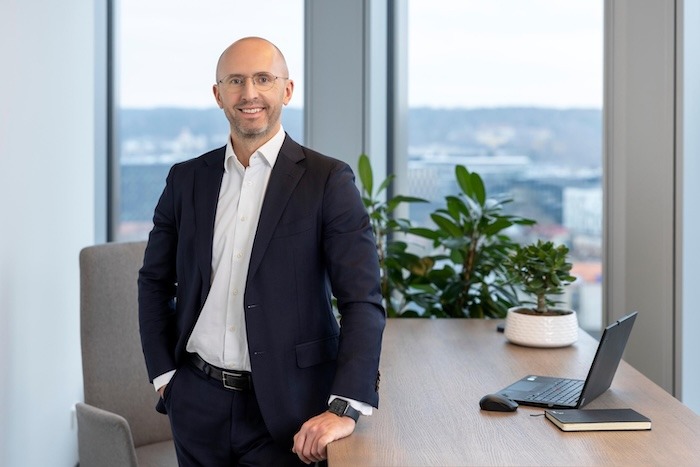
CEOs in the Baltic States are highly optimistic about revenue growth. Lithuania stands out, with as many as 64 percent of leaders expecting growth. Estonian leaders are the most cautious, with only 44 percent anticipating growth, while in Latvia every second CEO expects an increase.
Compared to last year, optimism has risen notably in Lithuania and Latvia (by 10 and 5 percentage points respectively), while remaining stable in Estonia.
“Our region’s optimism is quite exceptional. By comparison, only 42 percent of CEOs in CEE expect revenue growth this year. However, given that economic forecasts for Lithuania and the Baltic States remain relatively modest, there appears to be limited objective justification for such strong optimism – though it may also reflect leaders’ resilience and a deliberate choice to remain positive” said Nerijus Nedzinskas, Managing Partner at PwC Lithuania.
Heightened concern over geopolitics and cyber threats
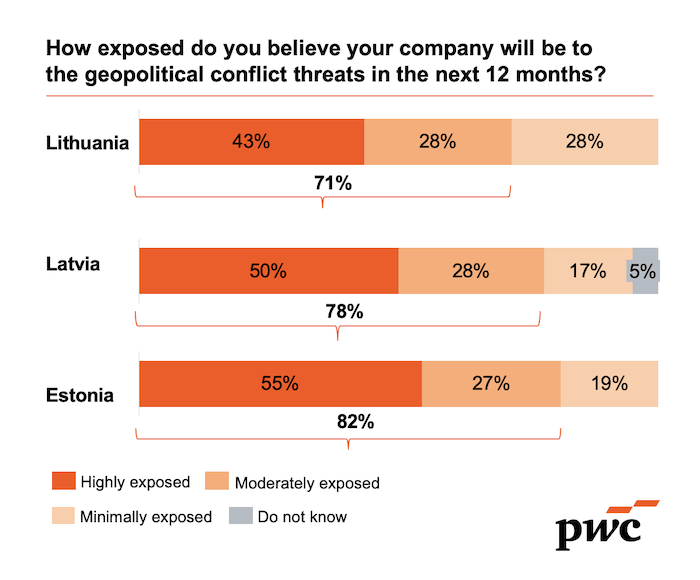
Baltic business leaders agree that geopolitical conflicts will remain one of the most significant threats. 82 percent of Estonian, 78 percent of Latvian and 71 percent of Lithuanian CEOs expect to face such risks this year, with potential financial impact.
Bn contrast, only 39 percent of CEE leaders express similar concern. In that region, geopolitical risks rank only fifth among top threats. “This contrast suggests that Baltic businesses cannot rely on others as a benchmark when diversifying risks. Leadership in decision-making and adapting to geopolitical realities must come from within,” added Nedzinskas.

Cybersecurity is also viewed as a major threat globally, but Baltic leaders perceive it far more seriously. While only 23 percent of CEE CEOs see cyberattacks as highly likely to cause financial losses, the figure is much higher in the Baltics: 67 percent in Lithuania, 75 percent in Latvia and 78 pervcent in Estonia.
Business transformation lacking momentum
In 2026, Baltic CEOs are most concerned about rapid technological change (especially AI), geopolitical uncertainty, workforce cost management and long-term viability.
The greatest concern across all countries is the insufficient pace of business transformation needed to keep up with technological change.
This concern is strongest in Lithuania, where roughly one in five CEOs highlights it.
AI not yet delivering business impact
AI adoption varies depending on business activity and feasibility of integration. In Lithuania, AI is most commonly used for demand generation (e.g. sales, marketing, customer service) (55 percent), internal support functions (e.g. finance, legal, HR, tax) (53 percent) and direction setting (e.g. strategy, annual planning, corporate review) (44 percent), and least for demand fulfilment (e.g. supply chain, manufacturing, logistics) (74 percent) and product or service development (63percent). Latvia shows similar trends.
Estonia differs, with companies using AI more strategically to enhance customer experience and operational decision-making, strengthening long-term competitiveness: demand fulfilment (e.g. supply chain, manufacturing, logistics) 41 percent. Despite growing adoption, AI’s impact on revenue remains limited. Seventy percent of Lithuanian CEOs say AI has not significantly affected revenue, compared with 75 percent in Latvia and 85 percent in Estonia.
Globally, this figure is 56 percent.
This suggests the Baltic region is still at an early stage of AI integration. Although many companies have AI strategies, restricted access to internal data may be limiting returns. AI may ultimately become a basic requirement rather than a competitive advantage. In Lithuania, 74 percent of CEOs say access of AI tools to company data is restricted, compared with 64 percent in Latvia and 63 percent in Estonia.
Shifting dynamics in the labour market
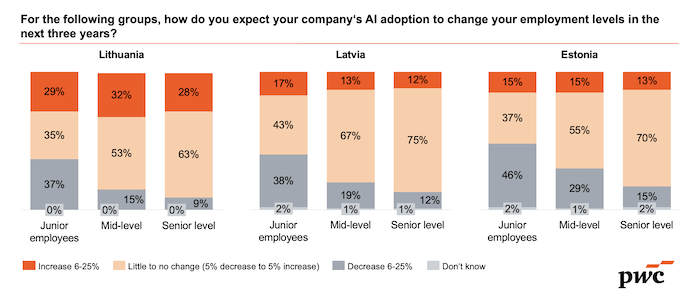
Most Baltic CEOs expect workforce numbers to remain unchanged this year (58% in Lithuania, 66% in Latvia, 56% in Estonia). However, longer-term trends suggest reduced demand for junior roles due to AI. Over the next three years, 37 percent of Lithuanian, 38 percent of Latvian and 46 [ercenmt of Estonian CEOs expect a 6–25 percent reduction in such roles. Senior roles are expected to be least affected.
“These trends should alert both young professionals and policymakers. Education systems must adapt to changing labour market needs. For businesses, this may ease pressure from rising wages and talent shortages as the balance of power in the labour market is shifting,” said Nedzinskas.
You can read PwC’s 2026 Global CEO Survey here.

PwC Advisory
PwC is an internationalassurance and tax advisory firm headquartered in New York. PwC is one of the world’s largest networks of audit, tax and consulting firms, operating in 136 countries.