
Sensationalist headlines and alarmist social media posts have created an impression of London as a dangerous, violent city. But is that the reality of life in London? Are the crime rates as high as people think? We asked Dr. Krisztian Posch, lecturer in security and crime science at University College London and got the perspectives of people who live in the British capital.
For context, Dr Posch noted that crime can be measured in several different ways and police recorded crime is a better reflection of the situation than victims’ surveys. In particular, he says that police recorded crime figures tend to be more precise and easier to geolocate, so these are the figures he is referring to with his analysis.
“Violent crime is down in London, with an especially stark drop in homicides, which were the lowest since records began in 2003 [according to] analysis released by the Mayors’ Office for Policing and Crime (MOPAC) in October 2025 that considered hospital data alongside police recorded crime data,” says Dr Posch.
The analysis found that overall crime has fallen by almost 60 percent since 2003.

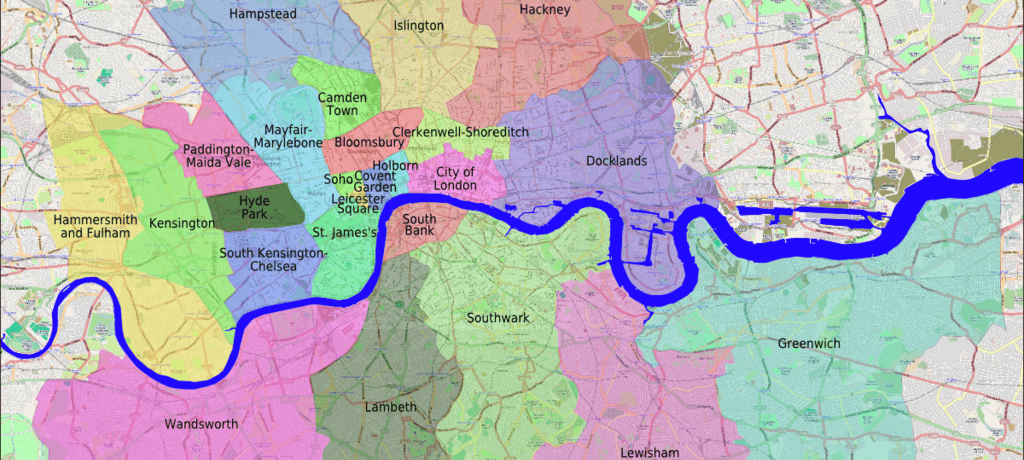
Image source Wikimedia Commons.
Breaking violent crime down by borough
Dr Posch says that a September 2025 MOPAC report found there was a considerable fall in violent crime in that past year. The report found that violent crime leading to injury fell in all 32 boroughs in the 12-month period it covered, with Camden, Enfield, Havering, Enfield, Southwark and Tower Hamlets recording some of the most significant reductions.
According to his research, Dr Posch says that to determine which London boroughs are the safest, it is worth considering the lowest rates of violence per 1,000 residents. Using this metric, Dr Posch says the least dangerous boroughs in 2025 were Richmond Upon Thames (3.88/1,000), Barnet (4.65/1,000), Harrow (4.69/1,000), Kingston Upon Thames (4.83/1,000), and Merton (5.21/1,000), while the most dangerous for the same period are Westminster (11.94/1,000), Camden (9.25/1,000), Greenwich (9.1/1,000), Lambeth (9/1,000), Hammersmith and Fulham (8.96/1,000). The London average is 7.13 per 1,000.
There has been an increase in the number of violent crimes captured by police from 2015 onwards. But Dr Posch points out that a June 2024 Office for National Statistics report highlighted that this is largely due to improved recording practices, which have had a “substantial impact” on violent crime recording over the past decade.
“In other words, a significant proportion of ‘additional’ violent crimes were due to changes and improvement to police records and not due to an actual violent crime wave,” Dr Posch explains. “However, as these changes are baked in, the recent drops in violent crimes are genuine.”
Regarding violent crime against the person, Dr Posch says that across all three categories – violent crime against the person into three categories: violence without injury, violence with injury, and homicides – all these crimes are happening “with increasing rarity in each category.”
There have been some shifts in how each of [these crimes] are recorded, but to give a sense of the difference, for violence without injury the number is around 130,000 to 140,000 each year, violence with injury is 50,000 to 60,000, while homicide is around 80, depending on the year, says Dr Posch.
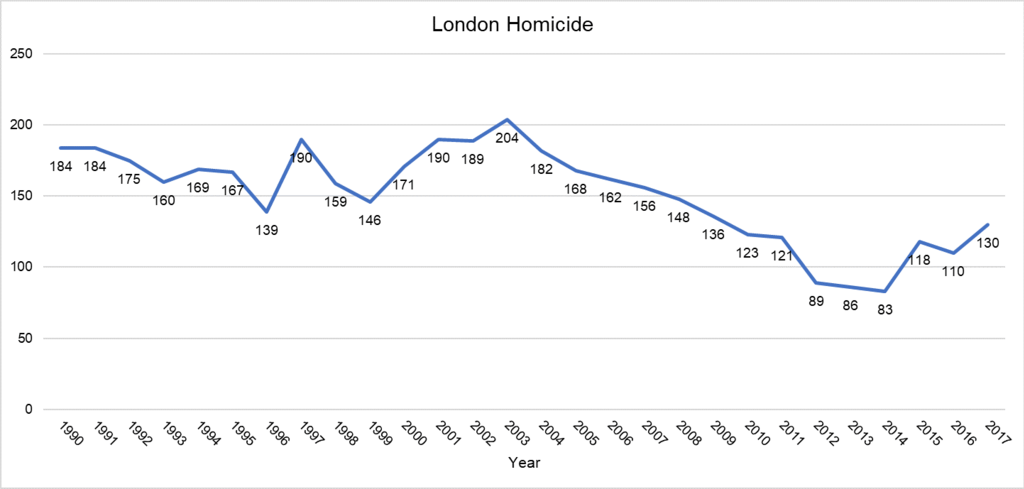
Image source Wikimedia Commons.
Mobile phone theft and burglary
Mobile phone theft peaked at 115,261 incidents in 2023, recorded phone thefts fell to 81,365 in 2024 and further dropped to 71,391 in 2025. Dr Posch says this downward trend is impossible to compare with other major cities, “as they don’t tend to have a separate category for phone theft, only a general one for ‘theft’. ”
Similarly, burglary rates have declined substantially.
Over the past decade, London experienced a decrease of around 20 percent in burglaries. Dr Posch says this sustained reduction is supported by the Crime Survey and official police records, though reporting changes make police data slightly more complex to analyse. Overall, the data indicates a positive trajectory in reducing personal robberies and residential crimes.
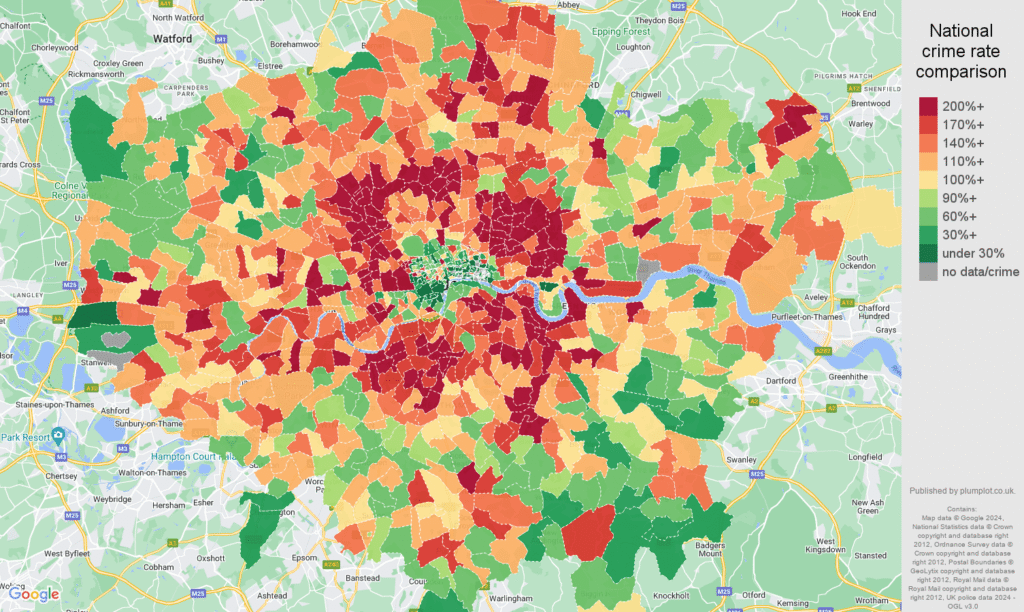
Read more about London burglary crime statistics by Plumplot here.
Reality versus perception
“There is certainly a disconnect, especially in international comparison,” says Dr Posch on the question of whether reality matches up to people’s perception of crime in London. “London is one of the safest cities of its size, much safer than all major metropolitan areas in the US, but even safer than Paris or Berlin when it comes to violent crime.
“This is not to say that when it comes to certain crime types London does not have a problem, but these crimes tend to be of non-violent nature.”
Real Londoners speak out on safety in the city
Alan, Blackheath: “I moved to London in 1973 and I lived in New Cross, Forest Hill, Brixton and Lewisham, before bringing up three children in Blackheath. I was pickpocketed once on a tube station escalator. The wallet contained nothing but a diary, which was left on a train. The finder called and brought it to my office. My house in Lewisham was burgled three times in a few months. The burglars waited until I’d replaced the VCR, portable TV and stereo before nicking them again. Our garage in Blackheath was broken into about 25 years ago and some tools were stolen. Touch wood, we’ve been OK for the past 25 years. No burglaries, robberies, pickpockets or street violence. I have a bike and it’s never been stolen.”
Kate, Fulham: “I’ve never felt actively unsafe in the 36 years I’ve lived here, though I am very careful about not getting my phone out if I’m in town.”
Tim, Croydon: “I do worry sometimes, but I worry about a lot of stuff. I take the precautions anyone would in any big city – keep doors shut, don’t wear lots of bling, steer clear of aggressive people – and in terms of global cities I’ve visited, I reckon I’m safer than I would be in New York, Hong Kong or Paris, maybe a bit less so in Tokyo or Singapore.”
Max, ex-Stanmore: “I now live just outside London, but have lived and worked in the city for 50 years and still spend plenty of time there. It’s certainly no less safe than it ever was – and in many respects, it’s safer.”
Katharine, Hackney: “I feel very safe most of the time, but I’m careful using my phone on the bus and street because I’m aware that snatchings are common.”
Vicky, Tottenham: “I’m not really worried, mainly because I don’t get as drunk as I did when I was in my 20s and I take fewer risks. I live in a part of London where there are always people around and I can always duck into a shop if I feel unsafe, even in the early hours. The only precaution I really take is to turn my music down if I’m walking from the station and someone is nearby. In my 49 years, we have been burgled once and I was once the victim of an attempted mugging and that was in far leafier parts of the city than where I now live. I certainly feel safer here than I do in New York.”
Daniel, North London: “I feel completely safe. Don’t wave your phone in the air, use two different kinds of lock on your bike and remind yourself that statistically London is safer than any US city and almost all other cities in Europe.”
Niki, Sutton: “There’s always been crime, it’s just plastered all over social media and the news in an attempt to make our lives even more miserable than they are. I don’t feel safe waving my phone around in some areas these days, but that’s commonsense. I’m more cautious about walking through dark streets than I was, but I’m not 19 anymore and can no longer bash my assailant and leg it like I used to. I’m not ignoring the fact that more people help than hinder and I will not live in fear.”
Beth, Blackheath: I lived in Rio de Janeiro for nearly five years, which is a properly dangerous city. You can’t wear valuables out and I was robbed at gunpoint on various occasions. As a teenager in London, there were some areas considered no-go, but there’s almost nowhere I wouldn’t walk at night now. I’m a bit cautious about having my phone in my hand in some places, but I’m a bit perplexed by this narrative that London is dangerous, especially when stats show definitively that violent crime has gone down. I wouldn’t want to belittle the issue of knife crime, but people should be wary of certain people pushing an agenda.”
Radhika, Lambeth: “I probably take more precautions than if we lived in the middle of nowhere, but on the other hand, I feel that my partner and I – we are both mixed race – are safer on the streets here than we would be in a lot of areas outside London. Crime isn’t just about phone snatching.”
Lucie, Southwark: “I don’t worry at all, no more than I do anywhere else, but I am a woman, so I’m used to being aware of my own safety. I know there’s more chance of phone-snatching these days due to gangs, so I try not to have my phone out. I’m sick of Americans and right-wingers talking down London. It’s a fantastic place to live. They’re just jealous of our culture and diversity.”
Perveen, West London: “I don’t want to jinx myself, but I’ve always felt safe and have lived in my West London neighbourhood for over 25 years. I know there is a lot of racism being peddled by some political leaders right now, but as a person of colour, I still feel relatively safe.”
Hilary, Tower Hamlets: “I hate to tempt fate, but I have lived in London for almost 54 years and I’ve always felt pretty safe. I’ve only been the victim of crime a couple of times. Once my bag was snatched from under a table in a bar and there have been a few sexual assaults, which can happen anywhere. I walk fast, wear sensible shoes that I can run in at night if I’m going to be walking home alone and I keep my wits about me. But I would do that anywhere.”
Wendy, Isleworth: “I sometimes carry my keys in my hand, but I don’t think London is that dangerous. It can be frightening, but it’s usually drunk people arguing or people asking reasonable things at odd times in odd ways. In terms of transphobic abuse, I’ve only been aware of it outside London. In London, someone once complained to the bar staff about me being in ‘their’ pub, but they were told it wasn’t their pub and they could change the subject or go drink somewhere else. I’m more conscious of potential threats and manage that risk. I don’t know whether it’s age, how I present or that I rarely drink to excess, or a combination that keeps me safe.”
Isabel, Bethnal Green: “It makes me furious that this narrative about London being dangerous is allowed to flourish and become politicised in the UK and abroad. I’ve lived in this city on and off and right across it since 1980. As a woman, I’ve been out at night in Dalston and Shoreditch and walked home in the early hours to Bethnal Green and never felt unsafe. My friends and I have all done this throughout the decades. While I wouldn’t want to tempt fate or take my own good fortune for granted, it does say something that over such a long period of time, the worst things that have ever happened to me as a woman living in London had nothing to do with the city. They happened online.”
Michelle, North Finchley: “Personally, I feel violated by the relentless levels of anti-Semitic criminal damage, almost weekly. Too many Londoners are astonishingly sanguine about it all. I don’t particularly want to see anti-Semitic slogans on Jewish businesses all over my high street week after week, nor does it make me feel safe.”
Louise, Rotherhithe: “I’ve lived here for 16 years and feel pretty safe. I run alone in the dark without feeling anxious and cycle all over the place at night. In summer, I leave my front door unlocked and open during the day, but lock it at bedtime. I’ve been the victim of several bike thefts, although one was returned two years later by the police, albeit in a sorry state. I once called a guy on the tube a wanker and he grabbed me by the neck. The police were amazing and I was cautious about tube travel for a while, but it doesn’t actually keep you any safer to be anxious and catastrophising all the time. I joined a neighbourhood social platform, but I hated it and left quickly because it was so anxious and fear-mongering. All the curtain-twitching and hand-wringing about ‘kids on bikes’ didn’t reflect the London I see or feel I live in.”
John, Wandsworth: “I had four motorbikes stolen in an eight-year period that ended six years ago. The police at the time seemed to be pretty effective. I feel safe here. Interestingly, a female friend who lives outside of London says she feels safer here than in quiet rural locations.”
**********
Read more about London here on Dispatches.

Georgia Lewis
Georgia Lewis is an Australian expat who spent five years living in the United Arab Emirates before moving to London in 2011. She is a freelance writer and editor. When she's not writing or editing, she loves cooking, trying new restaurants, going to the theatre and travelling. Her favourite destinations are the Greek islands, Mallorca, Oman and Vietnam.