
(Editor’s note: This edition of the Eindhoven Business Briefing is part of our Tech Tuesday series. Dispatches covers tech because so many of our highly skilled internationals are founders and entrepreneurs.)
It seems like every tech center in Europe has at one time or another claimed to be the “Silicon Valley” of Europe, including Stockholm, Berlin, Paris and yes, even Eindhoven. All nonsense – till now.
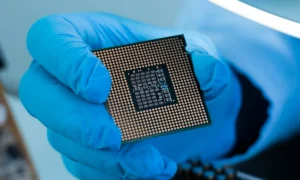
Eindhoven-based data center hardware startup Euclyd has a group of founders and investors that includes legends in the semiconductor world. Euclyd has developed an AI inference accelerator card, a specialized hardware component designed to speed up AI tasks. But their secret sauce is, their package uses less energy while outperforming the competition. Like, by a lot.
The team includes:
• Federico Faggin, who has a CV that includes time at Fairchild Semiconductor, which transformed Silicon Valley into Silicon Valley.
• Peter Wennink is the former CEO of ASML. During Wennink’s leadership, ASML went from a struggling Philips spinoff to the deepest of deep-tech companies … a global giant with a virtual monopoly on the technology that lets chipmakers such as TSMC make advanced chips.
• Bernardo Kastrup is the former director of Product Strategy at ASML.
• Dutch entrepreneur Steven Schuurman founded Elastic, a data search and analytics company that launched on the public equity markets in 2018. Schuurman also founded Atlantis Entertainment with Extreme guitarist Nuno Bettencourt. So, this is a Renaissance Man. One worth an estimated $1.5 billion.
Based in HTC 84 at High Tech Campus Eindhoven, Euclyd is a moon-shot project, building everything from scratch without using ARM or other architecture.
Kastrup told TechRadar that Euclyd’s philosophy “reimagines inference from the ground up, custom processors, custom memory and advanced packaging. We’ve engineered every gate for maximum efficiency and minimal power draw, by far the lowest in the industry.”
The performance is off the charts, generating 7.68 million tokens (the bits of text AI needs to analyze, then use to generate content) per second, with far lower power consumption. By comparison, Microsoft’s Azure system uses NVIDIA GB300 NVL72 racks reaching 1.1 million tokens per second.
Arjan Egelmeers, the tech journalist and technologist at MediaProc, writes:
Nvidia is currently the most powerful chip company on the planet. Yet in Eindhoven there is a team openly saying: this can be smarter, cheaper and fairer. That team is called Euclyd. What triggers me about Euclyd: they are building AI hardware that revolves around one thing: generating as many tokens per second as possible with as little energy as possible.
In the old days, rock stars would form super groups such as Blind Faith with Eric Clapton. Those efforts were, for many reasons, less than the sum of their parts. But with Euclyd, which has operations in San Jose, you have people not just with track records, but with access to capital.
We stole this from a recent Washington Post article, but it’s so relevant in late 2025:
In an era where competitiveness is measured by how quickly a country can build, produce and deploy technology, a coalition of investors, founders and public leaders will shape economic power and national security.
We like their odds.

Report: ‘Regional economy is strong but increasingly dependent on ASML’
Building an economy on one industry is not a great strategy. Ask Gary, Indiana, which used to be the steel capital of the world. Used to be ….
Brainport Development just issued a new report on Eindhoven’s competitiveness and found that one company controls our fate: ASML. That report asks and answers this question: What happens if ASML tanks?
The answer is, there are enough strong companies this won’t be a replay of 1988, when Philips moved its HQ to Amsterdam and took the best jobs with it.
The high-tech industry as a whole represents about 46 percent of the region’s economic value: 24.7 billion euros out of the 53.8 billion euro total, according to the report summary on Studio 040. Half of this 25 billion is ASML, which adds 22 percent of the region’s value … a little under 12 billion euros.
The other major companies – DAF, NXP, Philips, Signify, VDL and Thermo Fisher – together contribute 17 percent to the Brainport economy, or about 9.3 billion euros The companies in their supply chains contribute another 5.5 billion euros.
Of the 19 percent of the population employed by high tech, about 7 percent are at ASML.
The majority of the working population – approximately 41 percent – works in other sectors such as education and services.
The high-tech industry is forecast to grow from to 30 to 40 percent from 22 percent currently. The contribution of chip machines to employment will then increase from 7 percent to 10 percent, with ASML hiring an estimated 20,000 people over the next decade.

MedTech/BioTech sector is the next growth engine
High Tech Campus Eindhoven just posted the first part of a detailed – a very detailed – look at a crucial business sector, MedTech/BioTech. With AI and other innovations, Medtech will become a significant contributor to Brainport in patents, jobs and revenue. Think personalized medicine, less invasive diagnostics and data-driven care. Emerging technologies include regenerative biomaterials, robotic surgery, wearable patient monitoring and AI-assisted diagnostics.
Major points include:
• Building on foundations laid by Philips and Thermo Fisher Scientific, the Brainport region hosts more than 350 MedTech companies, produces 90 percent of Dutch MedTech patents and accounts for nearly half of the Netherlands life sciences output.
• HTC hosts a thriving MedTech and BioTech cluster that grew from Philips and now includes more than 70 organizations, including some major players such as Salvia BioElectronics, which is developing an implantable device to treat migraines, as well as AIKON Health, Bambi Medical, STENTiT and VIVOLTA.
• This emergence is fueled by all the usual suspects, including Eindhoven Technical University and R&D institutions such as TNO, imec and Holst Centre.
The increasing importance of the sector is changing the campus itself, with more specialized, dedicated facilities and labs, as well as innovation hubs, with the goal of catalyzing individual companies into a cohesive ecosystem. These purpose-built spaces include GMP-compliant cleanrooms for biomaterial production to AI innovation centers and biotech labs.
You can see the full introductory post here on HTCE’s website. We’ll have more as they post more.
inPhocal jobs
Speaking of jobs of the future, inPhocal is hiring. The High Tech Campus-based company uses proprietary optical laser technology to do everything from marking cans to slicing and dicing silicon wafers into computer chips.
From their LinkedIn post:
We’re #hiring! We have 4 new positions available. The fourth vacancy is for a Medior Embedded Software Engineer. Right now we are rolling out our new systems. So do you want to be responsible for #software that drives the world’s #fastest #lasermarking systems then this might be the job for you! https://lnkd.in/eTYx-ADz
inPhocal is a fast growing company with big ambitions. If you want to be part of our #team and contribute to the success of our company then check out our 4 vacancies!
•Senior Field Service Engineer: https://lnkd.in/etnWjrew
•Senior Sales Account Manager: https://lnkd.in/e88RDRx9
•Medior Sales Account Manager: https://lnkd.in/eK_G2va7
• 20251103 Software engineer medior

Co-CEO of Dispatches Europe. A former military reporter, I'm a serial expat who has lived in France, Turkey, Germany and the Netherlands.