
I stared up at her, and she looked down on me. We spoke, but neither of us could make the other understand. Hand gestures were employed, and sentences slowed to a crawl, but we still got nowhere. This scenario was repeated numerous times as I chased up and down my neighbourhood, knocking on doors to earn some hard cash for Bob-a-Job week, an annual fundraising effort in which Cub Scouts did small chores for people in England during the ’70s. But my pleas to wash cars or weed gardens fell on deaf ears, as many homeowners couldn’t speak English.
I spent my formative years in a part of London with a growing immigrant population, and it used to puzzle me why so many people would come to the United Kingdom and not be able to speak the language. Perhaps they were studying hard or had recently arrived. In my first couple of years in Spain, I found myself in the same boat as my erstwhile neighbours, a foreigner in a different land with a limited grasp of the native language.
I was determined to, if not master Spanish, reach a level of fluency that would let me hold my own in conversations, visit the bank without a translator, and make everyday interactions effortless.
Leaving the expat bubble
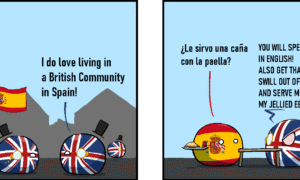
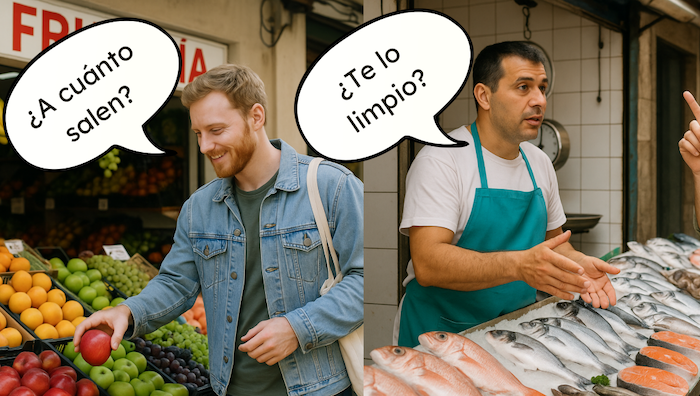
In many parts of Spain, particularly on the Mediterranean coastline, English-speaking expats can get by without uttering a word of Spanish. Some locals, especially those working in bars and shops, have a reasonable grasp of our language; translators for official/medical visits are plentiful, and there is a vast supportive expat community.
However, I think those who choose this route are missing out on a lot. My life has been made much richer by being able to communicate with locals on their terms and by fully immersing myself in the culture and rhythm of Spanish life. But getting here has not smooth sailing. Learning Spanish did not come easy, and my journey was marked by howlers too numerous to mention. More of those later.
When I first arrived here, I enrolled in a week-long language crash course. My brain crashed on Day Three. Direct and indirect pronouns had done for me. My little grey cells pulled up the drawbridge and wouldn’t let any more information through. Fortunately, I recovered in time to join a small weekly class. We role-played scenarios such as visiting a bank and supermarkets, using faltering phrases and dodgy accents. We made loads of mistakes, but it was fun and a great way to learn real-world interactions. After a few months, I decided to accelerate my learning and opted for one-to-one lessons.
My tutor was patient and incredibly encouraging, and I was most inspired by his suggestion to find a Spanish girlfriend to improve my proficiency.
Being the good, attentive student, I willingly applied myself to this task. And while I waited for Cupid to draw back his bow and fire, I hit the less appealing but essential books and homework with vigour. I also became an avid listener and viewer of Spanish TV and radio to get used to intonation and pick up new vocabulary.
Howlers
However, inevitably, practice led to pitfalls. My first classic blunder occurred during a local Christmas safety campaign, when police randomly stopped drivers for breath tests. The officer asked if I had been drinking, and I replied I had a drink with my meal four years ago (hace cuatro años) when I meant four hours ago (hace cuatro horas).
I had also joined a local Spanish dart team, both to integrate and because I used to be handy with a set of arrows. One evening, only one of the opposition’s players had turned up. I walked over and asked him where all his pensioners (jubilados) were, instead of saying “players” (jugadores).
At another match, after losing my game, I turned to my team and wanted to say how embarrassed I was (avergonzado). Instead, I announced I was pregnant (embarazada), which would have been a medical first.
After 17 years in Spain, I’m reasonably fluent and spend more time speaking Spanish than English.
One of the reasons for that is that Cupid’s arrow eventually found its mark, and I fell in love with a Spanish woman who is now my fiancée.
I still make occasional mistakes and am trying to improve my pronunciation to sound more like a native. That may be impossible as I appear genetically incapable of rolling my Rs. Nonetheless, chipping away at the language barrier, word by word, has been worthwhile and has helped make Spain feel like home.
••••••••••
Read more about Spain here in Dispatches’ archives.

Paul Arnold
Paul Arnold is a former BBC producer who worked on science, news and magazine programmes, traveling the world to interview Nobel Prize winners, politicians and celebrities. After 16 years, he left the corporation and moved to southern Spain, where he ghostwrites for publications across the USA, Canada and Europe.