
(Editor’s note: This is Pt. 2 in a two-part guide to life in Cairo for expats. You can jump to Pt. 1 here. Dispatches focuses mostly on Europe, but there are no borders for expats.)
Whether it’s your personal choice or a job transfer, you are ready to take the leap – you’re moving to Cairo, Egypt! Cairo is known worldwide for the Pyramids of Giza, the only one of the Seven Wonders of the World still visible today. But as you might expect, living in Egypt is very different from vacationing there. I have been living in Cairo for 10 years, so the city holds (almost) no secrets for me.
Healthcare, transportation and of course food … I will explain everything below. Ahlan wa sahlan felqaheera! (Welcome to Cairo!)
Pets
In general you can bring your pets to Egypt. For dogs and cats, the formalities consist of bringing their vaccination certificate proving that the animal has been vaccinated against rabies within the last year. You will also need to have a certificate of good health issued by a veterinarian less than 10 days before your arrival. There are good veterinary services in most Cairo neighbourhoods and they make house calls too.
Pet sitters are still quite rare, but boarding services such as kennels or pet hotels are growing rapidly. Every time I travel, my cat stays at his favourite “hotel’” where he has an entire air-conditioned room to himself for the equivalent of $7 a day including food.
Healthcare
The standard of healthcare is better than one might imagine. Many Egyptians study medicine abroad and then return to practice or open a private clinic in Cairo, applying the methods they learned abroad.
However, public hospitals should be avoided at all costs. Like public schools, public hospitals are only chosen by those looking for low costs.
Private practice medicine is better than hospital medicine. Many good physicians (general practitioners or specialists) provide care in private practices. But Egypt’s weak point remains nosocomial diseases due to hygiene issues. In other words, you risk entering the hospital with one disease and leaving with another. As a precaution, keep a list of hospitals recommended by the American and British embassies handy.
All medical specialties can be found in Cairo including alternative medicine such as acupuncture and homeopathy.
The almost exclusive method of delivery in Cairo is by C-section. If you are pregnant in Cairo and wish to give birth naturally, it is best to consider returning to your home country for a few months.
What to eat in Cairo
What you eat in Cairo is your choice. You can of course eat local food. But if you prefer to eat like you do at home, many foreign products are available in supermarkets.
If you’re tempted to try Egyptian dishes, here are the most popular ones.
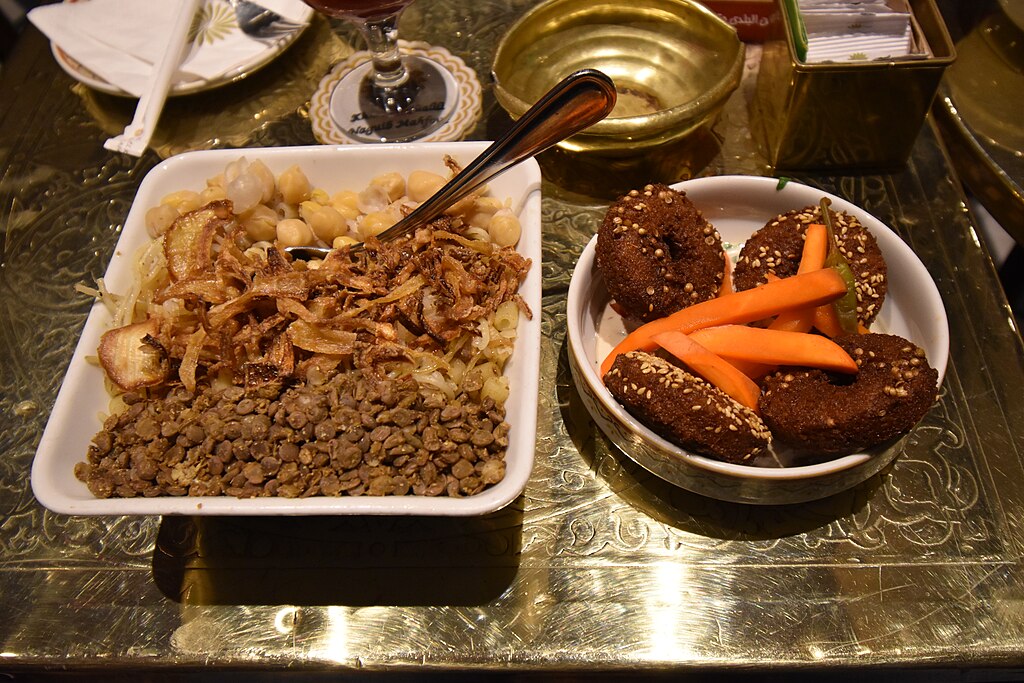
Koshary – This is street food sold in small specialty restaurants. It consists of pasta, rice, lentils, and chickpeas, topped with slices of fried onions and drizzled with tomato sauce, to which you can add either lemon sauce or a very hot chili sauce.
Mahshi – This is a Middle Eastern classic, consisting of vegetables such as zucchini, cabbage, or eggplant, which have been hollowed out, filled with a stuffing made of rice, sometimes meat, and flavored with coriander, then steamed in a pot. A very tasty vegan dish!
Molokheya – Molokheya is a green soup made from a herb that resembles spinach, cooked in a broth in which a whole chicken has been cooked, then a generous amount of garlic is added. The soup is then served with chicken and white rice.
All types of food stores exist in Cairo, from the small grocery store downstairs to the neighbourhood fruit and vegetable market, to medium-sized supermarket chains (Metro, Saudi, Spinneys, Gourmet) to hypermarkets (mainly from the Carrefour group).
Supermarkets are where you will mainly shop if you want to eat like you do at home. If you’re looking for Philadelphia Cheese to make cheesecake, you’ll find it! And if you want to celebrate Thanksgiving, you’ll find whole turkeys! – even though turkey is less commonly eaten than chicken in Egypt.
Food delivery apps are also recommended – Instashop and Talabat, for example, have thousands of listings (all types of shops, supermarkets, restaurants, etc.). They offer late-night delivery, even 24 hours a day.

Things to bring with you
Although there is a wide variety of products available in Egypt, some items are sometimes in short supply. It is therefore recommended that you bring them with you.
Medications – There is currently a real shortage of medications in Cairo. So if you are taking specific treatments for a chronic illness, it is highly recommended that you bring a year’s supply with you. Take them in your luggage on the plane as it is forbidden to import pharmaceutical products into Egypt.
Do not send them by freight (air or other).
Electronic devices can be very expensive in Egypt so if you need to replace your laptop or cell phone, do so before you come. Please note that only one cell phone per person is allowed (see above) and it must be registered upon arrival.
Organic cosmetics and makeup. Ladies, if you use organic cosmetics and makeup, it is best to bring them with you. A few Egyptian brands of “natural” products (Black Lotus, Areej, Nefertari) have developed in recent years but they mainly offer shampoos and soaps. Organic makeup is still in its infancy.
Climate and weather – It’s HOT HOT HOT!
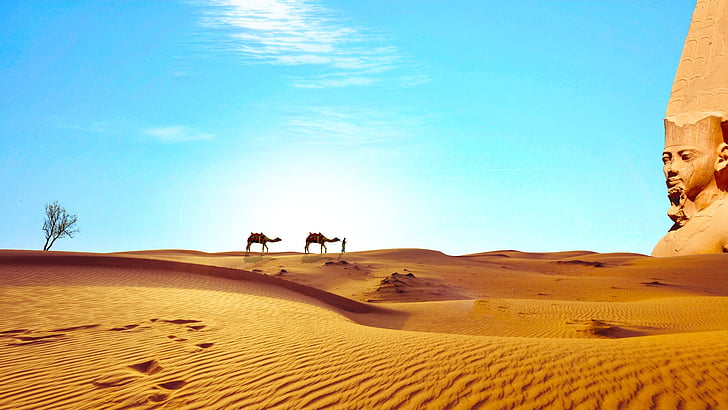
Egypt is located at a desert latitude – to the west lies the vast Sahara Desert which stretches across Algeria and Libya and to the east (across the Red Sea) lies Saudi Arabia, which is also desert. In fact, Egypt itself should be a desert country but it is saved from this fate by the Nile. Thanks to the Nile and its fertile silt, the Valley is very green and allows the cultivation of fruits normally found in a tropical climate – bananas, mangoes, guavas—as well as rice and cotton. Egyptian cotton is renowned for its high quality.
Nevertheless, the climate remains hot and dry. Temperatures are around 18°C in winter and 40°C in summer. There is very little rainfall; you can even go through some winters without seeing a drop of rain. Climate change does not help the situation as you can imagine.
Air and water quality
The Air Quality Index reaches 120 or higher in summer. That’s 30-to-50-percent worse than in many European capitals. Cairo has no urban policy and all recent developments are based on car use. As a result, the air is heavily polluted. The level of fine particles can be eight times higher than WHO recommendations. Indoor air purifiers are available in Egypt. This might be an option to consider.
Water quality is also poor but it is difficult to obtain accurate information on this subject. The installation of water filters in kitchens and bathrooms is becoming increasingly common.
How to dress in Cairo
Most of the time the climate in Cairo is hot and dry so you will want to wear summer clothes. Winter does exist but it is mild. You may need to bring sweaters but you will only wear them for two to three months at most, from mid-December to the end of March at the latest.
Although the population is predominantly Muslim and many women are veiled, Cairo residents are not strictly observant. Women who do not wear veils live without any problems. There are Christian Egyptian women making it common to see women without veils.
Both women and men can wear T-shirts in the street. Knee-length Bermuda shorts are also common but not shorts – although I did see some recently in a café! Miniskirts are not common either but a knee-length skirt is perfectly acceptable.
Safety
The Middle East is an unstable region, so it is easy to imagine, from the outside, that these countries are unsafe. Nothing could be further from the truth. The instability is purely political – the safety of people and property is very high.
I am a woman and have never restricted my movements. I can walk wherever I want on any street in Cairo, come home alone even at 2 a.m., including on the last subway.
There are certainly some very working-class neighbourhoods that are unsafe, but as a foreigner, the risk of you ever finding yourself there is close to zero. Petty crime is very low, so thefts are rare. In a café, I can leave my cell phone and laptop on the table, go to the bathroom, and come back – there’s no risk of them disappearing. Close your bags on the street and avoid traveling by tuk-tuk (see below) – these are pretty much the only safety tips you need to follow. Similarly, burglaries are rare – although they are sometimes reported. Most buildings have a security guard (a bawab) on duty 24 hours a day.
In my opinion this is the best deterrent.

Transport
Cairo is a very large city – 100 kilometers separate Badr City, east of Cairo, from the city of 6 October to the west. You will only live in one part of the city. By car is almost the only option to get around in the new cities. However, in the historic districts of Cairo there are various means of transportation. There are 3 metro lines running throughout the city. There are buses, some of which are air conditioned.
Microbuses run by private companies travel all over the city and cover both short distances within neighbourhoods and long distances from one point to another in the city. You can get on by signalling to the driver from anywhere along the route and get off in the same way, simply by asking the driver.
Tuk-tuks are used to travel short distances within neighbourhoods. Personally, I avoid taking them. Their drivers do not inspire confidence and drive very badly. As they are often as expensive as taxis, you might as well take a real car.
Official taxis are recognisable by their orange license plates. In theory they have meters but they do not always agree to use them. Taxi drivers in Cairo have always been a pain – luckily, there are apps! Uber, Didi, Careem, Indrive. Since they came along, I have given up on taxis. With apps, prices are fixed and drivers are reliable and punctual.
And with all of that information, Welcome to Cairo!
–––––––––––
See more about Egypt here in Dispatches’ archives.

Gaëlle Anne Fouéré
Gaëlle Anne Fouéré holds a Master's degree in journalism and has contributed to major outlets including Le Monde and the BBC website. Gaëlle later joined the United Nations system, where she worked with several agencies (WHO, UN Women, and peacekeeping missions), mainly producing both online and offline publications.