
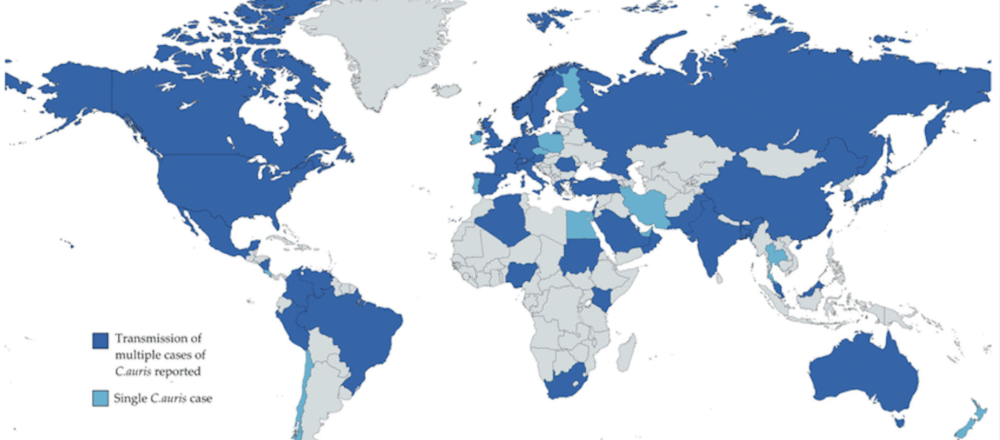
Okay, expats in Europe, we see you all smug and comfortable, living your best lives, enjoying access to the some of the best and most affordable healthcare in the world. Well, here’s a reason to take even better care of yourselves and avoid the hospital – Candidozyma auris, or C. auris.
A new European health survey from the European Centre for Disease Prevention and Control warns that Candidozyma auris – a drug-resistant fungal infection – is spreading rapidly in hospitals across the continent. A recent ECDC bulletin states that Candidozyma auris’s “ability to persist on different surfaces and medical equipment and to spread between patients makes it particularly challenging to control.”
Here’s the scary part – in some European countries, the fungus has become endemic in hospitals, and no one knows just how fast or far this thing is spreading because detection and prevention protocols weren’t yet in place and there was no mandatory reporting. The most enigmatic aspect of the rise of Candidozyma auris as a human pathogen “is that it emerged simultaneously on three continents, with each clade (cluster) being genetically distinct,” the American Society of Microbiology reports.
The fungus among us
Recent outbreaks have been reported in Cyprus, France and Germany, while Greece, Italy, Romania and Spain “have indicated they can no longer distinguish specific outbreaks due to widespread regional or national dissemination,” according to the ECDC.
Here are the details we’ve curated from medical bulletins and media reports about this fungus, the spread of which is attributed to climate change.
• The fungus (actually, a form of yeast) causes only mild infections in healthy people. But, in patients in, say, intensive care units with weakened immune systems, it can be deadly should it enter the bloodstream and vital organs. The fungus causes severe organ infections when it breaches the body’s natural immune defenses. Between 30 percent and 60 percent of patients with Candidozyma auris infections die because most already are in poor health. Treatment is difficult because there are strains resistant to anti-fungal drugs.
• Infections range in severity. Some people may carry the fungus without symptoms, while others develop serious infections such as infections in the blood, brain and spinal cord, bones, abdomen, wounds, ears, respiratory tract and urinary system, according to the UK Health Security Agency.
• Only 17 of 36 participating countries currently have a national surveillance system in place for Candidozyma auris. Only 15 countries in Europe have developed specific national infection prevention and control guidance. That said, 29 countries report having lab access to a mycology reference or expert laboratory and 23 offering reference testing for hospitals.
Staying power
The main reason you want to stay out of hospitals is the insidious nature of this fungus. People can carry C. auris on their skin without ever getting sick. But they can become infected if Candidozyma auris enters their body through a wound or if they have had an invasive medical procedure or require an IV or a catheter.
C. auris has been detected on bedside equipment, radiators, windowsills, sinks and medical equipment such as temperature probes, blood pressure cuffs and stethoscopes, according to the UK Health Security Agency.
At the root of the problem is climate change, with a warming planet expanding the range of such pathogens. Previously, Europe had been protected by what scientists call “a thermal restriction zone.” That is, temperatures were too low here for a fungus such as C. auris to thrive and spread. Now, there is concern that higher ambient temperatures will allow the fungus to become “more thermally tolerant, such that they can breach the mammalian thermal restriction zone,” according to American Association of Microbiology research.
Because C. auris went from unknown to a serious threat in a relatively brief time, public health officials “now have a critical window for early interventions to stop its spread,” according the ECDP. On a personal note, we’ve had otherwise healthy friends and relatives die of infections after successful medical procedures. So this is as serious as it gets.
Is this a COVID-level threat? Probably not. Will the climate deniers call this a hoax? Likely. But I think the thing we can all agree on is that it just goes to show that it’s always something.
––––––––––––
Read more about healthcare here in Dispatches’ archives.

Co-CEO of Dispatches Europe. A former military reporter, I'm a serial expat who has lived in France, Turkey, Germany and the Netherlands.