(Editor’s note: This editionr of the Eindhoven Business Briefing is part of our Tech Tuesday series. Dispatches covers tech across Europe because so many of our highly skilled internationals are researchers and scientists.)
True story … we used to work with an accelerator here in Eindhoven. One day, I suggested that startups should consider DARPA for funding. With its billions, the Defense Advanced Research Projects Agency has funded everything from the Internet to all sorts of advanced research, not just weapons.
You would’ve thought I was suggesting they start raising capital by knocking over nachtwinkels. “We will never cooperate with the military,” was the terse reply.
Then came Russia’s 2022 invasion of Ukraine and personal exoneration.
Now, Munich-based Helsing, which designs and builds advanced killer drones for Ukraine, is now valued at 12 billion euros ($14 billion), one of the most valuable start-ups in Europe, just behind French AI startup Mistral.
Russia has emerged as the single biggest threat to security in Europe at exactly the time the United States has ceased to be an ally. On 4 September, the New York Times broke story that the Trump administration is “phasing out longstanding security assistance programs that provide military support to European nations.”
If that’s true, then it’s likely the U.S. will start closing major military bases in Germany, Italy, Spain, Poland, Norway, Romania, the Balkans and the United Kingdom, leaving Europe with no credible militaries, negligible airlift and aging equipment purchased decades ago from the U.S., such as the 60-year-old F-16 fighter, the 58-year-old C-130 transport aircraft and 53-year-old CH-47 helicopters.
So far, the European response has been fought by think tanks, not actual tanks, mostly centered on proposals such as the European Commission’s ReArm Europe Plan/Readiness 2030 and vague pledges to up NATO spending.
Meanwhile, some EU countries (minus pro-Russia Hungary) are investing heavily in their militaries to prepare for the worst while sending a message to Vladimir Putin: “This isn’t 1938.”
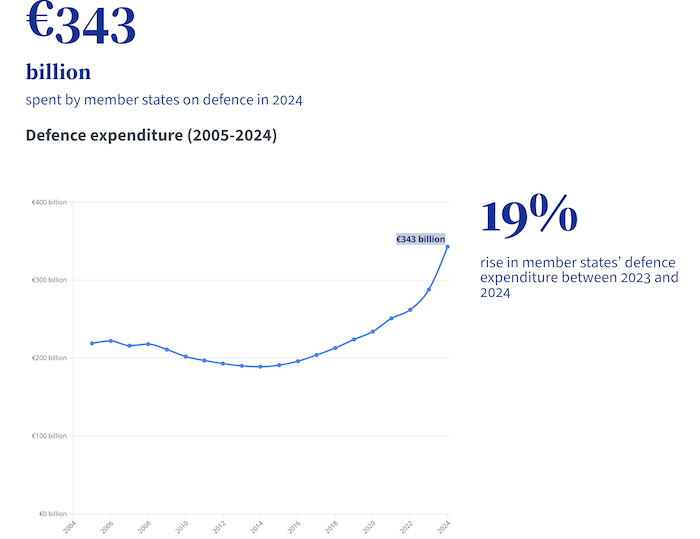
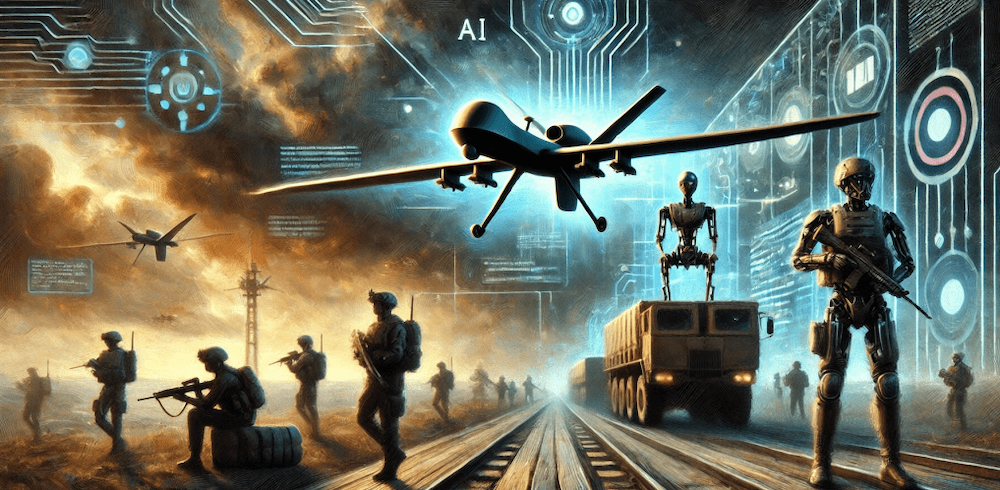
It’s likely too late, but Europe is – as a whole – finally making massive investments in military preparedness. The good news is, he who innovates, wins … brute force counts for less than advanced predictive tools and increased computing power. There won’t be tanks or fighter planes rolling off assembly lines in Eindhoven. Still, there are countless opportunities for startups and scale-ups in drones, cybersecurity, robotics, data analytics, surveillance and satellites in the rearmament game, valued at 632 billion euros globally. With investment increasing, there already are an increasing number of military-oriented startups across Europe, including Amsterdam.
In the Netherlands, the Security Fund (SecFund) launched at the beginning of 2025. This is a 100 million euro investment fund set up by the Ministry of Defense in collaboration with the Ministry of Economic Affairs and the ROMs.
Reuters has a post about some of the most innovative military startups in Europe founded by military veterans, i.e., people who experienced the battlefield. Alas, none of the companies is based in the Netherlands, much less Eindhoven. But Eindhoven does have one competitive advantage: It’s the headquarters for TNO, the applied science research institute funded by the Dutch government.
TNO – technically the Netherlands Organisation for Applied Scientific Research – is huge on defense and that will only continue.
From the TNO website:
For a growing number of TNO’s clients, such as the Dutch Ministry of Defence (MoD) and a range of stakeholders in the defense industry around the world, the sense of security is decreasing. A number of trends, including global warming, competition over resources, and the rise of nationalist reactions in many countries, lead to a growing need to invest continuously and structurally in strong and stable armed forces. This is especially true for investments in the pillar of force projection, in other words, weapons systems.
Privately held industrial conglomerate VDL is also part of the effort, signing a contract with the Dutch Ministry of Defense to help scale up the defense industry. The goal is ultimately to have up to 120,000 square meters of space dedicated to production of military equipment, including drones, as well as space to maintain and upgrade military vehicles.
Finally, Brainport Innovation & Technology for Security (BITS), brings together companies in the civilian sectors to apply their innovations to defense and security. This is a collaboration between the Ministry of Defence, the Ministry of Economic Affairs, the province of North Brabant, Brainport Development and the Brabant Development Agency (BOM).
We’ve compiled our own list of civilian startup that might contribute to strengthening the defense of Europe.
• Aircision, which transmits information via lasers, is exploring defense applications, according to a post on LinkedIn by CEO Luis Oliviera:
We’re collaborating with the Dutch Ministry of Defence through the Optical Wireless Alliance, alongside partners like Signify, TNO, Secura, Brainport Eindhoven (BITS: Brainport Innovation and Technology for Security) and others.
• Antenna Company makes high-performance 2D and 3D solutions based on advanced materials, proprietary design principles and RF system expertise. Multi-band antennas are crucial for secure battlefield comms.
• ANTENNEX is a TU/e spinout that makes equipment to measure the speed and accuracy of antenna used in wireless applications used in telecom, automotive and aerospace and defense.
• Avular has drone technology that can be converted to multiple uses.
• CUbIQ is developing a secure communications platform using quantum technology, a photonic integrated quantum optical transceiver.
• Eindhoven Technical University has multiple relevant projects, including drones.
• Euclyd is a startup focusing on the development of leading-edge integrated circuits and systems for foundational AI models, including large language models.
• Eyeo is pioneering the next generation of image sensors through their proprietary color splitting technology. This is another technology that could be adapted to advanced surveillance.
• Innovation center MIND (Military Innovation by Doing) recently opened an office at High Tech Campus. From HTC 27, called MINDbase, MIND scouts relevant innovations for the Dutch armed forces, including the Army, Air Force, Navy and Marechaussee.
• MRR Drones makes affordable pilotless drones
• Nierium – Nerium monitors, detects and responds to digital threats. Yet another software with possible military applications.
• Quantum Delta NL is a national quantum computing effort with hubs at the universities in Eindhoven, Delft, Leiden and Amsterdam. Quantum computing is essential to both AI and secure communications. This initiative targets three catalyst programs: quantum computing and simulation, national quantum network and quantum sensing applications.
• Teledyne DALSA is a global company with Eindhoven operations that designs and manufactures specialized electronic imaging components as well as specialized semiconductor fabrication. The company develops and produces sensors and detectors for digital imaging. Its imaging sensors, digital cameras and image processing software is used for aerial photogrammetry.
• TomTom TomTom develops location intelligence and mapping technologies supporting defense and military applications.
• Tulip Tech makes batteries that will allow drones to fly up to 100 percent farther, which could prove to be a huge edge on an extended battlefield.
EBB briefs:
• Reuters broke the news Sunday that ASML is investing 1.3 billion euros in two-year-old French startup Mistral AI in a staggeringly huge C round. That capital injection makes the Eindhoven-based photolithography giant the majority shareholder, and it boosts Mistral’s valuation to 10 billion, making it the most valuable AI company in Europe with a 10 billion euro ($11.7 billion) pre-money valuation. This improves the chances of Europe becoming independent of the American AI pioneers such as OpenAI.
• Financial Times just killed TNW, the tech outlet which puts on the annual The Next Wave tech event in Amsterdam, and Silicon Canals editor Remco Janssen is not happy about it. In his post “FT just killed The Next Web – and with it, a piece of Europe’s tech ecosystem,” Janssen writes, “This isn’t just sad. It’s completely fucked up.” We rarely see passion and candor like this, and it is refreshing. His point is valid: “This is precisely the moment when Europe needs a strong tech ecosystem more than ever,” with strong media documenting European breakthroughs across industries.

Co-CEO of Dispatches Europe. A former military reporter, I'm a serial expat who has lived in France, Turkey, Germany and the Netherlands.