(Editor’s note: Full disclosure – Izmir is not for everyone. We’re quirky people who like quirky places. Izmir is quirky. Noisy, crowded and not exactly beautiful, though it’s on one of the most magnificent bays in the world. If you know where to look, Izmir is magical.)
This started out as an overview of where we’ve traveled recently, including Denmark and Northern Germany.
But once I got into it, I realized the only place that resonated with me was Izmir and Turkey’s Aegean coast. Izmir was our best trip of the year.
It was another “workation,” this one in September 2024. But instead of going down the Aegean and Mediterranean coasts, we stayed in this huge city of four million, venturing out to beaches near Izmir. We were glad we did because it cut down on driving and upped the great experiences as we revisited parts of the region we hadn’t seen for 20 years.
Having lived here for four years – 1999 through 2003 – we have an affinity for what others might see as just another concrete city on the Aegean. We see a huge, diverse city with a surprising amount of green space, historical sites and ruins, access to beaches and a sheen of modernity that we don’t even have in our HQ of Eindhoven, Netherlands.
Party
We got into Izmir at 12:30 a.m., starving and craving a brew. No hay problema!, as they say in Turkish. We hit one of the many kebapçı near our Airbnb, finally getting to bed about 2:30 a.m. Early, by Turkish standards.
As we walked the streets late at night, I thought to myself, “The story here is, Izmir is a party town that never sleeps.”
There are restaurants, clubs and pubs up and down the commercial areas, or kordons, and on the sea that never seem to close. Music runs from traditional Turkish music to pop to American jazz to country. We saw the Mississippi Blues Bar but never made it this trip. Soon, though. Soon. The huge beers run about five euros everywhere. We found the Give More Pub, where the nightly cocktail special was about five euros.
We are not young, but here, that’s not the issue it is in the United States. In the old days, shuttling friends to the airport for early flights, we’d see plenty of 60-plus Turkish couples spilling out of Izmir’s nightclubs at 5:00 a.m.
Culture
We don’t typically do museums when the sun’s out, the weather’s perfect and the sea is beckoning. But we spent a day at the Izmir Culture and Arts Factory. It’s that fascinating because Izmir is the intersection of so many cultures and peoples. This was a Greek city until 1923, and there are some of the finest Greek and Roman ruins in the world within a day’s drive. So, this place is chockablock with artifacts and it seems like most ended up at this museum, which includes several restored buildings in an old factory.
Someone put a lot of time and money into this sophisticated complex.
The sophistication of Izmir started in the Bronze Age. As you go through the museum, you understand why craftsmanship and esthetics are still so important here. Displays are in Turkish and English and as well done as any museum in the world. The grounds provide a quiet green space and there are cafés and a restaurant as well as libraries and research centers.
The Agora, which is near the center of town, is also worth a visit as are the neighborhoods of Alsancak, Karșıaka and Bostanlı. Each has restaurants and shopping, and you can get there via the inexpensive ferries – about 40 cents each way – that run constantly … and on time!
Workation highlights included:
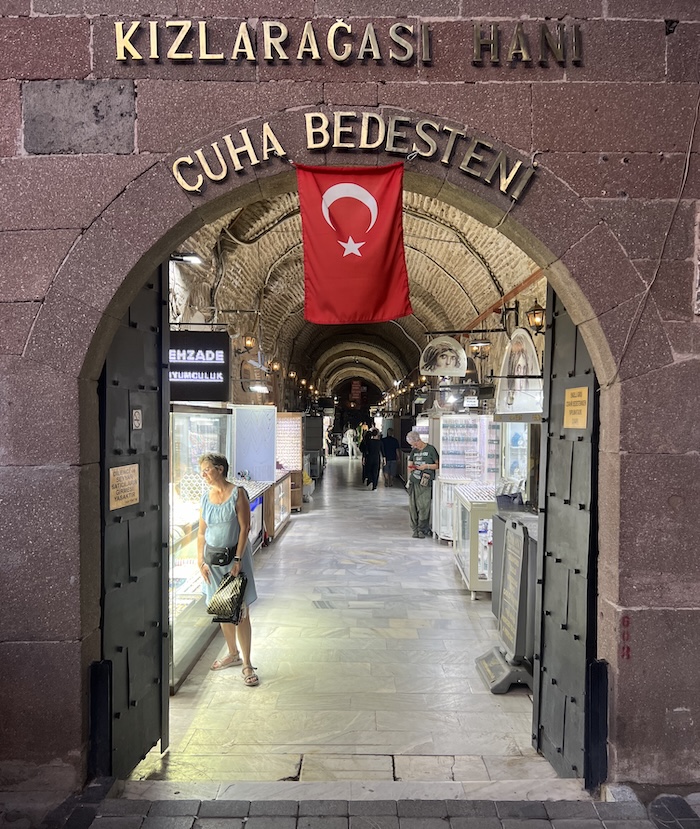
• shopping in the Kemeraltı, the old covered market that is so big and such a labyrinth that we get lost every time, despite having been there dozens of times during the past 20 years. Whatever you need, they got it here, from wedding dresses to leather goods to carpets to spices. Jewelry is plentiful, much of it high quality and reasonable prices in world terms. The restaurants are also very good and super affordable. This bazaar dates back to the Silk Road and was a stop for camel caravans. This is one of the last authentic places in Izmir as the Turks have raced to modernize.
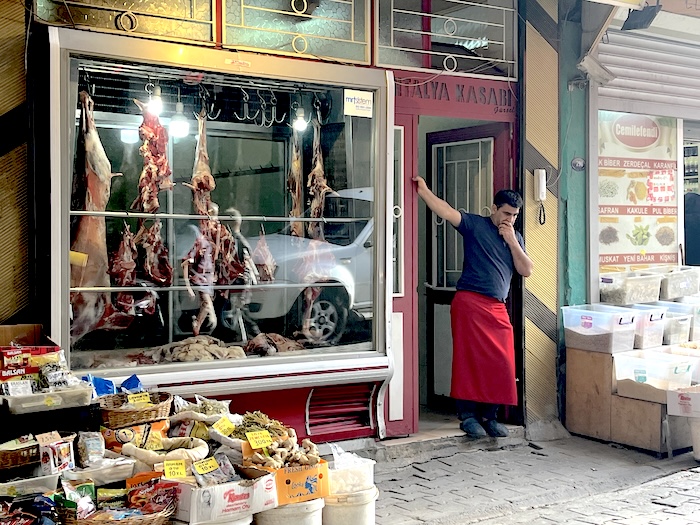
• taking the twisty alleys and streets up to the Kadifekale, the ancient fortress ruins on the highest hill overlooking Izmir. It is a climb, and I was out of breath half-way up. Cheryl is a walker, and she wasn’t even winded. But we burned some serious calories, only stopping to ask directions and take photos of the authentic markets on amazingly authentic streets in Kurdish neighborhoods festooned with bougainvillea and palms. While there’s not much left of the Kadifekale, there are amazing views of Izmir.
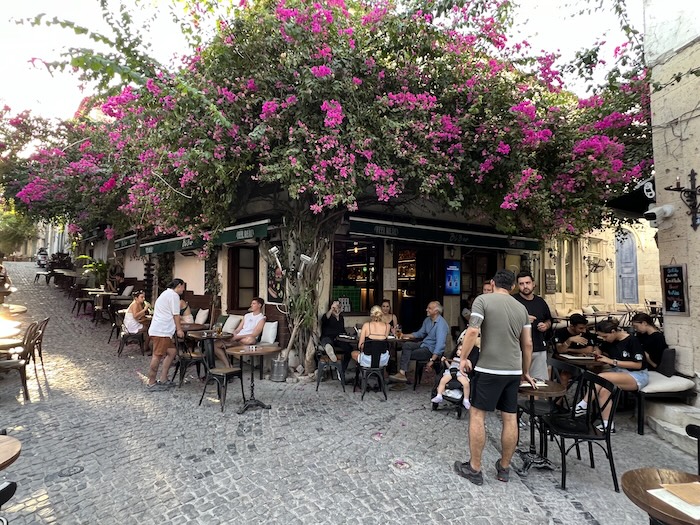
• a drive out to Alaçatı, an upscale windsurfing destination about an hour west of the city. Okay, we got lost and ended up in Çesme, which is the summer destination for most average Izmirians. Alaçatı is just to the south, but a world away in high-end sheen and prices.
When we lived in Turkey circa 1999, Çesme was sort of a low-rent, overcrowded place where all our Turkish friends, and quite a few Americans and Brits, had summer homes. Now, it’s been made over into this tourist destination, though it’s a Turkish tourist destination, with few people from outside, as far as we could see. We went to hang out on the beach and paid the equivalent of about 10 euros each for a beach café, which had great food and cold beer.
• For years, I’d wanted to go back to Karabarun, the undeveloped peninsula just outside Izmir. And we made it! Some of my fondest memories are of snorkeling with friends at the very north edge and hanging out with a group of bohemian Brits who lived out there in an ancient house they’d renovated … sort of. We needed a beach day this trip, so we went to Kuyucak Beach, which we had all to ourselves. There are a couple of restaurants there including one across the street. There are also campgrounds if you want to pitch a tent.
One note: Most of the Aegean beaches around Izmir are pebble beaches, so take water shoes. You don’t really get sandy beaches until you get down south to the Ölüdeniz area and Patara Beach on the Mediterranean coast.
Where to eat and drink in Izmir
• Varuna Gezgin Café (aka Café Del Mondo), terrific food and a young staff at a café founded by a group of world travelers. A cool space on a side street that you’d never find without a local. AND they serve American-style breakfast all day. Prices are a bit higher than more humble restaurants, but the ambiance is great, with high-quality food.
• Tuzu Biberi Kahvaltı, Atatürk Caddesi 328 A, on the First Kordon by the sea, Kültür Mahallesi, Alsancak, Atatürk Cd. No:192 A. This place has European prices, but you get a huge breakfast spread by the bay. Expect to spend the equivalent of 20 euros per person for the big traditional kahvaltı (breakfast) with fabulous puffy bread, honey, olives and other tasty treats.
• Deniz Kent Restaurant, Karșıyaka. This big fish restaurant with a huge seating area on the bay is a favorite with locals and a destination for wedding parties and client outings.
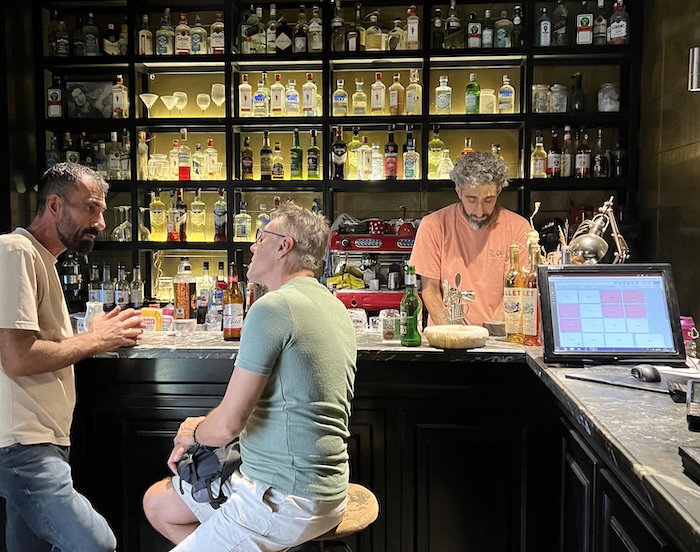
• Aksak Lounge is in an old house at Can Yücel Sk. No:10, Şehitler Cad. in Alsancak. When we were there, the buildings to the side had all been demolished. No telling what’s there now. But if it’s still there, an authentic Turkish spot to hang out in an old Ottoman-era house.
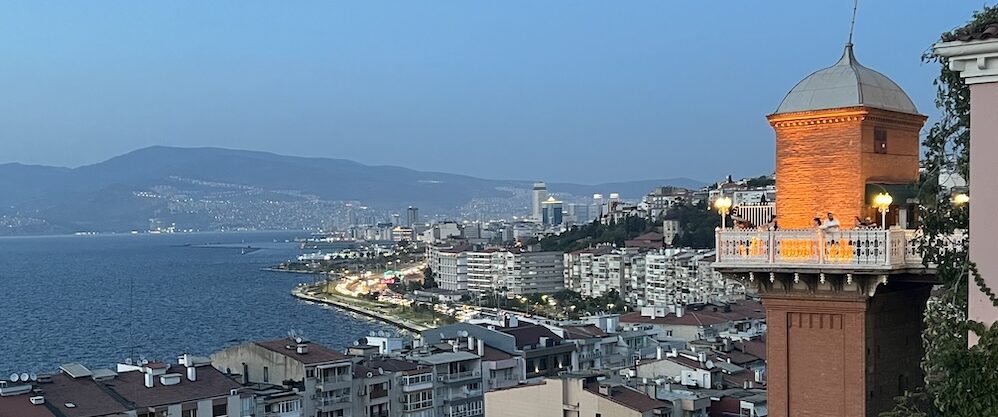
• Asansor – Moreno Café, Dario Moreno Caddesi. To get to the Asansor (elevator) area, you have to take an actual historic elevator to this café district. But the views of the city don’t get any better. Asansor was built by a Jewish businessman in the Moreno District, populated by Jews from Portugal. There’s still a synagog just down the street.
• The Give More Pub in Alsancak. They have special drink deals during the week, including Aperol Spritz and gin and tonic. Cocktails were five or six euros. To be a local, you have to party with the locals.
The climate:
Izmir is at 38 degrees N. latitude on the Aegean Sea. It has a semi-tropical, almost desert-like climate in the summer, with virtually no rainfall from April to October. It can get seriously hot in mid-summer, over 110 degrees F. The best time to visit is anytime except maybe July. Winters are cool and dry with periods of rain.
Where we stayed:
We stayed at a place on the Third Kordon, (Kıbrıs Şehitleri Caddesi), which has endless options for food, drink and shopping. We got this apartment two years in a row from a broker on Airbnb named Can Gürsel. But the apartment has disappeared from the website, likely because Airbnb takes 17 percent. It was nice … two spacious bedrooms, a nicely furnished living room, balcony and kitchen for 54 euros per night.
This is one of the last huge cities that’s still affordable. Honestly, it’s a better place to live than visit, with lots of cultural events. We saw performances ranging from Korean dancers to the Kölner Philharmonie when we lived there. And of course, you’re a 45-minute drive from Ephesus, arguably the world’s greatest preserved ancient city.
So, go and do what we do … hang out, have a cocktail and just soak in the ambiance of this 5,000-year-old city.
––––––––––
See more about Turkey here in Dispatches’ archives.

Co-CEO of Dispatches Europe. A former military reporter, I'm a serial expat who has lived in France, Turkey, Germany and the Netherlands.