
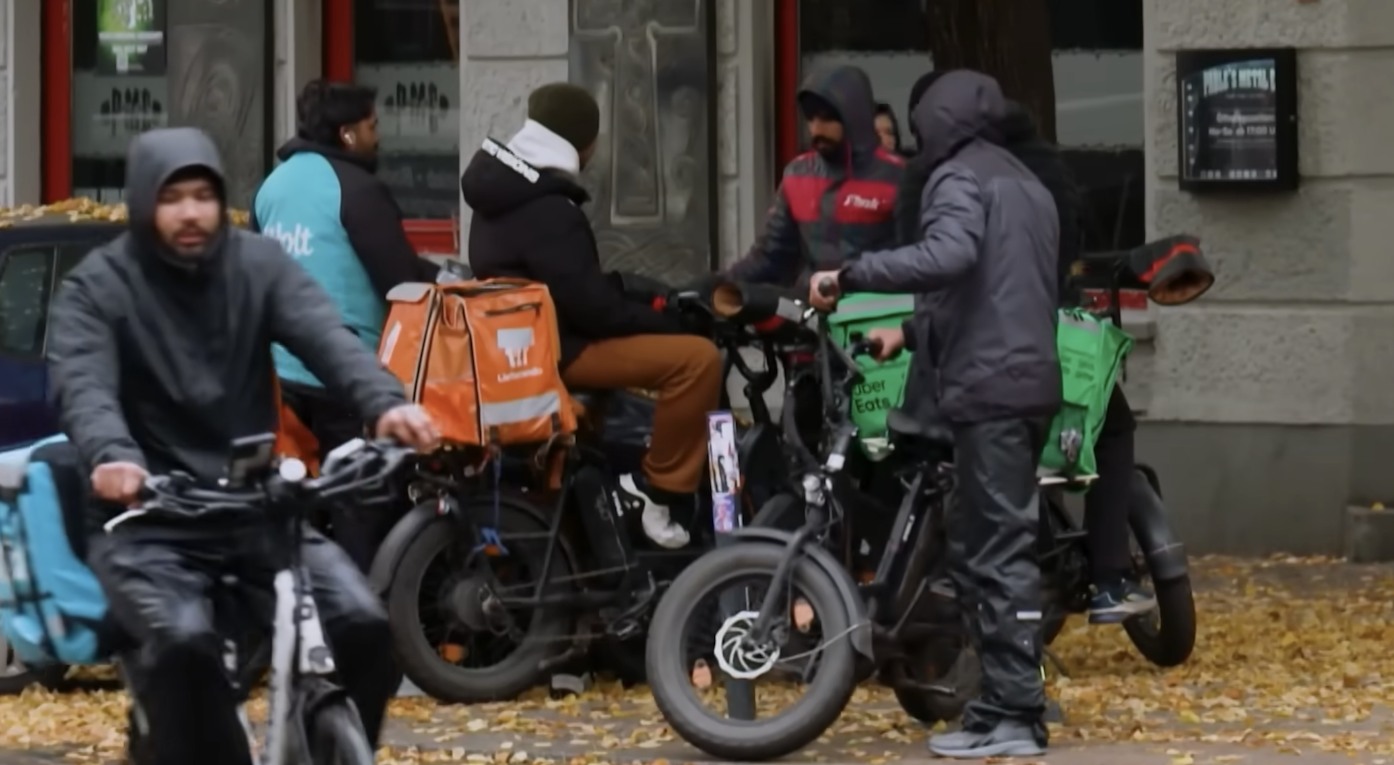
We’ve all been there: Long day at work, no enthusiasm to cook, or even to take on the mental load of picturing something worth spending the time preparing and cooking, which we will only inhale while numbing out in front of a laptop
“Keine Lust zum Kochen,” as the Germans would say.
So we open one of the myriad food delivery apps to quickly solve the problem of dinner and are presented with a colorful bounty of food options of all varieties, magically available to be brought to our door in as little as 30 minutes. With the press of a button, our meals are sorted. Those of us that are privileged enough with disposable income to afford this service enjoy our dinner with the assumed belief that the food delivery companies we are ordering from treat their workers fairly.
After all, this is Berlin, Germany, the capital city of a country that doesn’t allow such egregious worker exploitation of delivery personnel such as the USA, with its legions of undocumented folks schlepping food across town, hoping that they don’t get picked up by ICE . . . right? Everyone working for the prevalent companies here (Wolt, Lieferando, UberEats) surely all have above-board contracts and health insurance, with sick days and holiday pay because that’s how things are done here, right? Germany is known for its strong worker protections, right?
Wrong.
Troubling reality
The reality of this industry reveals a troubling trend: according to reporting from rbb24 Recherche, Die Zeit and Taz news outlets, barely any food delivery services actually use legitimately employed drivers. The majority are operating through a web of shady subcontractors whose treatment of employees is downright abusive. Wolt and Lieferando only directly employ a small number of riders and Uber Eats uses virtually none.
This leaves the majority of this workforce under the control of these shadowy subcontractors, many of whom only operate temporarily and in some cases have no actual brick and mortar address, operating solely through WhatsApp group chats. There are reported cases of workers being hired at just 7 euros per hour and not being paid their monthly wages at all.
In one striking case, rbb24 Recherche found that Wolt, a hugely popular food app in Berlin, had a contractual relationship with a company that didn’t actually exist, with an address listed at an empty factory in Brandenburg. The alleged managing director of this subcontractor was located in Poland and had no knowledge of his name being used to operate a food delivery subcontractor. The entire business proved to be very clearly a sham, a shell company operation created to circumvent German labor laws. Eventually Wolt terminated their contract and claimed no knowledge of anything untoward, but the damage had already been done to many exploited workers.

New immigration laws, expensive unis create cheap, desperate labor
But who are these workers and why in the last few years do so many of them seem to come from the same place?
In December 2022, Germany and India signed the Migration and Mobility Partnership Agreement, expanding the opportunities for Indians to work and study in Germany as well as speeding up visa processing times. As a result, the number of Indian students jumped dramatically to 59,419 in 2025 from 28,905 in 2020, making them the largest foreign student group in Germany. As the country made immigration from India attractive to young people and took an interest in recruiting potential future workers, other less well intentioned individuals and companies noticed.
As shown in thorough reporting from Die Zeit Magazine, entire frameworks of exploitive student recruiting, labor, housing and questionable private universities are being directed towards young Indians, with YouTube ads selling a dream of finding fortune and success in Berlin. These “universities” such as the International University of Applied Sciences (IU) in Friedrichshain, with its questionable “campus” located in the back of a shopping plaza, have a high fee, sending many young people deep into debt, forcing them to try to earn money as quickly as possible upon arrival. As soon as they get to Germany, they are led into WhatsApp chat groups connecting them with seemingly lucrative job opportunities for food delivery companies with very easy entry and little to no German language skill requirements.
To satisfy the registration requirements for their visas (the Anmeldung), they of course will quickly need to find a place to stay, which funnels them to another group of exploitative people: landlords. In reporting from Die Zeit there is the case of six men living in a sixty square meter apartment costing 2,000 euros per month. These landlords get around the rent cap laws by listing the rooms as “furnished,” and desperate students are tricked into paying exorbitant rents.
Indentured servitude
Then there are the actual working conditions for the riders. Despite being promised normal, legitimate job type things like minimum wage, secure employment contracts, bonuses and mileage compensation, the workers soon realize that they were intentionally misled, only to end up being paid well below minimum wage with no actual contracts.
Dodgy subcontractors can get away with this because of the currently permitted loose arrangement that they are legally allowed to have with the major food delivery platforms. The riders think they are getting a job for a legit company like Wolt, as all the branding looks the same, when in reality they are often working for faceless bosses over a WhatsApp group chat who can fire them at a moment’s notice or not pay them at all. The food delivery companies themselves avoid responsibility as the violations are legally the subcontractors fault, leaving migrant workers with little to no recourse.
Many riders found themselves in a horrible trap: They are in debt because of their studies and can’t make enough to afford housing and pay off their loans, so they are essentially stuck in a kind of ongoing indentured servitude.
Living in Berlin, it is striking how many young people zipping around the city on e-bikes all seem to come from South Asia. Not so noticeable however is the fact that a good percentage of them are getting royally screwed over by their pseudo-employers. As of this writing there have been worker strikes, individual lawsuits and proposed legislative changes in the Bundesrat but Germany has not yet banned subcontracting in the food delivery industry.
We all appreciate a quick meal magically appearing without much thought. But hungry Germans should be aware of the nefarious industry that is supported by continuing to use apps such as Uber Eats, Wolt or Lieferando and the human cost of our convenience.
Better to support your local food scene, order from restaurants directly and (eek) GO PICK IT UP YOURSELF.
––––––––––––
Read more about Berlin here in Dispatches’ archives.
See more from Chris here.