

The end of freedom of movement between the United Kingdom and the European Union after Brexit had an impact on the British creative sector. More complicated visa rules for hiring EU citizens have made it harder for people to come to the UK from abroad and take up creative roles – but it is not impossible. “The UK remains one of the world’s leading creative economies, particularly in music, film, television, gaming, advertising and digital content.” says Oliver Moheda, CEO, Total Artist Management.
Lawrie Jones, MD, 42Group, agrees: “Despite the negative press and perception that the UK is descending into anarchy, it’s still an incredible place to live and work. It’s a vibrant and exciting country with a huge creative sector, including film, TV, marketing, content and social.”
Even after Brexit, there are still exciting creative opportunities in the UK. Asma Bashir, co- founder, Centuro Global, supported a George Lucas company with bringing specialist creative talent to the UK for a “Star Wars” film: “The people needed were mainly specialists in visual effects and other highly technical production skills that were difficult to find locally at the level and within the timescale required and quite high in number.”
Location location, location
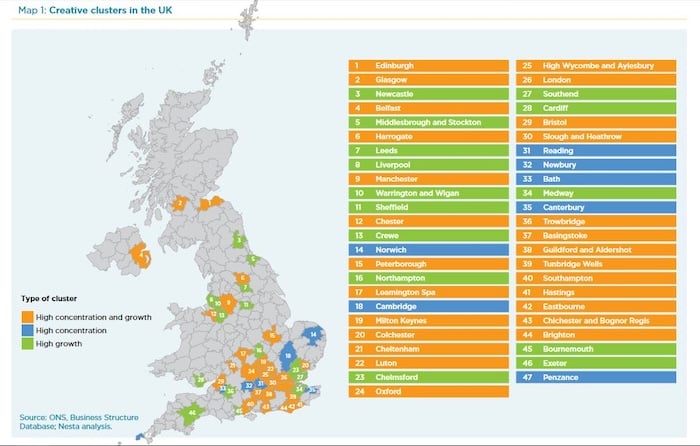
“While London is still the main hub, we’re seeing growing opportunities in cities such as Manchester, Liverpool, Bristol, Glasgow and Cardiff, where investment in creative industries continues to grow,” says Moheda. The UK’s “incredibly collaborative and internationally connected” creative sector is still a drawcard for talent from abroad, Moheda stresses. “People from overseas bring fresh perspectives, different cultural influences and global networks, which often lead to stronger creative outcomes,” he continues. “From my own experience, international backgrounds can become a real advantage because creativity thrives on diversity. The UK also offers access to world-class artists, labels, agencies and global entertainment companies, making it an excellent place to build a long-term career.”
Which sectors are hiring?
“The biggest opportunities tend to be for people who combine creative talent with commercial or technical skills,” says Moheda. “Roles in artist management, live events, digital marketing, content creation, production, music technology and creative business management are all areas where employers are actively looking for experienced professionals.” Demand for skilled professionals is growing across live music and touring, with Moheda highlighting the need for production and tour managers, technicians, logistics specialists and commercial experts.
In digital production, Moheda says there is strong, ongoing demand for international talent in visual effects, animation and gaming to ensure UK businesses remain globally competitive. Bashir says the UK offers strong opportunities in film and television, visual effects, animation, gaming, music, theatre, fashion and design: “London remains a major centre, but there are also growing creative hubs in cities such as Manchester, Bristol, Cardiff, Belfast and Glasgow.
“On major film projects, the opportunities go far beyond actors and directors to visual effects specialists, production designers, costume and make-up professionals, choreographers, musicians, technicians and other highly specialised behind-the-scenes roles,” she says.
What are the pitfalls?
According to Moheda, the biggest challenges are usually practical rather than creative: “Visa requirements, the high cost of living – particularly in London – and the competitive nature of the industry can make it difficult for newcomers to establish themselves.” “The UK creative sector is highly competitive with hundreds of applications for every open post and the industry has shifted from a salaried model to a predominantly freelance one,” adds Jones. “This inevitably puts those from outside the UK at a disadvantage, although schemes like the Skilled Worker visa system provides avenues for those from outside the UK to work.”
Unsurprisingly, AI is making its presence felt, with Jones saying these new technologies are “taking a huge bite out of the lower end of the market, but for those with clearly defined skills and experience, there are opportunities here.” Bashir says that creative work in the UK can be “project-based and unpredictable, while immigration permission may be tied to a particular engagement or sponsor.”
The Creative Worker route is generally designed for temporary engagements, the Skilled Worker route requires an eligible sponsored job and applicable salary, while Global Talent is aimed at “recognised leaders or potential leaders and provides much greater flexibility,” Bashir explains. “Visa fees, the Immigration Health Surcharge, housing costs and uncertainty between
projects can also be significant.”
Above all, be organised. Bashir says the most common practical mistake creative workers make when seeking work in the UK is leaving immigration planning too late: “Production schedules can move quickly, but the legal right to work cannot be improvised after someone arrives.”
Tips for creative jobseekers
“Networking is also essential; talent alone is rarely enough,” advises Moheda. “Building relationships and understanding how the UK industry operates are just as important for long-term success.”
“If I were starting out, I’d ignore the job boards and LinkedIn callouts and instead develop an impressive online portfolio full of creative executives, evidence of impact and client testimonials before going direct to agencies,” says Jones. “In a world where everyone is using technology to take the easy way out, this kind of effort – and human connection – is more likely to pay off.”
In the competitive UK market, Jones says those most likely to get work “are those with a defined niche – and the experience to back it up.”
“The CVs we see that jump out are confidently written and clearly capture the value and impact that you can have,” Jones explains. “Experience is more important than country of origin. On our freelance roster, we have skilled writers and designers from across the world.”
–––––––––––
Read more about the UK here in Dispatches’ archives.
See more from Georgia here.

Georgia Lewis
Georgia Lewis is an Australian expat who spent five years living in the United Arab Emirates before moving to London in 2011. She is a freelance writer and editor. When she's not writing or editing, she loves cooking, trying new restaurants, going to the theatre and travelling. Her favourite destinations are the Greek islands, Mallorca, Oman and Vietnam.