2:45 AM Friedrichshain. My wife is sleeping, I am awake.
As heard from the open window of our bathroom:
“Fick Dich”
“Fick Dich Selbst!”
Sound of a flute being furiously blown into, off key.
As the weather finally (albeit inconsistently) warms up in Berlin, the windows in our flat are left open, letting in the rejuvenating and complex birdsong from blackbirds during the day and at night, the sound of the sometimes rowdy folks living in the building across from us.
Having been a New Yorker for 16 years, hearing people screaming at each other at all hours is not at all unusual to me. But Germans (even Berliners) by and large have a firm respect for Nachtruhe, when everything gets super quiet outside from 10 p.m. to 6 a.m. Outside seating at bars and restaurants come inside and noise regulations are often strictly enforced.
An anomalous late night argument between tenants would be understandable in any urban environment, but these particular neighbors are regularly making lots of noise, yelling at each other, practicing the flute and sometimes screaming guttural, unintelligible German at no one. Our own building, and all others in our Kiez are whisper-quiet after 10, but the building across the Hof sounds like what some might call a “crazy house.”
Why could this be?
Playing the real estate long game
Further casual streetside observation during the day yields some illuminating evidence: Everyone we see coming and going from the building are dressed in such a way that indicates they probably aren’t working. People without shoes, with beltless pants hanging down far below their wastes. Folks with unkempt hair, long beards and filthy clothes. One individual caught in a perpetual argument with a person who isn’t there. We also recognize several guys from the nearby Ubahn station, where a regular group of panhandlers gather to drink and beg for money.
It occurs to us that the building next to us could be some kind of housing project, but with no information on the front door we’re left only with an address and the internet to gather further info. This being 2026, we quickly discovered the building’s history and current function, and an alternative, experimental solution to homelessness.

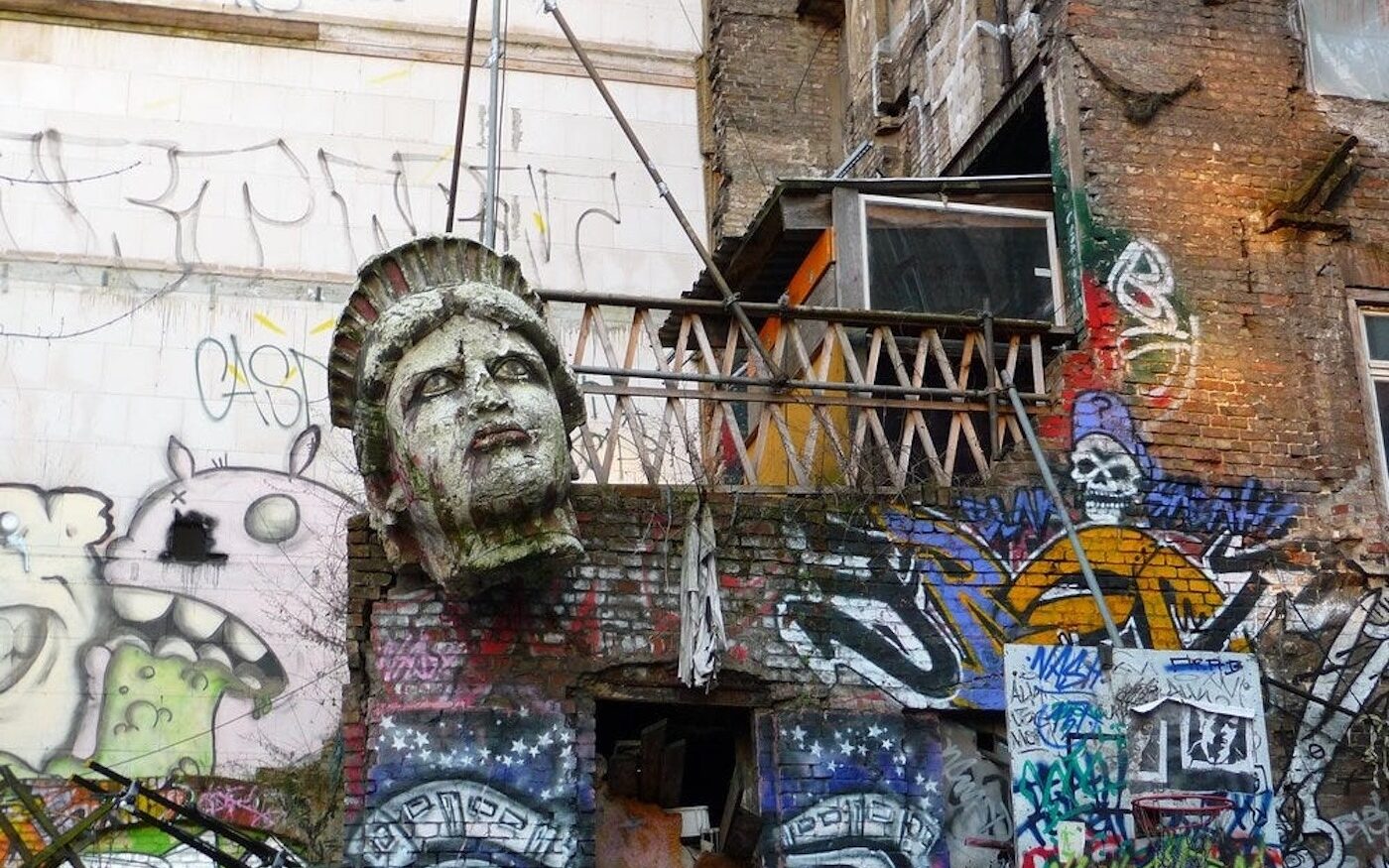
After the fall of the Berlin Wall, 1990s East Berlin was full of “squats,” abandoned buildings taken over by self-sufficient individuals and groups. Our neighboring building, known as a Hausprojekt, was at one point controlled by a leftist collective with an explicit goal to provide free housing to mentally disabled homeless people before it was acquired by notorious real estate magnate and gentrifier Gijora Padovicz, the guy who bought the Watergate nightclub and plans to turn it into office spaces.
In 2006, he got money from the state to renovate the squat with some key conditions: units were available only for those with low to no income who held a WBS (Wohnberechtigungsschein, or Housing Eligibility Certificate) which entitles qualified applicants to government subsidized housing. Padovicz is playing the Berlin landlord long game, simply waiting till the building’s tenants move out and he can turn it into pricey luxury apartments. With Berlin’s strong tenant protection laws, it could be a while.
Indeed, the building across from our courtyard is full of mentally disabled people who very well might otherwise be living on the street.
An experimental solution to homelessness
These revelations provided a strong contrast to my home country’s Hyper Capitalist Hegemony: “You mean, they just live there for free?! That guy I see drinking beer all day at the Ubahn, he just lives there rent-free?! How come they get to live there and not pay rent, when I have to have a job?! (Freelance writer, comedian, bartender, artist-guy).
Here, right next door to my building, is a text-book example of how housing functions as a socially protected necessity in Germany. Is it perfect? No. Is everyone simply guaranteed a flat if they have no money? Not exactly, but there’s lots of assistance. Is homelessness still a big issue in Berlin? Yes.
Bureaucracy abounds, creating hurdles for folks who don’t have all their documents sorted, often compounded if mental health issues are involved.
The housing shortage is intense and there are simply not enough cheap flats.
Berlin has a lot of folks on the streets who are from the EU, but not German, therefore putting them in a legal grey area where they are not eligible for all of the state benefits.
Housing first
But even in the worst cases, the city often provides emergency shelters, hostels or even apartments. Even in its most gritty manifestations, Berlin does not compare to the seemingly permanent scenes of homelessness found in the US, with tent encampments becoming a ubiquitous part of inner cities, videos of which have provided fuel for a recent trend of exploitative viral online content.
In general, there is a present philosophy of “housing first”, the idea that no matter what a person’s situation is, they should not be left on the street, this being beneficial not just to the individual, but to the population as a whole.
Whether it’s the Kältebus, a mobile rescue service that picks up people who would otherwise freeze to death during the winter months, or shelters that provide housing to folks without any prerequisite of sobriety, these organizations believe that getting individuals off the street is the first and most important step and that reintegration into society is only possible from there.
Is it an effective philosophy? Not always. Is it more humane than leaving people to fend for themselves in the gutter like wild animals?
Um, yes.
–––––––––––
Read more about Berlin here in Dispatches’ archives.