
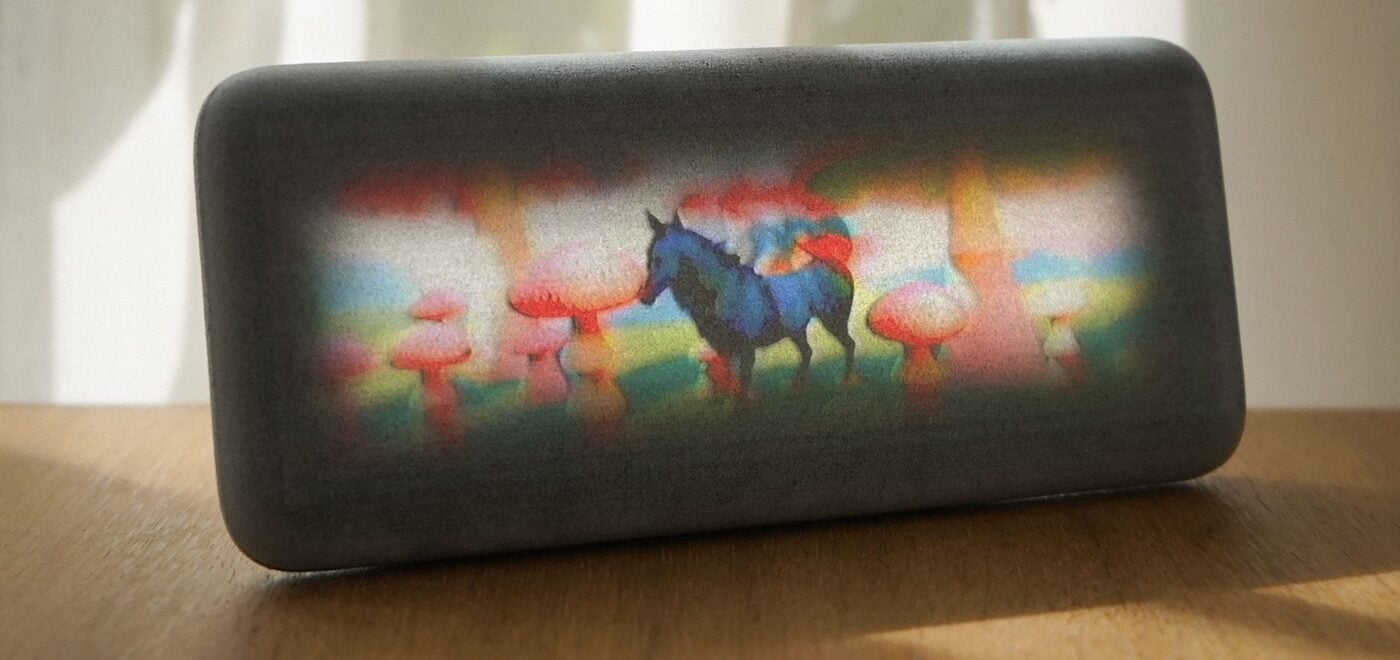
(Editor’s note: This post on Dream Recorder is part of our Tech Tuesday series. Dispatches covers tech because our highly skilled internationals dream big.)
Do you know that feeling of waking up, remembering you had the wildest dream, but struggling to piece it together? We’ve all been there, but that might soon change, thanks to Modem — a Dutch creative studio in Amsterdam that’s developed a bedside device promising to open a portal to your subconscious.
Forget dream journals: Their new invention is called Dream Recorder, and the name quite literally speaks for itself. The device doesn’t just help you recall your night visions — it also visualizes them.
The idea is simple: keep Dream Recorder on your nightstand, and as soon as you wake up, tell it what you’ve seen — in any language. The rest is handled by artificial intelligence, which transcribes your voice recording into text and feeds it to the generative video model. As the result, you get an ultra-low-definition cinematic dreamscape in the aesthetics of your choice, created in collaboration with French artist Alexis Jamet, whose lo-fi, blurry-line style perfectly captures the hazy way we usually see dreams.
“AI generates images by filling in blanks, stitching together fragments of learned data into something coherent … but often strange. That process mirrors how our minds construct dreams: nonlinear, symbolic, filled with distortions and substitutions”, explains Modem in conversations with It’s Nice That.
If you’re a fan of Freud’s dream theories or simply love analyzing your night visions, you’ll appreciate the device’s capacity. It can store up to seven recordings at once, creating a week-long archive for you to play back and reflect on. But don’t get overly attached — once all the slots are full, new dreams will automatically overwrite the old ones.
A healthy balance of mindfulness and letting go, perhaps.
Simplicity
Since its release earlier this year, Dream Recorder has generated coverage around the world. Modem co-founder Bas van de Poel told Dezeen magazine that his team gave Dream Recorder a look that felt at home in the bedroom – “calm, quiet, and free from the noise of everyday tech”. In line with their belief that the bedroom should stay a phone-free zone, Modem designed the Dream Recorder to work independently:
• no Bluetooth,
• no special apps,
• no screen distractions.
Its tactile, streamlined 3D-printed form also breaks away from the cold, clinical aesthetic typical of tech gadgets. Moreover, the Dream Recorder can be anything you want, as you can build one of your own.
Modem has made the software open-source on GitHub, along with detailed hardware instructions and assembly notes. The setup’s estimated cost is around 285 euros for an HDMI screen, an 8-gigabyte processor, a micro SD card and a USB microphone. And of course, there is a small fees for OpenAI text-to-speech and video generation, and LumaLabs dream rendering, costing roughly $0.15 per dream in total.
So next time you wake up wondering what on earth that dream meant, your bedside might just have the answer.
°°°°°°°°°°°°°°°

Oxana Skibun
Oxana Skibun is a fashion and lifestyle editor who has crafted her stories for print and digital media outlets across Europe, the Middle East and Russia. Raised in Moscow, she now lives in Amsterdam, where she continues writing for international audiences.