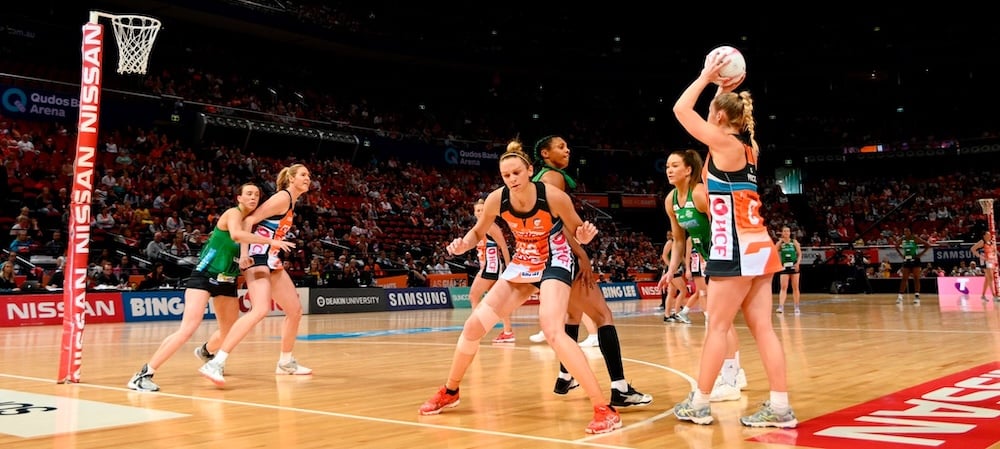
What is netball, anyway? Sixty minutes of seven disciplined players on court, each under pressure to pass with three sharp seconds. Sharp changes in direction, sprints into space – the players use every tiny gap on court to get their passes accurately and clinically down to their two shooters in the semi-circle where they can finally shoot.
With the ball finally in hand, the shooter takes a deep breath while taking a shot on goal, hoping that the defender doesn’t plan a well-timed rejection. The shot is flat. The ball hits the rim of the net, the defender jumps up to claim the rebound and the ball is sent down to the other side of the court for a quick counter-attacking goal.
From niche to global phenomenon
Netball is a fast-paced team sport, played by more than 20 million people across 117 countries – especially in Commonwealth nations such as Australia, New Zealand, England, and Jamaica. The game has been officially recognised by the International Olympic Committee since 1995, and while it comes in different formats, the standard version features two teams of seven women, although the mixed-gender and men’s game is also expanding worldwide.
According to World Netball, the sport’s global governing body:
“The team with the ball, through running, jumping, throwing, and catching, attempts to move the ball into its goal circle from where a goal may be scored, while the opposing team uses defensive movements and strategies to prevent this and to gain possession.”
The team with the most goals after 60 minutes of gameplay wins.
Internationally, there are 43 women’s national teams in the official World Netball rankings, with Australia, New Zealand, England, Jamaica, and South Africa at the top. Club netball also thrives, particularly in the elite leagues of Australia, New Zealand, and the UK.
But for many in Europe, netball is still a mystery.
The expats growing netball in Europe
National and club netball is, however, expanding in Europe – especially in Portugal, Italy, the Netherlands and France. Across these countries – and in Germany, where I’m based – expats are shooting hoops and jumping through bureaucratic and cultural hoops to grow the sport by the book.
Most Europeans reading this probably know that netball isn’t yet widely established on the continent. If I, as an expat in Germany, try to explain the sport to a German, I am obliged to sell it as a hybrid of handball and basketball (two sports where Germany has strong international success), but there’s no dribbling, no running with the ball and each player is limited to certain areas of the court.
One post published last year by BILD, a major German tabloid, even described the sport as “GAGA” – meaning absurd or ridiculous. But clubs do exist across Germany, Netherlands, France, Sweden, Italy, Denmark, Switzerland, Portugal, Spain and Belgium – some with even their own national team.
Most club members are expats and training is typically all in English.
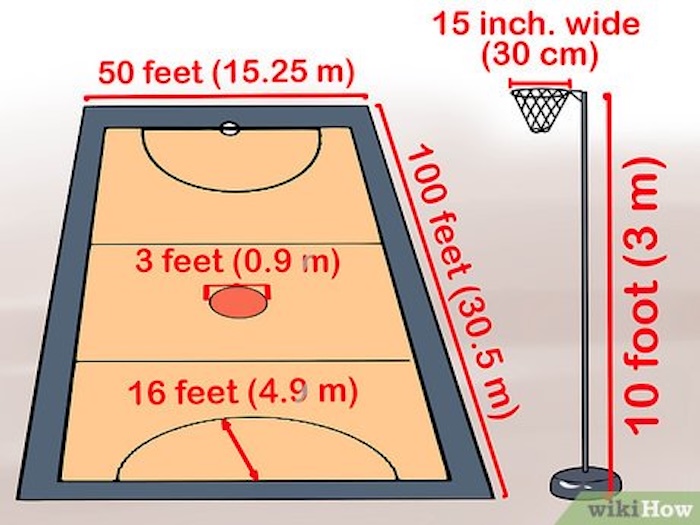
When I moved to Hamburg in 2017, I was relieved to find a local netball club – albeit a small, mixed-gender group I discovered on Facebook. Turnout when I first joined training that summer was also admittedly uninspiring. We had to play on an indoor basketball court with basketball lines and shoot basketball hoops. For reference, a netball post has no backboard, and the netted rings are 38 centimetres in diameter, as opposed to a basketball hoop’s 45.72-centimetre diameter. A netball court is around 1.85 metres longer than an NBA-regulation court – and don’t get me started on the court lines.
In 2025 the majority of clubs here in Germany now have procured real netball posts, but members still tape down the court lines every week and manage tenuous relationships with sports hall providers who have never heard of netball. Many halls are fully booked for traditional sports, and these amateur netball groups are often squeezed out.
One major hurdle for netball clubs in Germany is navigating the legal and bureaucratic process to become a Verein – an officially registered club. Without that legal status, it’s nearly impossible to access public funding, training spaces or to build a recognised national federation. Clubs in Sweden and the Netherlands have faced similar challenges. But there are signs of progress: friendly inter-Europe club tournaments now happen more frequently – and at a much higher level than ever before.
From Facebook groups to federations
Swiss Netball has officially existed for over a decade, with 12 clubs and almost 250 adult members. You also have Netball France, with 13 clubs, which joined the likes of England, Wales, Scotland, Switzerland, Israel and the United Arab Emirates, to become the twelfth member of Europe Netball and a full member of World Netball. The Federazione Italiana Netball joined this growing list of officially recognised full members earlier this year. Just for context: England Netball, by far one of the most established national governing bodies in Europe Netball, has more than 3,000 netball clubs and reports that at least 320,000 people regularly play netball.
Netball Netherlands and Netball Portugal have also seen recent momentum, the latter having hosted various tournaments in the Algarve and in Lisbon to bring visibility to the sport. It is still considered an emerging member of Europe Netball (like Germany), but it is waiting for its federation application to become a fully fledged member. This summer, Netball Netherlands – not yet a full Europe Netball member – participated in a friendly U23 international series with France. The country also launched a domestic league with six Dutch teams and one Belgian team competing weekly from October 2023.
In many European countries, it’ll still take time for the sport to grow and especially grow beyond expat circles. But with or without the further expansion of registered netball clubs and national federations in Europe, these clubs are a brilliant way to meet people who are English-speaking, active and approachable team players. Most of my closest friends and professional connections in Hamburg have directly or indirectly come from joining my local netball club.
If you’re reading this article and are now curious if there is a club near you, you might just discover one – they are popping up more frequently in European cities. Chances are, if there’s an expat community near you, someone’s already out there passing, pivoting – and shooting their shot.
You can discover more about netball by searching for it on any social channels, YouTube and through the World Netball website.
Sara Vordermeier is a Hamburg-based freelance writer and editor specialising in sports, technology and culture stories from her life abroad. Her professional writing experience spans more than seven years in the fields of content marketing, organic search trends and journalism.
Receive the latest news and updates from Dispatches Europe. Get lifestyle & culture, startup & tech, jobs and travel news dispatched to your inbox each week.